
TL;DR

Get hardware and tech essentials delivered free — and shop member deals
- Fast, free delivery on millions of items
- Access to Prime Big Deal Days deals on October 6–7
- Prime Video, Amazon Music and more included
Anthropic’s $65 billion Series H isn’t just about valuation; it’s a strategic move to secure the compute infrastructure needed for the next wave of AI. Revenue growth is sky-high, but the real game is controlling chips, cloud, and memory supply chains.
When you hear about a company valued at nearly a trillion dollars, you might think it’s all about cutting-edge AI models or innovative software. But behind the headlines, a different story is unfolding. Anthropic’s latest funding round isn’t just a cash infusion — it’s a massive investment in the hardware and infrastructure that keeps AI running at scale.
Imagine a freight train barreling down the tracks — the engine isn’t just the software, but the thousands of tons of steel, the tracks, and the fuel. That’s the new AI economy. The real story isn’t just the $965 billion valuation. It’s what that number represents: a strategic push to dominate the chips, clouds, and memory supply chains that will power AI for years to come.
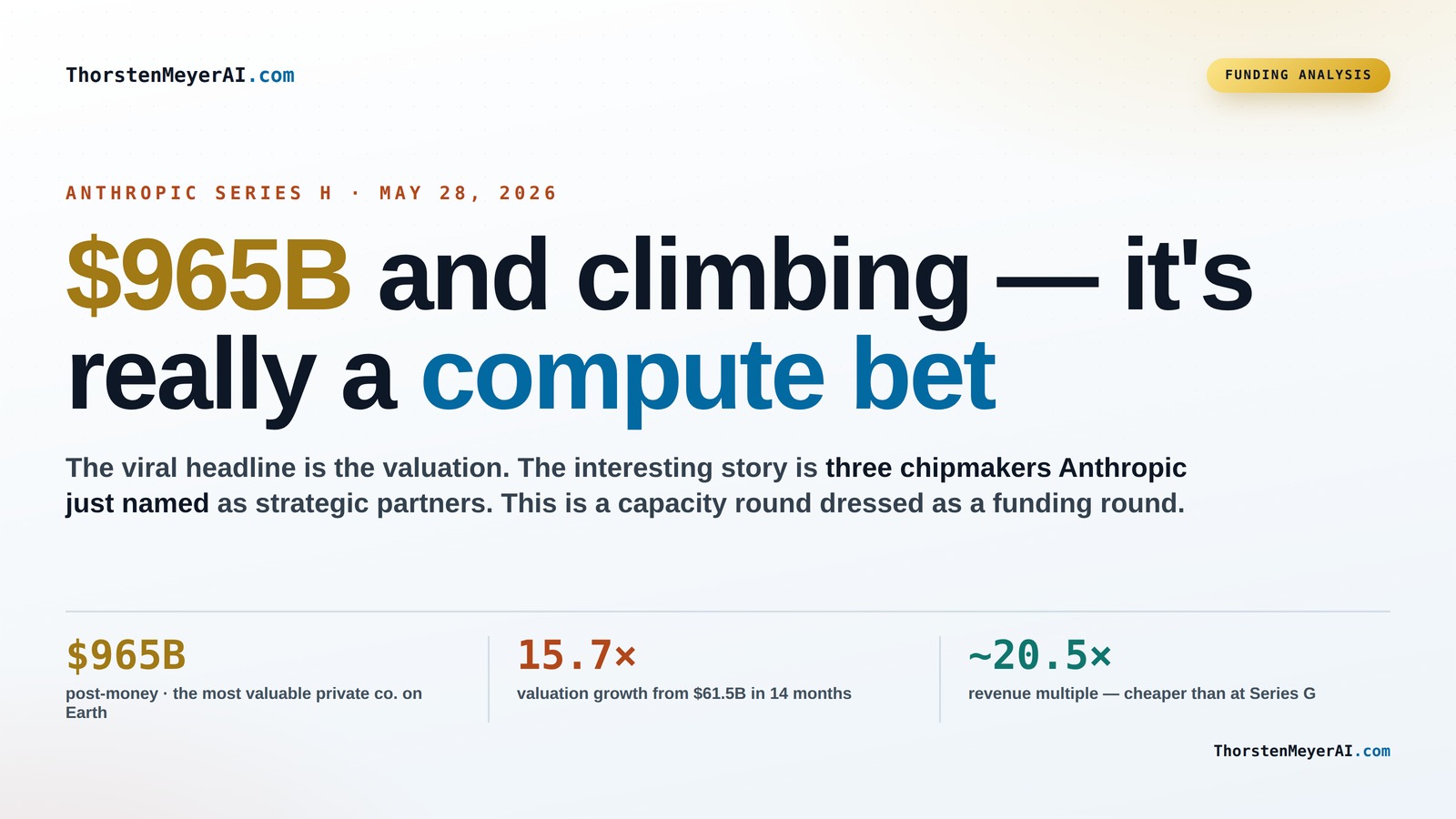
$965B and climbing — it’s really a compute bet
The viral headline is the valuation. The interesting story is in the press release’s middle paragraphs — and in three chipmakers Anthropic just named as strategic partners. This is a capacity round dressed as a funding round.
The numbers nobody can quite parse in sequence
Read together they describe a trajectory with no precedent in enterprise software. Read individually, each looks like a typo.
From $61.5B to $965B in fourteen months
Salesforce took roughly two decades to reach revenue numbers Anthropic just blew past. The sequence below is the part most coverage skips — it’s not the size, it’s the shape.
Anthropic’s valuation ladder · Mar 2025 → May 2026
Five rounds, fourteen months. Bar height is the valuation; the climb itself is the story. Tap any milestone for context.
The multiple actually got cheaper
Bubbles look like multiples expanding while revenue lags. Anthropic’s pattern is the inverse — the valuation tripled, but revenue grew faster, and the multiple compressed.
Revenue-to-valuation multiple · Series G → Series H
Same company, three months apart. The denominator (revenue) is outrunning the numerator (valuation) — exactly the opposite of what a bubble narrative predicts.
10+ gigawatts and three chipmakers
When you name Micron, Samsung & SK hynix alongside your equity backers, you’re saying the binding constraint isn’t demand or model quality — it’s the physical supply of memory chips. The Series H is a capacity round.
Compute commitments backing Anthropic’s capacity bet
$200B+ in announced compute spend across multi-year contracts. The $65B Series H raise has to be read against that bill, not against operating losses.
A genuinely durable bet — or a structural exposure?
Both readings can be true at once. The answer arrives over the next 18–24 months as the gigawatts come online and either fill with paying demand or don’t.
Revenue growth has no precedent in B2B software ($1B → $47B in 17 months). The multiple is compressing, not expanding. Claude is the only frontier model on all 3 major clouds. Enterprise AI spend share went from ~10% to >65% in a year. Compute commitments are tied to specific contracts with capacity dates.
20× revenue is not cheap by any historical software-investing standard. Revenue is reported gross of cloud-reseller pass-throughs, which inflates the top line. Profitability is 2 years out. Amodei’s own warning: a 12-month delay in AI progress “would make him bankrupt” — the compute commitments are a structural exposure to demand persistence.
The valuation race — and the IPO context
Anthropic shipped Opus 4.8 the same morning as Series H — not a coincidence. One week after OpenAI filed confidentially for IPO. The late-2026 frame is set: two frontier AI companies racing to public markets, each pitching durability.
Key Takeaways
- Anthropic’s $965 billion valuation signals a shift from software growth to infrastructure control, especially chips, cloud capacity, and memory supply.
- The $65 billion raise is mainly about securing compute capacity and supply chains, not just funding equity or R&D.
- Control over semiconductor and cloud infrastructure is now a key determinant of who leads in AI development.
- Rapid revenue growth, from $9 billion to $47 billion in a few months, underscores the importance of compute scale for AI success.
- The AI industry is evolving toward a global industrial complex, where raw materials and supply chains are as critical as models and algorithms.
AI hardware infrastructure servers
As an affiliate, we earn on qualifying purchases.
As an affiliate, we earn on qualifying purchases.
Why the $965B valuation is a signal, not just a number
Anthropic’s valuation of $965 billion makes it the most valuable private AI company ever. But that’s not just about how many AI models they have or how big their user base is. It’s about the *faith* that this company will control the infrastructure needed to scale AI to billions of users.
Think of it like investing in a power grid rather than just a power plant. The real value lies in the capacity to generate and distribute electricity — or in Anthropic’s case, compute capacity.
According to recent data, the company’s revenue run rate has exploded, crossing $47 billion just a few weeks ago. Yet, investors aren’t just betting on current revenue—they’re betting on the *future* capacity to grow that revenue even further, which hinges on access to chips, cloud, and memory.
This shift in valuation signals a deeper understanding: AI’s true value isn’t solely in the models or algorithms but in the underlying hardware and infrastructure that enable these models to run efficiently and at scale. This means that companies controlling these resources will have a competitive advantage, potentially dictating who leads in AI innovation and deployment.

enterprise cloud computing hardware
As an affiliate, we earn on qualifying purchases.
As an affiliate, we earn on qualifying purchases.
The real purpose of this $65B raise? It’s a capacity gamble
The headline is big: $65 billion raised in a single round. But the *real* story is what that money is meant for. It’s not just to buy equity — it’s to lock in massive compute capacity, secure supply chains, and build the infrastructure for future AI models.
In fact, three major chipmakers — Micron, Samsung, SK hynix — are listed as ‘strategic partners’ in the press release. They’re not just suppliers; they’re part of the core strategy. The deal includes over 10 gigawatts of compute commitments, enough to power hundreds of thousands of GPUs for training and inference.
This isn’t just a funding round; it’s a long-term bet that the scarcity of chips and cloud capacity will be the bottleneck for AI’s growth. If you want to build the next ChatGPT or Claude, you’d better have access to the hardware that makes it possible. This is a strategic move: by investing heavily in supply chain control now, Anthropic aims to avoid future bottlenecks that could slow down AI progress, much like how a nation might stockpile resources in anticipation of supply disruptions. The tradeoff, however, is that such a focus on infrastructure might divert resources from pure innovation, potentially stifling smaller players who lack the capital to secure these resources. But for industry giants, this is a calculated risk to ensure dominance over the AI landscape.

high-performance AI memory modules
As an affiliate, we earn on qualifying purchases.
As an affiliate, we earn on qualifying purchases.
How compute economics are shaping AI’s future
AI models today are like gigantic factories — they need a constant flow of raw materials: chips, memory, power. The cost of training a model like GPT-4 or Claude can reach into the hundreds of millions of dollars, mostly due to compute expenses.
Recent data shows Anthropic’s revenue growth is outpacing its valuation. From $9 billion at the end of 2025 to over $47 billion in early May — that’s a 5.4x jump in just a few months. This rapid growth underscores how essential compute capacity is becoming.
Imagine trying to build a skyscraper with a limited supply of steel. Even if your plans are perfect, shortages will slow you down. That’s the core challenge for AI developers now. Control over chips, cloud, and memory is what determines who leads and who lags behind. The economic implications are profound: companies that secure hardware supply chains will have a significant cost advantage, enabling faster scaling and more profitable operations. Conversely, those dependent on external, constrained supply chains risk bottlenecks that can halt progress and erode competitive advantage. This creates a tradeoff: investing heavily in infrastructure now may reduce short-term margins but ensures long-term dominance.

chipmaker supply chain management tools
As an affiliate, we earn on qualifying purchases.
As an affiliate, we earn on qualifying purchases.
Supply chain and infrastructure: the unseen engines of AI growth
The $965 billion valuation isn’t just a number; it’s a statement about control over the supply chain. The round mentions giants like Micron, Samsung, and SK hynix — all critical to producing the memory chips that fuel AI hardware.
For example, Samsung’s latest memory chips are used in the most powerful GPUs, which in turn train the biggest models. Without these chips, AI progress stalls. That’s why Anthropic’s strategic partnerships are so important — they’re securing the backbone of AI’s future.
Imagine a city’s water supply. If you don’t control the pipes and reservoirs, your ability to grow depends on external factors. The same applies here. AI’s future depends on securing chips, cloud capacity, and energy supply. The implications are significant: as these supply chains become more centralized among a few key players, the risk of bottlenecks and geopolitical tensions increases. Control over these critical resources could determine not only who leads in AI but also who can sustain growth during global disruptions. The tradeoff is that heavy reliance on a few suppliers might introduce systemic vulnerabilities, but for now, industry leaders are betting that securing these supply chains outweighs the risks.
What this means for AI giants and startups alike
Anthropic’s move signals a new era. Valuations are now as much about infrastructure as about innovation. For established players like OpenAI, Google, or Microsoft, it’s a wake-up call: whoever controls chips and cloud wins the race.
Startups aiming to compete will need to think differently. You might not just need a good model — you need access to the same hardware and supply chains that Anthropic is locking down.
This shift could lead to increased consolidation in the industry, as smaller firms find it difficult to secure the necessary resources without forming strategic partnerships or entering long-term contracts. The tradeoff is that this infrastructure-centric approach might slow down open innovation, favoring well-funded incumbents with existing supply chain dominance. However, it also underscores the importance for startups to prioritize hardware access and supply chain resilience in their growth strategies, recognizing that success increasingly depends on resource control rather than just algorithmic prowess.

The bigger picture: AI is now an industrial game
AI is shifting from a software innovation to an industrial-scale operation. The new gold rush isn’t just building better models but controlling the factories, supply chains, and power plants that produce them.
Picture AI as a giant factory complex, where the raw materials come from a global supply chain of chips, memory, and energy. Whoever owns the resources can set the pace, the cost, and the nature of AI development.
Anthropic’s valuation and the massive raise are a clear sign: this is no longer a hobby for startups. It’s a global industrial enterprise, with trillions of dollars riding on resource control. This industrial perspective implies that future AI growth will depend less on individual innovations and more on the strategic control of the entire supply chain ecosystem—an approach with significant implications for global economics, geopolitics, and technological sovereignty.
Frequently Asked Questions
How can Anthropic justify a $965B valuation?
The valuation reflects expectations that Anthropic will dominate the infrastructure needed for AI’s future growth—control over chips, cloud capacity, and memory supply is as valuable as the models themselves.
Is the $65B all new money, or is some of it strategic infrastructure capital?
Most of it is strategic, with a significant portion committed to securing compute capacity and supply chain partnerships, especially with major chipmakers like Samsung and Micron.
What does it mean that this is ‘really a compute deal’?
The core of the deal is about locking in the hardware and infrastructure needed to train and run massive models at scale, not just raising cash for product development.
How does Anthropic’s revenue compare with OpenAI’s?
Anthropic reports a run rate of over $47 billion, surpassing OpenAI’s valuation-based multiples, and demonstrating how rapidly revenue is scaling alongside compute capacity.
Why are chipmakers and cloud giants involved?
They provide the raw materials, hardware, and capacity needed to keep AI models growing. Their involvement signals a shift toward infrastructure as a strategic asset in AI development.
Conclusion
This isn’t just a funding round; it’s a signal that AI’s future depends on controlling the infrastructure of the industry. Companies that secure chips, cloud, and memory will set the pace for the next decade.
For anyone watching AI’s evolution, the takeaway is clear: the real race isn’t just about smarter models — it’s about owning the hardware and supply chains that make those models possible.

Fall Picks
fall essentials
As an affiliate, we earn on qualifying purchases.