
TL;DR

Get hardware and tech essentials delivered free with Prime
- Fast, free delivery on millions of items
- Prime Video, Amazon Music and more included
- Member-only deals all year
IdeaClyst is a local-first, AI-powered war room for founders. It combines structured debate, discovery, and planning tools to help you validate ideas faster and more confidently—without cloud data or subscriptions.
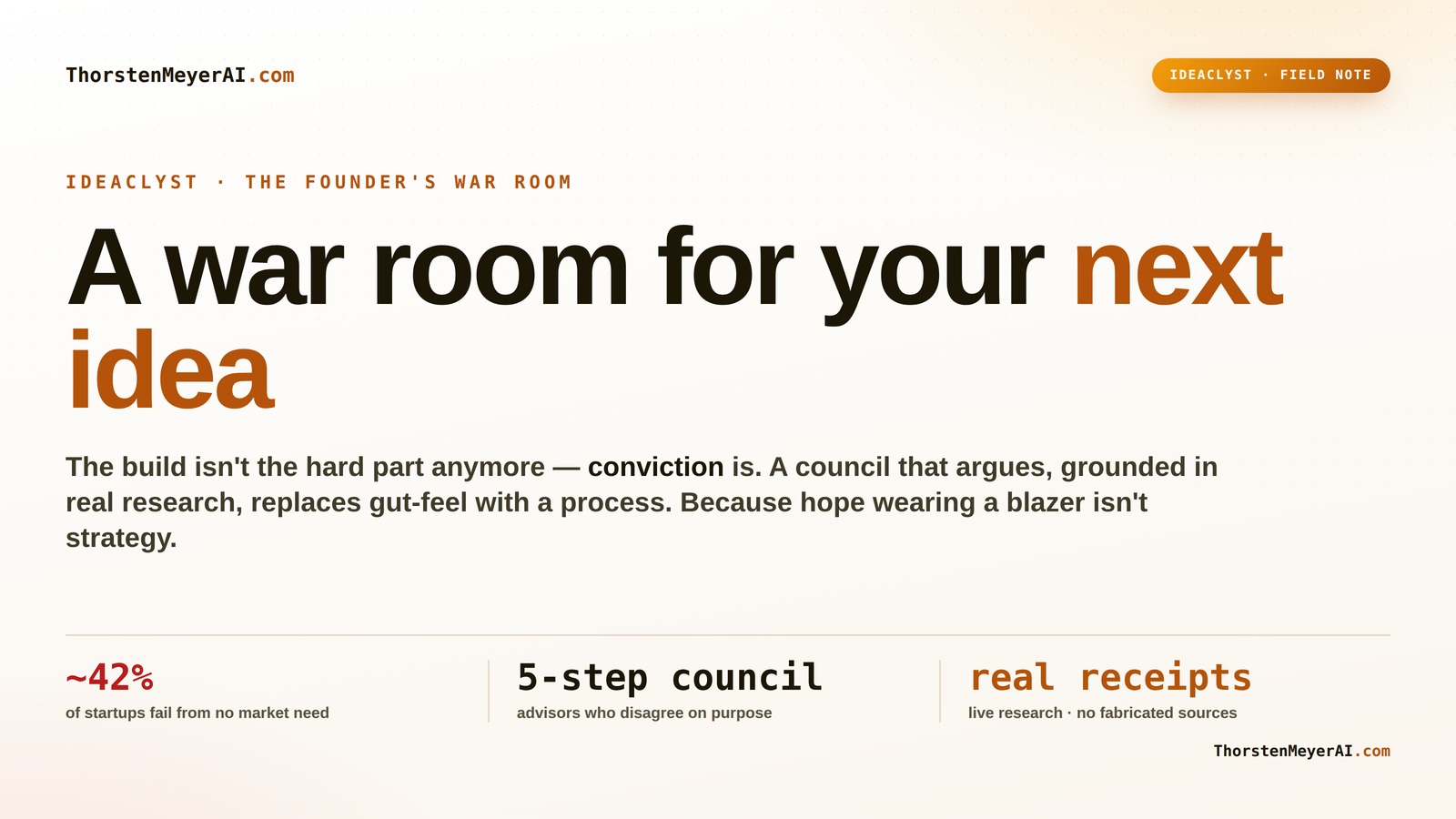
A war room for your next idea
The build isn’t the hard part anymore — conviction is. Knowing which idea deserves the next six months, and being able to defend it. Most founders answer with gut feel and optimistic math. That’s hope wearing a blazer. IdeaClyst replaces it with a process.
The most expensive decision is what to build
The single most valuable thing a tool can do is talk you out of the wrong six months. The numbers make the case better than any pitch.
Three tools in one — on your own machine
Strip away the framing and IdeaClyst is three things at once, all running locally with nothing leaving your laptop.
An AI council
Pressure-tests an idea you bring it — advisors who argue on purpose.
A discovery engine
Finds ideas you didn’t know to look for by hunting real demand signals.
A founder’s workspace
Carries winners from “interesting” all the way to “ready to build.”
Advisors who disagree on purpose
Not one confident, agreeable answer — a structured five-step deliberation where models play different roles and turn on their own work. The disagreement is the feature.
The five-step deliberation
A council that leads with the bad news surfaces the objections you’d otherwise find the expensive way, on month five.
Product strategy
Who’s it for, what’s the wedge, why now, what’s the business model.
Technical architecture
What would it actually take to build — and where’s the risk.
Critique pass
The council turns on its own work. Where’s the hand-waving? What kills this?
Second, independent critique
A different voice, a different angle — so blind spots don’t survive.
Final synthesis
Everything into one coherent founder packet: strategy, architecture, validation, plan.
When IdeaClyst cites a source, it actually fetched it
The hard departure from “ask an AI what it thinks of my startup.” It runs in a strict, real-data-only mode — if it can’t gather genuine evidence, it says so plainly rather than inventing a plausible paragraph.
Confidence with receipts
No fabricated statistics, no imaginary competitors, no made-up citations. The packet survives a skeptical co-founder or a sharp investor because the reasoning has receipts.
Market research first
Scouts the landscape before the council reasons about anything.
Competitor read
Real positioning, pricing signals, feature claims — differentiation vs. reality.
Validation with links
Not “talk to customers” — concrete signals & sources you can click.
From the blank page to build-ready
Evaluation is half the problem; the blank page is the other half. And a plan is worthless if it dies in a tab you never reopen.
Bring a space, not an idea
“AI for accountants,” “tools for indie game studios” — plus your goal and real capacity. It hunts demand signals across HN, Reddit, Product Hunt, GitHub, pricing pages.
- An honest market read — leads with the bad news when a space is hard
- An opportunity map — high pain, thin competition
- Ranked candidates — wedge, who pays, effort, risk, confidence
- each with KILL CRITERIA — when to walk away
A home and a forward path
Every promising idea gets carried forward, with every artifact in plain files on your disk.
- Validation tooling — sprint board, interview list, evidence browser
- Founder profile — a personal-fit lens; same discovery, different advice
- Build workspaces — funnel, personas, landing draft, version history
- “Build this idea” → a PRD + task queue, ready for a coding agent
Key Takeaways
- A war room centralizes your ideas, debates, and plans, making decision-making faster and clearer.
- IdeaClyst is a local-first AI tool that provides structured critique and discovery without sacrificing data privacy.
- Structured disagreement from an AI council reveals hidden risks and strengths you might overlook alone.
- Grounding idea validation in live web research drastically reduces the risk of building something nobody needs.
- Keep your war room active with regular updates, visual cues, and routine reviews to prevent stagnation.
local AI startup idea validation software
As an affiliate, we earn on qualifying purchases.
As an affiliate, we earn on qualifying purchases.
Why a War Room Is the Secret Weapon for Your Next Big Idea
A war room is a dedicated space—physical or digital—that keeps your team focused, aligned, and moving fast. It’s where ideas are visualized, progress is tracked, and decisions are made with clarity. For startups, it’s the difference between a chaotic scramble and a sharp, strategic push forward.
Think of it like a cockpit in a fighter jet. Everything you need—data, charts, plans—right in front of you, ready for quick decisions. When you’re trying to launch something new, especially in a fast-changing market, that clarity can save months and thousands of dollars.
Recent trends show the rise of digital war rooms—portable, shared, and often integrated with project management tools. But the core idea remains: keep your focus laser-sharp, and make the space a hub of action, not just decoration.
As an affiliate, we earn on qualifying purchases.
Inside IdeaClyst: The Digital War Room That Keeps Your Ideas Private
IdeaClyst is a breakthrough in how founders handle idea validation. It’s a local-first AI tool that acts as your personal advisory council, discovery engine, and planning workspace—all on your own computer. No cloud, no subscription, no data leaks. Learn more about IdeaClyst.
Picture this: you bring a half-formed idea—say, a new SaaS feature or a novel app concept—and IdeaClyst’s AI council debates it from multiple angles. It challenges your assumptions, finds hidden risks, and suggests overlooked opportunities. All while keeping your data safe on your machine.
This local-first approach isn’t just about security. It’s about control. Your raw ideas, your plans, your research—all stay under your roof, in plain files, editable, shareable, and versioned.
idea discovery engine for entrepreneurs
As an affiliate, we earn on qualifying purchases.
As an affiliate, we earn on qualifying purchases.
How IdeaClyst’s AI Council Debates Your Ideas Like a Board of Disagreeing Experts
Ever wish you had a team of advisors who could argue your plan from every angle? That’s what IdeaClyst’s AI council does. It stages a structured debate—five steps—covering strategy, tech, critique, independent critique, and final synthesis. See how it works.
But why does this matter? Because in startup decision-making, bias and blind spots are common. Human advisors, no matter how well-intentioned, can overlook risks or be influenced by personal preferences. An AI council, however, can simulate diverse perspectives, challenge assumptions, and push you to consider angles you might ignore. This structured disagreement forces you to defend your ideas, revealing flaws early—saving you from costly mistakes later. It’s like having a diverse panel of critics who never get tired or biased, ensuring your plans are robust before execution. The output—a Markdown report—serves as a clear record of this rigorous vetting process, which can be revisited and refined over time.
AI-powered project planning software
As an affiliate, we earn on qualifying purchases.
As an affiliate, we earn on qualifying purchases.
Grounded in Reality: How IdeaClyst Uses Live Web Research to Validate Ideas
Unlike generic AI tools that just echo your assumptions, IdeaClyst pulls in real-time web data. It’s like having a research assistant constantly scouring current market trends, competitor data, and industry reports. Discover more about its live research capabilities.
For example, if you’re exploring a new SaaS feature, IdeaClyst checks recent user reviews, market growth stats, and tech news—all embedded into its critique and strategy suggestions. This grounding in live data makes its advice more reliable than just “what the AI remembers.”
According to recent research, 42% of startup failures stem from building something nobody needs. By integrating live web research, IdeaClyst helps you avoid this trap, giving you real-time insights that align your ideas with current market realities. This approach reduces the risk of developing features or products that are outdated, irrelevant, or oversaturated, thus increasing your chances of market fit and success.
From Idea to Action: How to Turn Your Ideas into Clear Plans in IdeaClyst
Getting an idea into a workable plan is often the hardest part. IdeaClyst makes it straightforward with a step-by-step process that turns fuzzy concepts into actionable roadmaps. Learn how to turn ideas into plans.
This process encourages clarity and discipline. By breaking down the journey—debate, critique, synthesis—it ensures you don’t skip critical validation steps. This structured approach not only accelerates planning but also embeds a mindset of continuous refinement, which is vital in fast-paced startup environments. The tradeoff, of course, is that it requires active engagement; neglecting any step can lead to incomplete or overly optimistic plans. But the benefit is a well-vetted, clear roadmap that aligns with your original goals and market realities, reducing the risk of costly pivots or failures later on.
Here’s a simple process:
- Input your initial idea or hypothesis.
- Let the AI council debate its merits and risks.
- Review the critique reports and suggestions.
- Generate a final synthesis report with milestones and validation steps.
- Export the plan as Markdown for easy sharing and iteration.
This structured approach not only saves time but also ingrains good decision-making habits, which are crucial for startup success.
Physical or Digital? Setting Up Your Own War Room for Idea Success
While physical war rooms are legendary, digital versions are now more practical—especially for remote teams or solo founders. IdeaClyst’s local setup makes it easy to establish your own personal war room, right on your laptop. Explore setting up your digital war room.
For a physical setup, you might use a whiteboard, sticky notes, and a dedicated corner. For digital, create a folder structure, templates, and a habit of updating your Markdown reports regularly. The key is visibility and consistency. See tips for effective war room setup.
One startup founder I know keeps a dedicated Evernote notebook and a weekly review ritual—she calls it her “idea war cabinet.” It’s simple, portable, and always accessible, helping her keep her ideas alive and evolving.
Keeping Your War Room Active: Tips to Prevent It Becoming Stale
A war room only works if it stays alive. It’s tempting to set it up and forget it—big mistake. Regular updates, fresh ideas, and ongoing critique keep the space vibrant and useful.
Some tips:
- Schedule weekly reviews of your reports and plans.
- Add new ideas or data points regularly.
- Invite trusted advisors or team members to weigh in.
- Use visual cues—charts, color codes—to track progress.
- Treat it like a living document, not a static artifact.
One founder I follow has a standing Friday afternoon “war room session” where she updates her Markdown files, debates new ideas, and plans next steps. It keeps her focused and confident.
Who Can Use a War Room? Startups, Solo Creators, and Beyond
The beauty of IdeaClyst and digital war rooms? They’re flexible. Whether you’re a solo founder, a small startup, or even an NGO, this approach adapts to your needs. It’s about creating a space that encourages honest critique, discovery, and planning.
For example, a solo developer experimenting with an app idea can use IdeaClyst to validate features before coding. A nonprofit planning a new campaign can map out strategies and risks. Teams can share the Markdown files and keep everyone aligned.
The key is to treat your war room as a living hub—no matter the size or scope of your project.
Avoid Common Pitfalls: How to Keep Your War Room Effective
It’s easy to turn your war room into a cluttered mess or leave it to gather dust. Common mistakes include overcomplicating the setup, neglecting regular updates, or relying solely on AI without human judgment.
Pro tip: Keep it simple. Use clear labels, checklists, and a routine for review. Remember, the goal is clarity and action, not decoration.
For example, don’t just dump ideas into a folder and forget. Schedule weekly check-ins, refine your reports, and stay engaged. That’s how you turn a war room from a static shrine into a powerhouse of decision-making.
Your Next Step: Build Your Own Digital War Room with IdeaClyst
Ready to stop guessing and start making smarter decisions? Head over to IdeaClyst and explore its features. It’s a powerful, privacy-focused tool designed for founders who want full control.
Set up a dedicated folder, create initial templates, and start debating your ideas today. Remember: the best strategy is the one you keep revising, questioning, and improving.
And don’t forget—your idea war room isn’t a one-time setup. It’s a living space that grows with your project. Keep it active, keep it honest, and watch your ideas turn into action.
Frequently Asked Questions
What exactly is a war room?
A war room is a dedicated space—physical or digital—where you focus on developing, debating, and tracking your ideas. It helps keep your team aligned and decisions swift, especially when launching new projects.Is IdeaClyst a physical room or a digital tool?
IdeaClyst is a digital, local-first tool. It runs on your own machine, providing AI-driven critique and discovery without cloud storage or subscriptions—giving you full control over your data.How does a war room improve idea validation?
It centralizes your thinking, encourages honest critique, and keeps ideas visible. When combined with live web research, it reduces the chances of building something nobody needs—saving time and money.Can I use a war room if I work alone?
Absolutely. Solo founders, freelancers, and creators benefit just as much. It creates a disciplined space for idea evolution, planning, and validation—making solo work more strategic and confident.What should I keep in my war room?
Include your raw ideas, critique reports, research findings, roadmaps, and progress updates. Keep it simple, visual, and regularly refreshed to stay effective.Conclusion
A war room isn’t just a fancy name—it’s your secret weapon against costly guesswork. With tools like IdeaClyst, you turn your raw ideas into sharp strategies, all while keeping your data private. Your next breakthrough could come from a simple, disciplined space—make it yours today.Halloween Picks
halloween
As an affiliate, we earn on qualifying purchases.