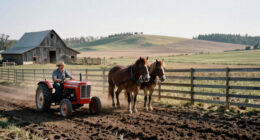

🔍 Read the full analysis: How Society Moved Beyond Farming—and What AI Could Change on ThorstenMeyerAI.com

Get hardware and tech essentials delivered free with Prime
- Fast, free delivery on millions of items
- Prime Video, Amazon Music and more included
- Member-only deals all year
TL;DR
An analysis published Nov. 3 traces how farming’s share of U.S. employment fell from an estimated 73.7% in 1800 to about 1.5% today, as tools, crop science and fertilizer raised output. The author argues that agriculture offers a useful comparison for AI’s potential effect on work, while emphasizing that the transformation took generations and that his forecast of automation affecting up to 90% of a sector is a thesis, not an established finding.
Thorsten Meyer published an analysis Nov. 3 arguing that agriculture’s two-century shift from human labor offers a useful, though incomplete, comparison for assessing how AI could change work. The piece traces the decline in farming employment alongside rising output, and presents the possibility that automation could affect as much as 90% of a sector as Meyer’s thesis—not a confirmed forecast.
In the United States, about 73.7% of the labor force worked in agriculture in 1800, according to estimates by economic historian Stanley Lebergott later published by the U.S. Census Bureau. The estimate covers a labor force of 1.9 million people aged 10 and older, including about 530,000 enslaved people. The underlying figures before 1840 are estimates rather than census counts; Meyer says “about three in four” is the more careful summary. Today, he puts the U.S. agricultural workforce at about 1.5%.
The shift did not happen through a single invention or in a single generation. Meyer describes successive changes in farm equipment, crop breeding and fertilizer. A steel plough developed by John Deere in 1837 helped address sticky Midwestern soil, while later reapers, threshers and tractors mechanized additional work. In the 1960s, high-yielding dwarf wheat varieties, used with irrigation and fertilizer, helped raise harvests in India and Pakistan.
Meyer also points to synthetic fertilizer made with the Haber-Bosch process, which made nitrogen fertilizer available at industrial scale. The global cereal harvest grew 4.2-fold from 1961, while the world’s population grew 2.7-fold over the same period, according to figures cited in the analysis. These comparisons describe food production and population over that period; they do not by themselves show how productivity gains were distributed or what happened to individual workers.
Agriculture’s Lessons for AI Work
The agricultural record shows that a sector can employ a far smaller share of workers while producing much more. That matters to the AI debate because it complicates two simple assumptions: that automation must cause an immediate collapse in employment, or that it will have little effect because demand for a sector’s output remains strong. Farming’s history suggests that output, employment and the pace of change can move in different directions.
It also shows why the transition’s duration matters. In the United States, the number of farm workers continued to rise until about 1910, reaching an estimated 11.8 million, even as farming’s share of the workforce was changing. In Germany, the agricultural share fell from 43% to 25% between 1882 and 1939, while the number of farm workers remained between 8 million and 10 million. A shrinking share did not mean that employment immediately fell in absolute terms.
For workers and businesses, the comparison is a reminder that technological change can raise productivity without specifying in advance who benefits, how quickly jobs change, or which new jobs appear. The evidence from farming can inform questions about AI, but it cannot establish that AI will follow the same path. Software and AI systems may affect different tasks and sectors, and their adoption, costs and labor-market effects remain uncertain.
Products Worth Considering

Ledger Flex + Folio Crypto Hardware Wallet

Ledger Flex Crypto Wallet

Logitech MX Keypad Programmable Macro Pad for Developers, Graphite
As an affiliate, we earn on qualifying purchases.
From Farm Labor to Higher Yields
Before mechanized equipment and modern agricultural inputs, farming depended heavily on human and animal muscle. A household using hand tools and draft animals could produce only a limited surplus, so a large share of the population had to grow food. The historical estimates cited by Meyer show similarly high agricultural or primary-sector employment in other countries, though the figures are not fully comparable: Japan was estimated at about 85% in 1872, China’s 1952 series recorded 83.5% in the primary sector, and India’s 1951 census counted cultivators and agricultural laborers as 69.7% of workers.
Those estimates have different sources and definitions. Japan’s figure is a historical reconstruction covering farming, forestry and fishing; China’s is a primary-sector measure; India’s figure combines cultivators and agricultural laborers. Germany’s first official occupational census, in 1882, counted 43.4% of earners in agriculture and forestry, but Meyer notes that women working on family farms were undercounted. They illustrate a broad pattern, rather than a clean, like-for-like international ranking.
Yields changed as technologies accumulated. India’s wheat harvest rose from 12.3 million tonnes in 1964–65 to 26.4 million tonnes in 1971–72, according to official statistics cited by Meyer. He also reports that U.S. farm output in 2023 was nearly three times its 1948 level, with only a small rise in total inputs. These measures do not mean that farming stopped requiring people: the International Labour Organization estimated that 928 million people worked in agriculture worldwide in 2025, about one in four workers, with the share varying widely by country.
Limits of the AI Comparison
There is no confirmed estimate here of how many jobs AI will eliminate, create or change, or over what time frame. Meyer’s figure of up to 90% is a personal thesis about automation’s possible reach, and the analysis does not establish a measured probability or a specific employment outcome.
The comparison also leaves open how AI adoption will differ from farm mechanization. Agricultural change unfolded over roughly two centuries in the United States and depended on connected advances in equipment, plant science, fertilizer, infrastructure and markets. It is not yet clear whether AI will spread at a similar pace, affect work in comparable ways, or produce the same relationship between output and employment. The article does not provide a detailed forecast by industry, occupation or country.
Historical statistics also carry limits. Early U.S. labor figures are estimates, some national measures use different definitions, and the agricultural share is not the same as a count of jobs lost. The global figure of 928 million describes people working in agriculture in 2025; it does not show how many might be affected by future automation.
The Next Test: AI Adoption
The article is part of Meyer’s Work After Work series, which examines how economic sectors and work may change. Its next installment is identified as a closer look at the mechanization of farming, including reapers, threshers and tractors. That history may add detail to the agricultural comparison, but it will not, by itself, resolve how AI affects employment.
For readers tracking the broader question, the next evidence will come from observed changes: which tasks organizations automate, how quickly employers adopt AI, whether workers shift into other roles, and how productivity and employment change together. The source provides no schedule for those outcomes and no confirmed forecast. For now, agriculture offers a historical case study—not a timetable or a guarantee for AI.
Key Questions
What is the new development?
Thorsten Meyer published an analysis on Nov. 3, 2026, using agriculture’s long decline in employment share as a case study for considering possible AI effects on work. It is an analysis, not a new employment study or official forecast.
How much did the U.S. farming workforce decline?
Meyer cites an estimate that 73.7% of the U.S. labor force worked in agriculture in 1800, compared with about 1.5% today. The 1800 figure is based on historical estimates, not a census count, and the two shares refer to different points in time.
Does the article predict that AI will automate 90% of jobs?
No. Meyer describes automation affecting up to 90% of a sector within a decade or a few decades as his thesis, not a fact. The article does not give a confirmed estimate of AI’s eventual effects on jobs.
Did fewer farm workers mean less food?
The figures cited in the analysis point in the opposite direction for the periods measured: global cereal production grew 4.2-fold from 1961 while population grew 2.7-fold. That does not mean the benefits were evenly shared or that agriculture no longer requires large numbers of workers.
How many people still work in agriculture worldwide?
The International Labour Organization estimate cited by Meyer puts the number at 928 million in 2025, about one in four workers worldwide. This is a global estimate, not a count of people whose jobs are expected to be automated.
Source: ThorstenMeyerAI.com