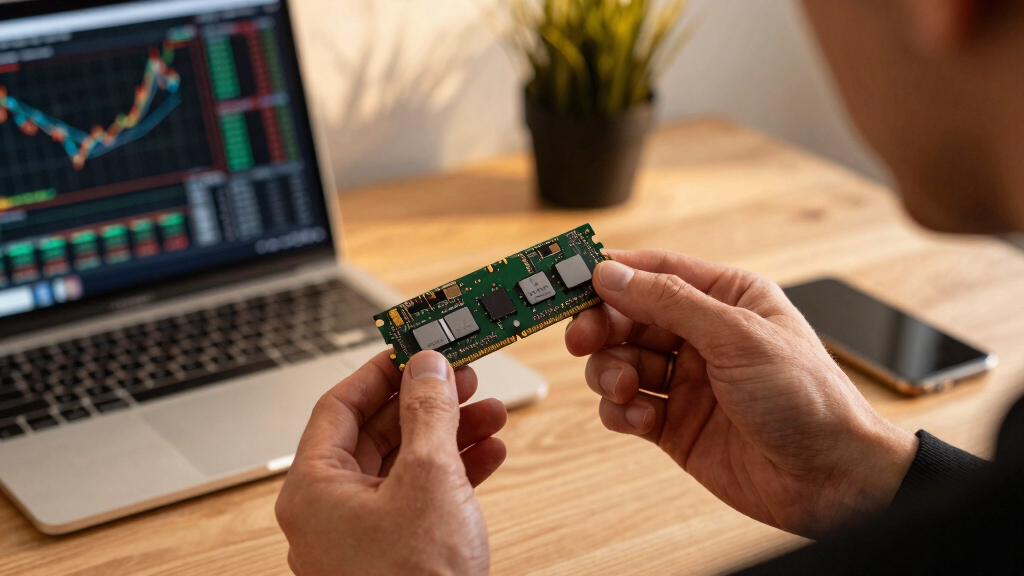

📊 Full opportunity report: When Does Cheap Memory Come Back? The 2027–2029 Question on ThorstenMeyerAI.com — validation score, market gap, and execution plan.

Get hardware and tech essentials delivered free with Prime
- Fast, free delivery on millions of items
- Prime Video, Amazon Music and more included
- Member-only deals all year
TL;DR
Memory prices are expected to stabilize around late 2027, but returning to pre-crisis levels may take until 2028–2029. Supply constraints and demand factors complicate the outlook.
Memory prices are unlikely to return to pre-crisis levels before 2028 or later, according to industry analysts and major manufacturers. While capacity additions are underway, physical and technological constraints mean relief will be gradual and potentially permanent at a higher baseline, affecting markets and consumers alike.
The consensus among industry experts suggests that memory supply will begin to stabilize around 2027. IDC predicts prices will level off by mid-2027, while others like Counterpoint see the fourth quarter of 2027 as the earliest point for a significant inflection. However, Intel’s CEO has explicitly stated there will be no relief until 2028.
Major memory manufacturers, including Samsung and SK Hynix, warn that shortages could persist into 2027 and beyond. Industry estimates place a true easing of supply and a return to normal pricing around late 2028 to 2029. The physical constraints—particularly the time required to build and ramp new fabs—are the primary reason relief is delayed. For example, Micron’s new Idaho DRAM plant, expected to start production mid-2027, is one of the first capacity increases, but the largest planned facility, Micron’s Clay megafab in New York, has been pushed back to 2030.
While new fabs are being constructed, the bottleneck remains the availability of cleanroom space, which cannot be expedited. The industry’s expansion plans are also influenced by current demand, with many companies choosing to hold back on overbuilding to preserve profit margins, especially given the ongoing surge in AI-related memory demand.
When does cheap memory come back?
The question everyone’s really asking: do I just wait this out? The honest answer is a timeline, three scenarios, and news you may not want — the cheap memory you remember isn’t coming back. A less-expensive market probably is — later, and at a higher floor.
Capacity ramps ’27–’28; price climbs stop, then ease. Settles ~30–50% above pre-crisis — the new baseline, not a return to 2024.
AI keeps accelerating; OpenAI locked ~40% of DRAM through 2029; makers pause expansion to protect record margins; each HBM gen worsens the math.
AI demand moderates just as delayed ’27–’28 fabs all arrive → classic overshoot → prices crash. Not the bet — but never impossible in this industry.
The one relief valve that needs no fab is efficiency: if compression (Part 9) cuts how much memory each model needs, demand softens on the timescale of a software update, not a construction project. So the posture isn’t waiting — it’s the discipline this series has been about. Memory is now a scarce, valuable resource; treat it that way. Buy what you need, right-size, own what’s steady, rent what’s spiky, quantize either way. The people who do best won’t be the ones who guessed the bottom — they’ll be the ones who stopped needing so much. That’s the squeeze, end to end.
Implications of Delayed Memory Price Relief
The delayed return to affordable memory prices means ongoing higher costs for consumers and industries relying on memory-intensive technology, such as AI and data centers. This persistent scarcity could influence product pricing, supply chain strategies, and technological development cycles for years to come. Additionally, the prospect of permanently elevated memory prices alters the economic landscape for hardware manufacturers and end-users, shaping market dynamics well into the next decade.
As an affiliate, we earn on qualifying purchases.
Physical and Market Factors Behind the Delay
The primary reason for the delayed easing is the physical time required to build and ramp new memory manufacturing capacity. Major capacity additions, such as Micron’s Idaho DRAM plant and SK Hynix’s Indiana facility, are scheduled for 2027 and 2028 but will take years to reach full operational capacity. The largest planned facility, Micron’s Clay megafab, is not expected until 2030. Additionally, the industry faces a bottleneck in advanced packaging—such as TSMC’s CoWoS—further constraining supply. Market discipline by manufacturers, who are prioritizing profitability over expansion, also contributes to the persistent scarcity, especially amid rising demand from AI applications.
Historically, the memory industry has experienced boom-and-bust cycles, with oversupply leading to crashes. The current scenario reflects a complex mix of physical constraints, demand growth, and strategic capacity management, making a sudden price crash unlikely in the near term.
“There is no relief until 2028.”
— Intel CEO
As an affiliate, we earn on qualifying purchases.
Key Unknowns in Memory Market Recovery
Several factors remain uncertain, including the pace of AI demand growth, potential technological breakthroughs in manufacturing, and the impact of possible market oversupply. The possibility of a sudden glut and crash—similar to past cycles—cannot be entirely ruled out, especially if demand moderates sharply or a new technological shift reduces memory needs significantly.
As an affiliate, we earn on qualifying purchases.
Upcoming Capacity Expansions and Market Indicators
The next critical developments include the ramp-up of Micron’s Idaho plant in mid-2027, SK Hynix’s Indiana facility, and the broader impact of US CHIPS Act-funded fabs expected to start between 2028 and 2030. Monitoring demand trends, especially from AI and cloud computing sectors, will be essential to gauge whether supply will outpace or keep pace with consumption. Industry reports and quarterly earnings from major players will provide further clues about the evolving balance between supply and demand.
As an affiliate, we earn on qualifying purchases.
Key Questions
When can I expect memory prices to return to pre-crisis levels?
Most analysts and industry insiders agree that a full return to pre-crisis prices is unlikely before 2028 or later, with some estimates extending into 2029.
What are the main factors delaying relief in memory supply?
The primary factors include the physical time required to build new fabs, bottlenecks in advanced packaging, and strategic decisions by manufacturers to limit capacity expansion amid high profitability and demand growth.
Could there be a sudden oversupply causing prices to crash?
While historically possible, such a crash is less likely in the near term given current demand, capacity constraints, and manufacturers’ discipline. However, market dynamics could shift if demand sharply declines or technological shifts reduce memory needs.
How will AI demand influence memory prices in the coming years?
AI demand is expected to remain strong, which could sustain high prices. However, innovations in efficiency and compression techniques might reduce overall memory consumption, easing pressure without new capacity.
Source: ThorstenMeyerAI.com
Fall Picks
fall essentials
As an affiliate, we earn on qualifying purchases.