
📊 Full opportunity report: Use Estate Planning Software To Track Trust Assets on IdeaNavigator AI — validation score, market gap, and execution plan.

Get hardware and tech essentials delivered free with Prime
- Fast, free delivery on millions of items
- Prime Video, Amazon Music and more included
- Member-only deals all year
TL;DR
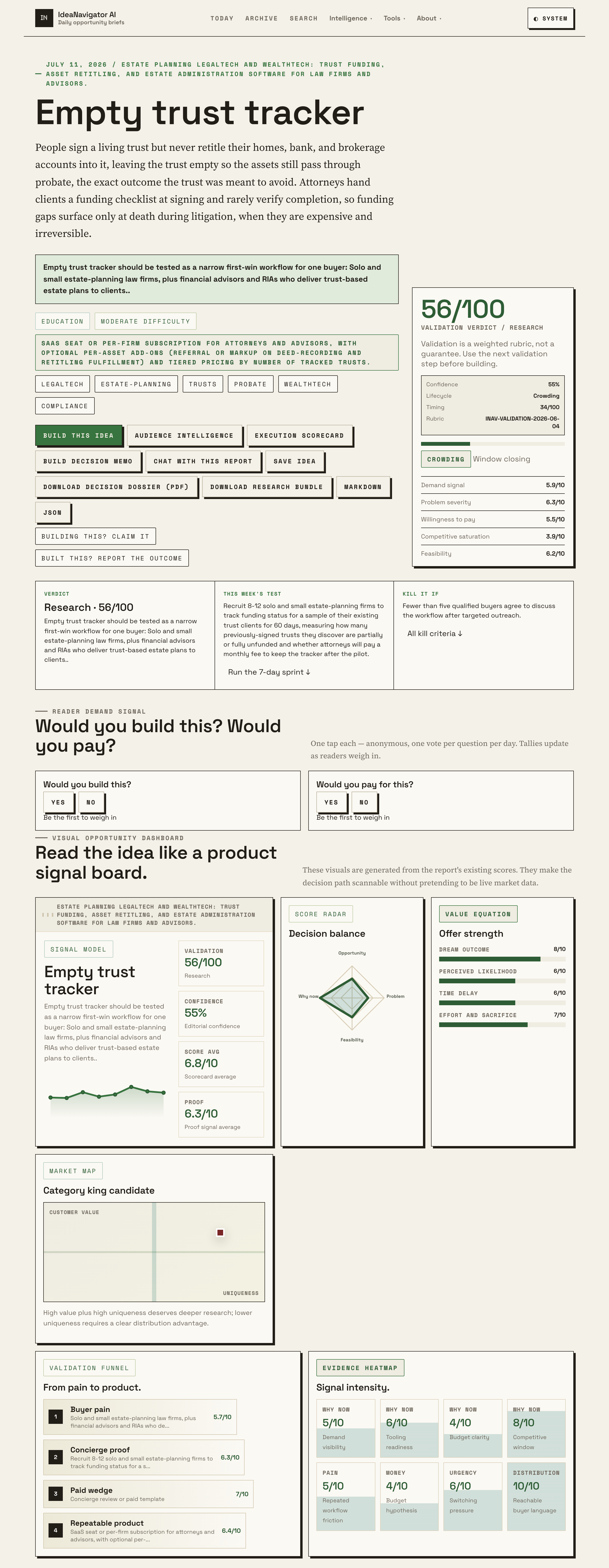
An IdeaNavigator AI proposal outlines a software tracker for law firms and financial advisors to monitor whether clients move assets into living trusts. The concept remains untested: a 60-day pilot with 8 to 12 firms is proposed to measure funding gaps and willingness to pay.
According to IdeaNavigator AI’s proposal, the software would let attorneys or advisors create an asset checklist for each trust, covering items such as real estate, bank and brokerage accounts, business interests, retirement assets and beneficiary designations. Each item could be marked pending, in progress or confirmed funded, with documents such as a recorded deed or retitled account statement attached as proof.
IdeaNavigator AI also proposes automated client reminders and a firm dashboard. The dashboard would show the share of tracked assets funded across a firm’s trust clients, allowing staff to flag trusts with substantial gaps for follow-up. The proposal does not report a launched product, completed pilot or measured results.
The proposal suggests a subscription priced by firm, seat or number of trusts, with possible add-on revenue from deed recording or asset-retitling services. Its validation plan calls for recruiting 8 to 12 solo and small firms, tracking a sample of existing trust clients for 60 days, and measuring how many trusts prove partly or fully unfunded and whether firms would pay a monthly fee.
Closing the Trust Funding Gap
As general estate-planning context, a living trust can only manage assets that have been transferred into it or otherwise appropriately connected to it. If clients sign trust documents but do not retitle relevant property, those assets may not receive the intended trust treatment and could still pass through probate. IdeaNavigator AI’s proposal targets the gap between preparing estate documents and completing the follow-up work.
IdeaNavigator AI argues that a shared tracker could make funding follow-up more visible than a paper checklist delivered at signing. Whether that improves completion rates, reduces disputes or saves costs has not been established. The proposed pilot would need to show that firms can verify status reliably and that the process is useful enough to justify a recurring subscription.
IdeaNavigator AI cites existing fulfillment services, including per-deed funding services reportedly priced from $250. The proposal presents that amount as market context, not as a confirmed price for the tracker. Any connection between monitoring and paid retitling services would need clear disclosure to clients.
From Signed Trusts to Funded Assets
IdeaNavigator AI’s proposal identifies a practical distinction in estate planning: signing a living trust is a document milestone, while funding it involves transferring or designating assets in ways consistent with the plan. Real estate may require a deed, while accounts and other holdings can involve different institutions and procedures. The proposed tracker would collect these tasks in one client-by-client workflow.
IdeaNavigator AI says only about 11% of Americans hold a trust, but the provided figure has no date, methodology or cited survey details. The proposal also characterizes estate-planning adoption and digital tools as increasing in 2026; it provides no supporting measurements. These claims are attributed market context from IdeaNavigator AI, not independently established findings.
The proposal frames the opportunity for solo and small estate-planning practices and for advisors or registered investment advisers that include trust-based plans in client offerings. IdeaNavigator AI argues that current document-drafting tools do not close the funding follow-up gap, but it does not identify specific products or document a comparison of their capabilities.
Pilot Results Still Pending
IdeaNavigator AI reports no product launch, participating firms, customer interviews, pilot data or subscription commitments. It is not yet clear how often firms find trusts with missing or incomplete funding, how many clients respond to reminders, or whether uploaded documents would provide adequate verification.
The scope also needs testing across asset types and jurisdictions. Retitling rules, provider processes and documentation can vary, and the proposal does not explain how the tracker would handle sensitive financial records, data security, access controls or mistaken status updates. The reported 11% trust-ownership figure and the stated 2026 market trends lack supporting detail in the proposal.
Testing Demand With Small Firms
IdeaNavigator AI proposes a 60-day pilot with 8 to 12 solo and small estate-planning firms. Participating firms would track funding for a sample of existing trust clients, count partially and fully unfunded trusts, and assess whether attorneys would continue using the tool for a monthly fee.
IdeaNavigator AI reports no pilot start date or findings. A decision to build or expand the product would depend on recruitment, the frequency of funding gaps, the ability to confirm asset transfers, and firms’ willingness to pay after the trial.
Source: IdeaNavigator AI
Key Questions
Has the trust funding tracker launched?
No launch is reported. The tracker is presented as a proposed product and validation opportunity.
What would the proposed software track?
It would track trust-related assets through pending, in-progress and confirmed-funded statuses, with supporting documents and client reminders.
Who is the proposed tool for?
The proposal targets solo and small estate-planning law firms, as well as financial advisors and registered investment advisers offering trust-based estate plans.
How would the idea be tested?
The proposed test is a 60-day pilot with 8 to 12 firms, measuring how many existing trusts are partly or fully unfunded and whether firms would pay to keep using the tracker.
Source: IdeaNavigator AI
Halloween Picks
halloween
As an affiliate, we earn on qualifying purchases.