📊 Full opportunity report: Ozempic, Wegovy, Zepbound, And Mounjaro: A US Access Index on IdeaNavigator AI — validation score, market gap, and execution plan.

Get hardware and tech essentials delivered free with Prime
- Fast, free delivery on millions of items
- Prime Video, Amazon Music and more included
- Member-only deals all year
TL;DR
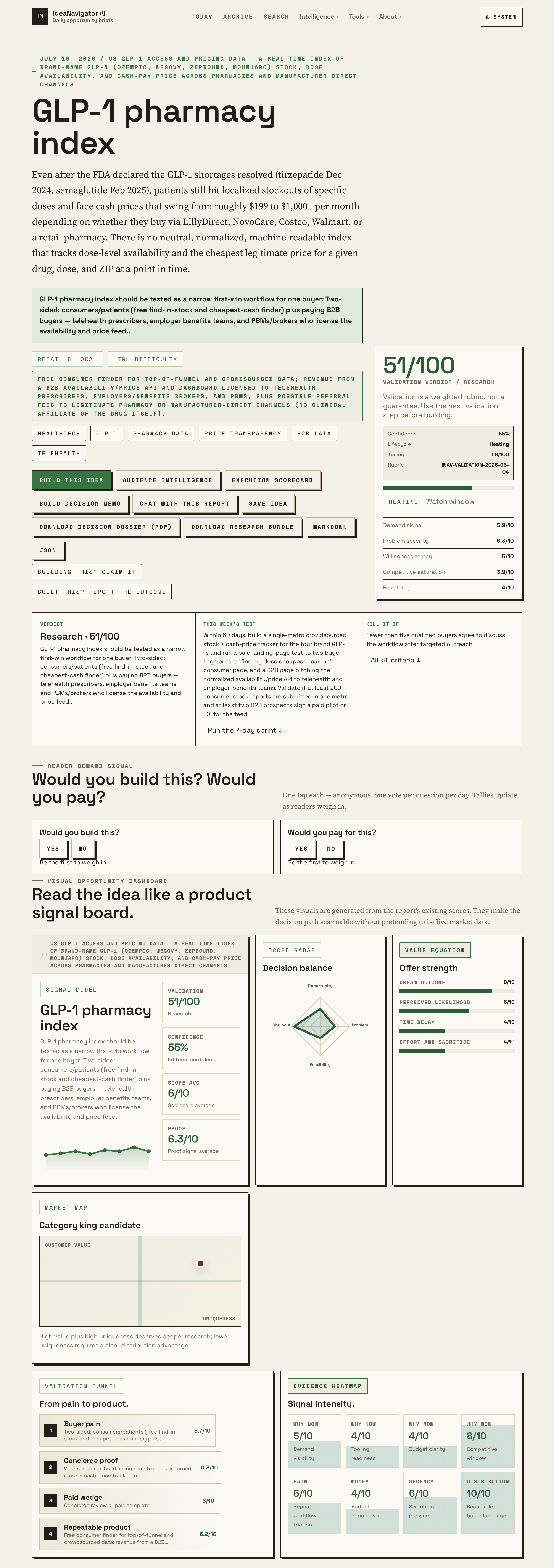
A proposal from IdeaNavigator AI outlines a two-sided ‘GLP-1 pharmacy index’ that would show patients where Ozempic, Wegovy, Zepbound, and Mounjaro are in stock by dose and ZIP, and at what cash price. It responds to a market shift: FDA-declared shortages ended in 2024-2025, but localized dose-level stockouts and cash prices ranging roughly $199 to over $1,000 per month persist across competing channels.
A new proposal calls for building a national GLP-1 access index that would tell US patients, in real time, which pharmacies actually have Ozempic, Wegovy, Zepbound, or Mounjaro in stock at a specific dose — and where the cheapest legitimate cash price is. The plan, published by IdeaNavigator AI, argues that the US market has moved from a shortage problem to a fragmentation problem: the FDA declared GLP-1 shortages resolved, yet patients still face localized dose-level stockouts and monthly cash prices that swing from roughly $199 to more than $1,000 depending on the buying channel.
According to the proposal, the FDA removed tirzepatide (the active ingredient in Zepbound and Mounjaro) from its shortage list in December 2024 and semaglutide (Ozempic and Wegovy) in February 2025. But resolution of the formal shortages did not end access problems. Patients continue to report that specific doses are unavailable at specific pharmacies, even when the drug is nominally on the market, and cash prices vary widely across channels including LillyDirect, NovoCare, Costco, Walmart, traditional retail pharmacies, and the TrumpRx portal launched in February 2026.
The core gap the proposal identifies is informational: there is currently no neutral, normalized, machine-readable index that tracks dose-level availability and the cheapest legitimate price for a given drug, dose, and ZIP code at a point in time. The proposed product would be two-sided. Consumers and patients would get a free ‘find-it-in-stock and cheapest cash price’ tool covering all four brand GLP-1s, seeded with crowdsourced stock reports and normalized public pricing data from manufacturer direct sites, Costco and Walmart cash programs, and a GoodRx-style price layer. On the other side, paying business customers — telehealth prescribers, employer benefits teams, and PBMs or brokers — would license the availability and price data feed through an API or dashboard.
The business model would keep the consumer finder free to generate usage and crowdsourced data, with revenue coming from B2B API licensing and dashboards, plus possible referral fees to legitimate pharmacy or manufacturer-direct channels. The proposal includes a concrete validation plan: within 60 days, build a single-metro crowdsourced stock and cash-price tracker for the four drugs and run paid landing-page tests to both a consumer audience and B2B prospects. The threshold for proceeding: at least 200 consumer stock reports submitted in one metro area and at least two B2B prospects signing a paid pilot or letter of intent.
Why Fragmented GLP-1 Pricing Hurts Patients and Employers
The proposal lands at a moment when GLP-1 demand is reshaping US pharmacy economics. Employers report that GLP-1s now account for roughly 20% of pharmacy spend, according to the proposal, creating pressure for cost-steering data that does not currently exist in normalized form. For patients, the stakes are direct: a person prescribed a specific dose of Zepbound or Ozempic can face a month of calling pharmacies to find stock, then discover that the same prescription costs several times more at one channel than another.
The shift from shortage to fragmentation matters because the policy levers changed. During the FDA-declared shortage, compounding pharmacies could legally produce copies of the branded drugs; the end of the shortage designations triggered deadlines that forced compounders out of that market. At the same time, manufacturers launched competing direct cash-pay channels — LillyDirect and NovoCare, joined by retail programs at Costco and Walmart and the government-linked TrumpRx portal. The result is a sprawl of prices and dose-level supply gaps that no single source currently normalizes, exactly when both consumers and large benefits buyers need comparability.
Top picks for "ozempic wegovy zepbound"
As an affiliate, we earn on qualifying purchases.
How the GLP-1 Market Got Here
: “The four drugs at the center of the proposal are the leading brand GLP-1 receptor agonists and dual agonists in the US market: Novo Nordisk’s Ozempic and Wegovy (semaglutide) and Eli Lilly’s Mounjaro and Zepbound (tirzepatide). Soaring demand starting in 2022 and 2023 produced genuine supply shortages, prompting the FDA to add the drugs to its shortage list and opening a legal window for compounded versions.
That window closed in stages: the FDA determined the tirzepatide shortage was resolved in December 2024 and the semaglutide shortage in February 2025, and enforcement deadlines followed that ended most compounding of the branded molecules. Simultaneously, Novo Nordisk and Eli Lilly built out direct-to-consumer cash channels, and by February 2026 the TrumpRx portal had entered the mix. Each channel prices differently, and each may or may not carry a given dose at a given time — the specific gap the proposed index would fill.
What the Proposal Has Not Yet Proven
The index is currently a proposal, not a launched product. No metro-level tracker has been built, no consumer stock reports have been collected, and no B2B pilot agreements exist yet — all of those are gated behind the 60-day validation plan. It remains unclear whether crowdsourced stock reports can be gathered at enough volume and accuracy to be reliable at dose level, or whether pharmacies, manufacturers, or price-aggregation incumbents might object to having their data normalized into a comparison feed.
The pricing figures cited — the roughly $199-to-$1,000+ monthly cash range and the 20% employer pharmacy-spend share — come from the proposal itself and are not independently audited here. Actual prices vary by dose, channel, and eligibility for manufacturer programs. Whether telehealth prescribers and benefits buyers will pay for a feed that partially overlaps with existing price-comparison tools is also untested.
The 60-Day Test That Decides the Index
Under the proposal’s own plan, the immediate next step is a single-metro pilot: a crowdsourced stock and cash-price tracker for Ozempic, Wegovy, Zepbound, and Mounjaro, paired with paid landing-page tests aimed at consumers (‘find my dose cheapest near me’) and B2B buyers (telehealth and employer-benefits teams). The go/no-go signals are explicit — at least 200 consumer stock reports in one metro and at least two paid B2B pilots or letters of intent. If those thresholds are met, the roadmap calls for layering dose-level availability alerts on top of the consumer tool and expanding the normalized feed to design-partner B2B customers. If they are not, the proposal itself treats that as a signal to stop.
Key Questions
Are Ozempic, Wegovy, Zepbound, and Mounjaro still in shortage in the US?
No. The FDA declared the tirzepatide shortage resolved in December 2024 and the semaglutide shortage resolved in February 2025. However, patients still report localized stockouts of specific doses at specific pharmacies, which is a different problem from a formal national shortage.
How much do these drugs cost without insurance?
According to the proposal, monthly cash prices range from roughly $199 to more than $1,000 depending on the drug, dose, and channel — including manufacturer-direct sites like LillyDirect and NovoCare, Costco and Walmart programs, and retail pharmacies. Prices vary and should be verified at point of purchase.
Does the GLP-1 access index exist yet?
No. It is a published product proposal from IdeaNavigator AI. A single-metro prototype, crowdsourced data collection, and B2B pilot agreements are all still ahead, gated behind a 60-day validation plan.
Why can’t patients just use existing price-comparison tools?
Existing tools compare prices but, according to the proposal, no neutral source combines dose-level, ZIP-code-specific real-time availability with the cheapest legitimate cash price across manufacturer-direct channels, retail cash programs, and pharmacies in one normalized feed.
Who would pay for such an index?
Under the proposal, consumers would use it free, while telehealth prescribers, employer benefits teams, and PBMs or brokers would pay to license the availability and price data feed — driven by employer reports that GLP-1s make up roughly 20% of pharmacy spend.
Source: IdeaNavigator AI
Fall Picks
fall essentials
As an affiliate, we earn on qualifying purchases.