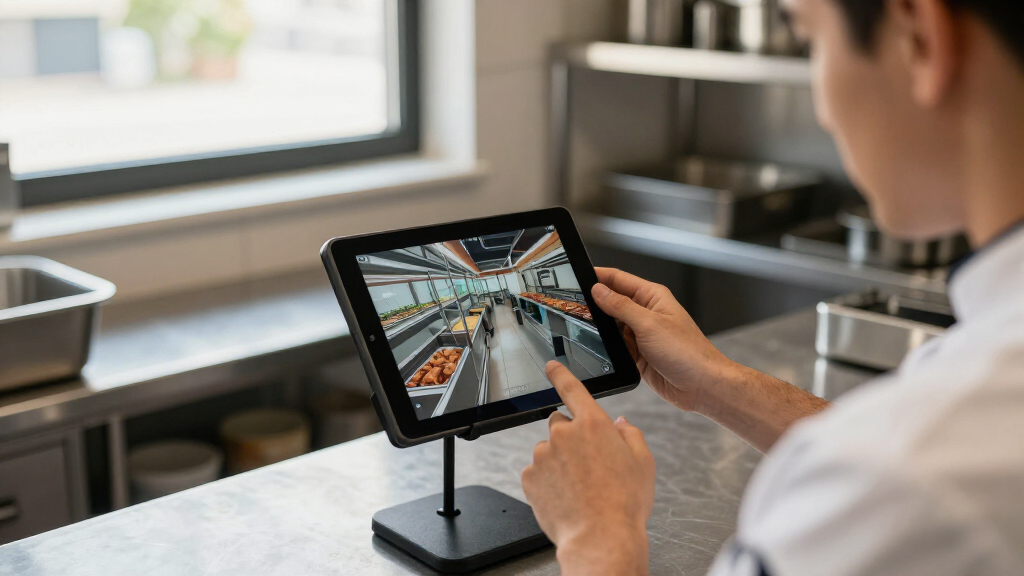

📊 Full opportunity report: How Computer Vision Is Changing The Way Restaurants Monitor Food Safety on IdeaNavigator AI — validation score, market gap, and execution plan.

Get hardware and tech essentials delivered free with Prime
- Fast, free delivery on millions of items
- Prime Video, Amazon Music and more included
- Member-only deals all year
TL;DR
Restaurants are adopting computer vision to automate food safety inspections by analyzing photos of kitchen areas. This technology provides verifiable, timestamped data, improving accuracy and accountability. The development is currently being tested in multi-unit restaurant groups.
Computer vision technology is being tested in restaurant kitchens to automatically verify food safety compliance during routine inspections, marking a shift from manual checklists to verifiable digital records. This development aims to improve accuracy and accountability for multi-unit restaurant groups.
The new system uses existing smartphone cameras to capture images during morning walk-throughs, which are then analyzed by AI models trained to detect violations such as uncovered containers, propped cooler doors, and missing date labels. According to sources involved in the pilot, the system generates timestamped reports with severity ratings for each violation, providing a clear record for operations and quality assurance teams.
Restaurant managers at a multi-unit group are currently testing this approach over two weeks across five locations. The goal is to compare the AI-flagged violations with findings from hired health-inspection consultants, to validate the system’s accuracy and reliability. The technology aims to turn subjective, manual inspections into objective, data-driven processes without requiring new hardware investments.
This solution is offered as a per-location monthly subscription, with a dashboard that aggregates data across the restaurant group, enabling trend analysis and compliance monitoring at scale.
How Computer Vision Is Changing the Way Restaurants Monitor Food Safety
Phone photos are becoming verifiable inspection records. A developing system analyzes routine kitchen walk-throughs, flags visible violations, assigns severity levels and gives multi-unit operators a timestamped view of compliance.
Captured with existing smartphones.
Timestamped findings and severity ratings.
Subscription priced per restaurant location.
Accuracy is still being validated.
From morning walk-through to group-wide insight
The workflow fits around existing routines: employees document the kitchen, AI reviews the images and managers receive structured findings that can be tracked across locations.
Capture
Staff photograph key kitchen areas during a routine walk-through.
Analyze
Computer vision models inspect each image for trained visual patterns.
Flag
Potential violations are identified and given severity ratings.
Verify
Managers review timestamped evidence and initiate corrective action.
Aggregate
A dashboard reveals repeat issues and trends across the restaurant group.
Common violations become searchable data
The system focuses first on visible, recurring problems that standard phone photography can document clearly.
Uncovered containers
Identifies exposed food or containers that appear to be missing protective lids.
Propped cooler doors
Flags doors that appear open during inspection and may put safe holding temperatures at risk.
Missing date labels
Detects stored items without visible date markings needed for rotation and disposal decisions.
Timestamped proof
Connects each finding to a specific inspection time, image and restaurant location.
Severity ratings
Helps operations teams distinguish urgent hazards from lower-priority corrective work.
Location trends
Aggregates repeat findings so quality teams can target training, equipment or process gaps.
Manual checklist versus computer vision
Computer vision adds evidence and consistency, but it remains a support layer for human judgment while validation is underway.
| Inspection capability | Manual checklist | Computer vision workflow |
|---|---|---|
| Objective visual record | ~Depends on staff documentation | ✓Photo-backed finding |
| Automatic timestamp | ~Often entered manually | ✓Captured with the report |
| Consistent violation criteria | ~Can vary by employee | ✓Same trained model applied |
| Cross-location trend analysis | ~Requires manual consolidation | ✓Aggregated in one dashboard |
| Complex contextual judgment | ✓Human interpretation available | ~Still under evaluation |
| Additional camera hardware | ✓Not required | ✓Uses existing smartphones |
The promise is strong. The proof is pending.
A multi-unit restaurant group is comparing AI-flagged findings with results from hired health-inspection consultants. The central question is whether the model can remain reliable across different layouts, lighting conditions and ambiguous real-world situations.
The AI models can reliably flag common food safety violations from standard phone photos, turning subjective inspections into objective, verifiable data.
Anonymous researcher involved in the development
One photo can drive five operational outcomes
The value extends beyond detection: documented findings create a connected process for correction, accountability and long-term prevention.
Evidence
A visual record replaces an unsupported checkbox.
Detection
The model surfaces likely safety violations.
Priority
Severity helps teams decide what to fix first.
Correction
Managers can assign and document follow-up work.
Prevention
Trend data exposes recurring system-level problems.
What operators should know
Commercial expansion depends on validated accuracy, useful feedback from managers and low-friction integration into daily work.
Will it replace human inspectors?
No. The current design supplements human review with consistent evidence; it does not remove the need for expert judgment.
What changes for restaurant groups?
Central teams gain standardized reports, faster escalation and a clearer view of compliance across multiple locations.
What about privacy and security?
Restaurants still need clear photo protocols, access controls, retention policies and safeguards for employees and operational data.
When could adoption expand?
If pilot results are successful, broader testing and commercial availability could follow within the next year.
What happens next?
The pilot will continue, AI results will be measured against consultant findings, and the models will be refined before any large-scale deployment decision.
Implications for Food Safety and Restaurant Operations
This technology could significantly improve food safety compliance by providing verifiable, timestamped records of inspections, reducing reliance on subjective checklists. It offers the potential for quicker identification of violations, better accountability, and streamlined reporting processes. For restaurant groups, this means enhanced operational oversight and reduced risk of violations leading to fines or health issues.
However, the system’s accuracy and ability to handle complex or ambiguous violations remain under evaluation. Widespread adoption could reshape how restaurants conduct routine safety checks, but further validation is necessary before full deployment.
As an affiliate, we earn on qualifying purchases.
Recent Advances in AI-Driven Food Safety Monitoring
Traditional food safety inspections rely on manual checklists completed by staff, which are often incomplete or inaccurate, leading to missed violations and delayed corrective actions. Recent developments in AI and computer vision have enabled automated analysis of photos taken during inspections, promising more reliable and objective assessments.
Several startups and tech companies have begun exploring AI-driven solutions for food safety, with pilot programs showing promising results. The current focus is on integrating these systems into existing restaurant workflows without requiring additional hardware, leveraging smartphones and existing infrastructure.
This shift aligns with broader trends toward digital transformation in restaurant operations, emphasizing data-driven decision-making and compliance management.
“The AI models can reliably flag common food safety violations from standard phone photos, turning subjective inspections into objective, verifiable data.”
— an anonymous researcher
As an affiliate, we earn on qualifying purchases.
Validation and Reliability of the Computer Vision System
It is not yet confirmed how accurately the system will perform across diverse kitchen environments or with complex violations. The pilot is ongoing, and results comparing flagged violations with expert inspections are still pending, so full reliability remains unproven.
As an affiliate, we earn on qualifying purchases.
Next Steps for Broader Adoption and Validation
The pilot program will continue for at least two more weeks, with results analyzed to determine the system’s accuracy. If successful, the company plans to expand testing to more locations and refine the AI models. Widespread adoption will depend on validated performance, user feedback, and integration ease.
As an affiliate, we earn on qualifying purchases.
Key Questions
How does the computer vision system identify violations?
The system analyzes photos taken during walk-throughs, using AI models trained to detect common violations like uncovered food, improper storage, or missing labels, and assigns severity ratings.
Will this replace human inspectors entirely?
Currently, the system is designed to supplement human inspections by providing verifiable data, not to replace human judgment. Full automation is unlikely in the near term.
What are the benefits for restaurant groups?
Automated, timestamped reports improve compliance tracking, reduce errors, and streamline reporting processes, helping groups manage multiple locations more effectively.
Are there privacy or operational concerns with using phone cameras?
Since the system uses existing smartphones during routine inspections, privacy concerns are minimal. Proper protocols can be established to ensure data security and compliance.
When might this technology be widely available?
If validation is successful, the system could be offered commercially within the next year, with broader adoption depending on pilot results and customer feedback.
Source: IdeaNavigator AI
Fall Picks
fall essentials
As an affiliate, we earn on qualifying purchases.