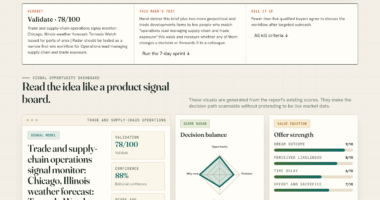
📊 Full opportunity report: Matching Buyer Strengths With Small-Business Sales on IdeaNavigator AI — validation score, market gap, and execution plan.

Get hardware and tech essentials delivered free with Prime
- Fast, free delivery on millions of items
- Prime Video, Amazon Music and more included
- Member-only deals all year
TL;DR

IdeaNavigator AI proposes testing a skills-based matching workflow for people buying small businesses and brokers seeking qualified buyers. The concept would compare verified buyer profiles with listing requirements, explain matches and measure whether hand-delivered recommendations improve inquiry-to-letter-of-intent conversion; no test results are reported.
IdeaNavigator AI has proposed a small-business sales pilot that would match buyers to listings by their skills and operating experience, then assess whether those recommendations produce more serious inquiries. The concept targets individual buyers and brokers, but it remains a proposed workflow: no launch, participating marketplace or test results are identified.
According to the IdeaNavigator AI proposal, the product would ask buyers to create a verified profile of skills and experience, then score businesses for operational fit. It would explain why a listing matches a buyer, rather than relying only on price and industry filters, which the proposal describes as common on business-for-sale platforms. Brokers would receive inquiries with fit scores, intended to help distinguish potential buyers from less-qualified contacts.
The proposal calls for an initial test scoring 500 active listings against 100 buyer profiles and hand-delivering the best matches. It suggests measuring inquiry-to-LOI conversion against a platform baseline. An LOI, or letter of intent, is a preliminary expression of interest in a transaction. The proposal does not specify how the baseline would be selected, how long the test would run or what result would count as success.
The proposed business model combines buyer subscriptions with broker success fees on matched closings, according to the same IdeaNavigator AI page. These are suggested revenue sources, not confirmed pricing or existing fees. The proposal does not identify a company or marketplace that has adopted the system, nor does it report that any buyer has completed a transaction through skills-based matching.
Testing Fit Beyond Price and Industry
A buyer’s capacity to operate a business can matter alongside its asking price and sector. The IdeaNavigator AI proposal illustrates this with a marketing executive who might be better suited to acquire an agency than a laundromat, even if conventional listing filters surface the laundromat first. The example illustrates the concept; it is not a reported buyer case.
If a pilot showed that skills-based recommendations led to more qualified conversations or letters of intent, it could give buyers a more targeted way to search and reduce time brokers spend responding to inquiries that do not fit a business. Those benefits have not been demonstrated. The proposal suggests comparing conversion with a platform baseline, but such a comparison would need to account for differences in buyers, listings and broker practices before attributing any improvement to matching.
The proposal also argues that operator-skill fit may become more relevant as retiring business owners put more companies on the market. It provides no market-size estimate or data on the number of businesses for sale, so the scale of that opportunity cannot be assessed from the plan alone.
Products Worth Considering

Logitech MX Mechanical Full-Size Wireless Mechanical Keyboard, Tactile Quiet Switches, Backlit Keys, Bluetooth, USB-C, Multi-Device, Graphit

Logitech MX Keys S Wireless Keyboard, Graphite

Ledger Flex Crypto Wallet
As an affiliate, we earn on qualifying purchases.
From Search Filters to Operator Fit
IdeaNavigator AI describes business-for-sale searches as often organized around price and industry. Those filters can narrow a large catalogue, but they do not necessarily show whether a buyer has relevant experience managing a particular business. The proposed matching layer would add an assessment of buyer capabilities to familiar listing details.
The proposal frames the idea as a narrow first use case rather than a broad replacement for business-sale platforms: begin with one buyer searching listings and brokers looking for qualified prospects. Its suggested validation method is manual at first, with top matches delivered by hand before any wider automated service is presumed. That approach could help test demand, but the proposal does not say that the pilot has begun or that a platform has agreed to participate.
Matching would depend on the quality of information from both sides. Buyers would need to provide credible experience details, while listings would need enough operational information to judge what skills a business requires. The proposal calls buyer profiles verified but does not explain who would verify them, what evidence would be accepted or how listing information would be checked.
Pilot Design and Verification Gaps
No pilot outcome is available, and the IdeaNavigator AI proposal does not name a launch date, product team, participating brokers or business-for-sale platform. It also provides no evidence that buyers would pay subscriptions or that brokers would accept success fees tied to matched closings.
Several design questions remain open. The proposal does not define the fit-scoring method, how recommendations would be explained or how incomplete or inaccurate profiles would be handled. It does not specify the comparison-platform baseline, conversion period or treatment of buyers who inquire about a listing but do not submit an LOI. Without those details, even a reported difference in conversion would be difficult to interpret.
The proposal also does not state how sensitive business and buyer information would be handled, or how the system would address cases where a person’s experience does not capture their ability to finance or complete an acquisition. Skills could help identify operational fit, but the proposal does not claim they replace financial qualification, due diligence or professional advice.
The Proposed 500-Listing Test
The next step described in the IdeaNavigator AI proposal is to compare 500 active listings with 100 buyer profiles, manually deliver the strongest matches and track inquiry-to-LOI conversion against a platform baseline. Before results could be evaluated, organizers would need to define the scoring criteria, verification process, measurement window and comparison group.
No schedule or named operator for the test has been announced in the proposal. If it proceeds, useful evidence would include conversion rates, the number of participating buyers and brokers, how often recommendations are acted on, and whether matches lead to completed transactions. Until results are reported, skills-based matching remains a proposal rather than a proven improvement to small-business sales.
Source: IdeaNavigator AI proposal
Key Questions
What is skills-based matching for small-business sales?
It is a proposed search method that compares a buyer’s skills and operating experience with the needs of businesses for sale, in addition to factors such as price and industry. The approach is outlined in an IdeaNavigator AI proposal.
Has the proposed matching service launched?
No launch or participating marketplace is identified in the IdeaNavigator AI proposal. It describes a proposed pilot, and no test results are reported.
How would the pilot be evaluated?
The IdeaNavigator AI proposal suggests scoring 500 listings against 100 buyer profiles, delivering top matches by hand and comparing inquiry-to-LOI conversion with a platform baseline. It does not specify the baseline or test period.
Would skill matching replace financial checks or due diligence?
No. The proposal focuses on operational fit and does not claim that matching replaces financial qualification, due diligence or other steps in a business acquisition.
Source: IdeaNavigator AI