📊 Full opportunity report: Facilitating Better Benefits Access With Automated Benefit Check Tools on IdeaNavigator AI — validation score, market gap, and execution plan.
Listen free for 30 days with Audible
Thousands of audiobooks and originals — cancel anytime.
Start your free trialAs an affiliate, we earn on qualifying purchases.
TL;DR
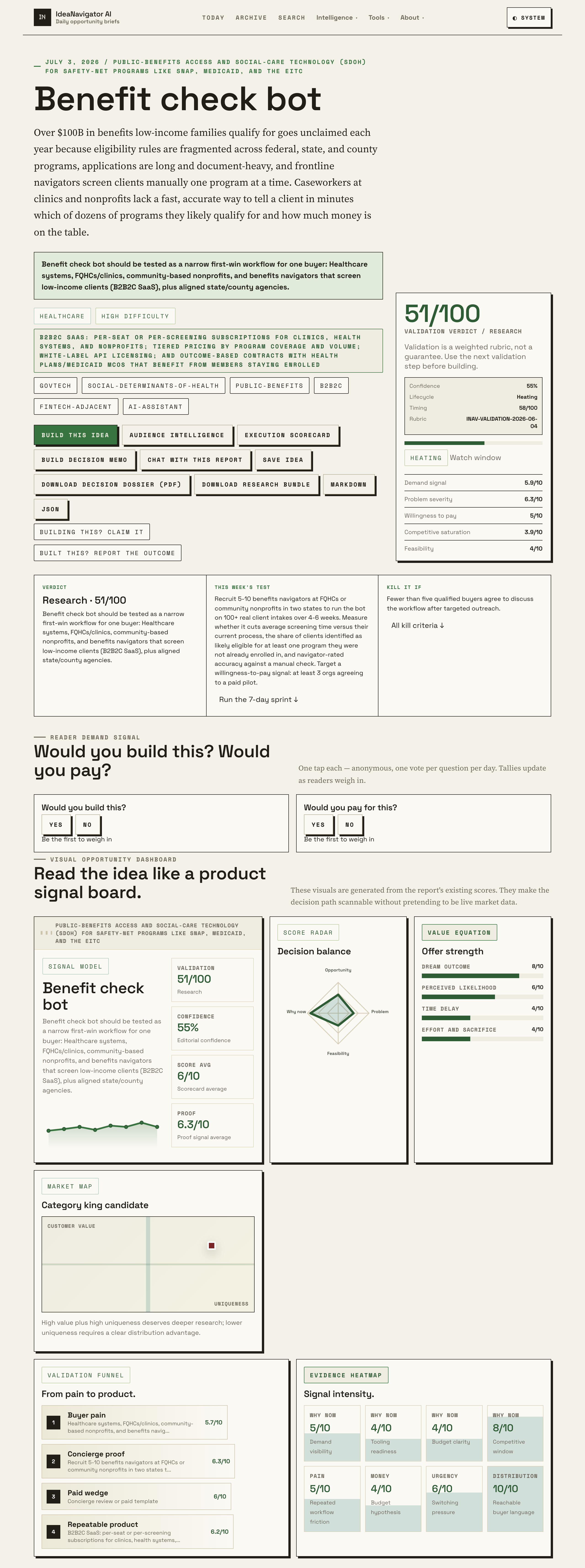
A new AI-powered benefit check bot is being tested to improve access to public benefits for low-income families. It automates eligibility screening, promising faster, more accurate results, and potentially billions in unclaimed benefits recovered.
A new AI-powered benefit check bot is being tested across select healthcare systems and nonprofits to automate eligibility screening for public benefits, aiming to reduce manual workload and increase benefit uptake among low-income families. The tool, designed as a white-label conversational interface, can quickly identify programs clients qualify for and estimate benefits, addressing a longstanding gap in benefits access caused by fragmented eligibility rules and cumbersome application processes.
The benefit check bot is a SaaS solution tailored for healthcare providers, Federally Qualified Health Centers (FQHCs), community nonprofits, and state agencies that serve low-income populations. It uses conversational AI to ask clients a series of yes/no and multiple-choice questions, then provides an estimated list of eligible programs such as SNAP, Medicaid, EITC/CTC, WIC, and LIHEAP, with benefit amounts and next-step application links.
Developed in response to the shutdown of Benefits Data Trust—a nonprofit that historically managed benefits screening for multiple states—the tool aims to fill a capacity gap. It leverages recent advances in conversational AI technology, making multi-program screening feasible at near-zero marginal cost, a significant shift from traditional, labor-intensive manual processes.
Early pilots involve recruiting 5-10 benefits navigators at FQHCs and community nonprofits in two states. These pilots will test whether the tool reduces screening time, increases identification of eligible benefits, and maintains accuracy compared to manual checks. The goal is to demonstrate measurable improvements in efficiency and benefits recovery, with potential for scalable deployment across multiple jurisdictions.
Why Automated Benefit Checks Matter for Public Health
This innovation addresses a critical gap in social safety-net programs, where over $100 billion in benefits go unclaimed annually due to eligibility complexity and manual screening limitations. By automating eligibility assessments, the tool could significantly increase benefit uptake, reducing financial hardship for millions of low-income households. Additionally, it offers a scalable, cost-effective way for health systems and government agencies to manage benefits enrollment, especially amid ongoing Medicaid redeterminations and post-pandemic recovery efforts.
Experts suggest that improved screening efficiency could lead to better health outcomes, as more families access vital support services. Furthermore, the technology’s multilingual capabilities could help overcome language barriers, a common obstacle in benefits access. Overall, this development could reshape how social determinants of health are addressed at the community level, making benefits more accessible and reducing administrative burdens.
benefit eligibility screening software
As an affiliate, we earn on qualifying purchases.
As an affiliate, we earn on qualifying purchases.
Background on Benefits Access Challenges and AI Solutions
For years, low-income families have struggled to access public benefits due to fragmented eligibility rules across federal, state, and local programs. Applications are often lengthy, document-heavy, and require navigating complex bureaucratic processes, which discourages many from applying or leads to missed opportunities. Frontline workers, including benefits navigators and caseworkers, manually screen clients for eligibility, a process that is time-consuming and prone to errors.
The shutdown of Benefits Data Trust in 2024, which provided outsourced benefits screening across seven states, further exposed the capacity limitations of manual processes. Meanwhile, the post-pandemic Medicaid unwinding and redetermination efforts have increased the workload for health systems and state agencies, highlighting the need for more efficient screening tools. Advances in conversational AI now make it feasible to automate these assessments at scale, with high accuracy and multilingual support, promising to bridge the longstanding gap in benefits access.
As an affiliate, we earn on qualifying purchases.
Uncertainties Around Deployment and Effectiveness
It is not yet clear how well the benefit check bot will perform at scale across diverse jurisdictions, or how accurately it can identify benefits compared to manual screening. The pilot results are pending, and questions remain about integration challenges, user acceptance, and long-term cost savings. Additionally, the impact on benefits uptake and whether it will significantly reduce unclaimed benefits are still to be demonstrated through broader deployment.
public benefits application assistance
As an affiliate, we earn on qualifying purchases.
As an affiliate, we earn on qualifying purchases.
Next Steps in Testing and Scaling the AI Benefit Tool
The initial pilot phase will run over the next 4-6 weeks, during which participating clinics and nonprofits will evaluate the tool’s accuracy, efficiency, and usability. If successful, plans include expanding to additional states, refining the AI algorithms, and integrating the tool more deeply into existing benefits enrollment workflows. Stakeholders also aim to explore outcome-based contracts with Medicaid managed care organizations to incentivize improved benefits access and retention.
As an affiliate, we earn on qualifying purchases.
Key Questions
How does the benefit check bot improve over current manual screening?
The bot automates the eligibility assessment process, reducing screening time from hours to minutes, and increases the likelihood of identifying benefits that clients might not be aware of, all while maintaining high accuracy.
Will the tool work in multiple states with different benefit rules?
Initially, the tool will support rules for 2-3 states, with plans to expand. Its design allows for customization based on state-specific eligibility criteria, but broad deployment will require further adaptation.
What are the main barriers to deploying this AI tool widely?
Potential barriers include integration with existing systems, ensuring data privacy and security, gaining user acceptance among frontline workers, and verifying accuracy across diverse programs and populations.
Could this AI tool replace human benefits navigators?
While it aims to automate routine screening, the tool is intended to augment human workers rather than replace them, allowing navigators to focus on more complex cases and personalized support.
How soon could this technology be available for widespread use?
After successful pilot testing, broader rollout could happen within the next 12-18 months, depending on regulatory, technical, and funding factors.
Source: IdeaNavigator AI
Flea & tick season Picks
flea and tick prevention
As an affiliate, we earn on qualifying purchases.