
TL;DR

Get hardware and tech essentials delivered free with Prime
- Fast, free delivery on millions of items
- Prime Video, Amazon Music and more included
- Member-only deals all year
Mistral is shifting from a model-centric lab to a full-stack, sovereignty-focused AI provider, emphasizing open weights, local control, and enterprise deployment. This move aims to carve a niche in Europe’s regulated market but raises questions about its technical competitiveness.
When you hear about Mistral, the first thing that sticks out isn’t just its models. It’s how it’s positioning itself—like a European champion of sovereignty in AI. This isn’t about building the biggest models anymore. It’s about control, regulation, and independence. The question is: does this strategy mean they’re ahead in the game, or are they already playing catch-up?
At the recent AI Now Summit in Paris, Mistral made it clear. They’re no longer just a model lab. They’re building a full-stack AI business—compute, models, platform, and support. That shift hints at a different approach, one rooted in local control and European values. But can this really stand up against the giants? That’s what we’ll explore here.
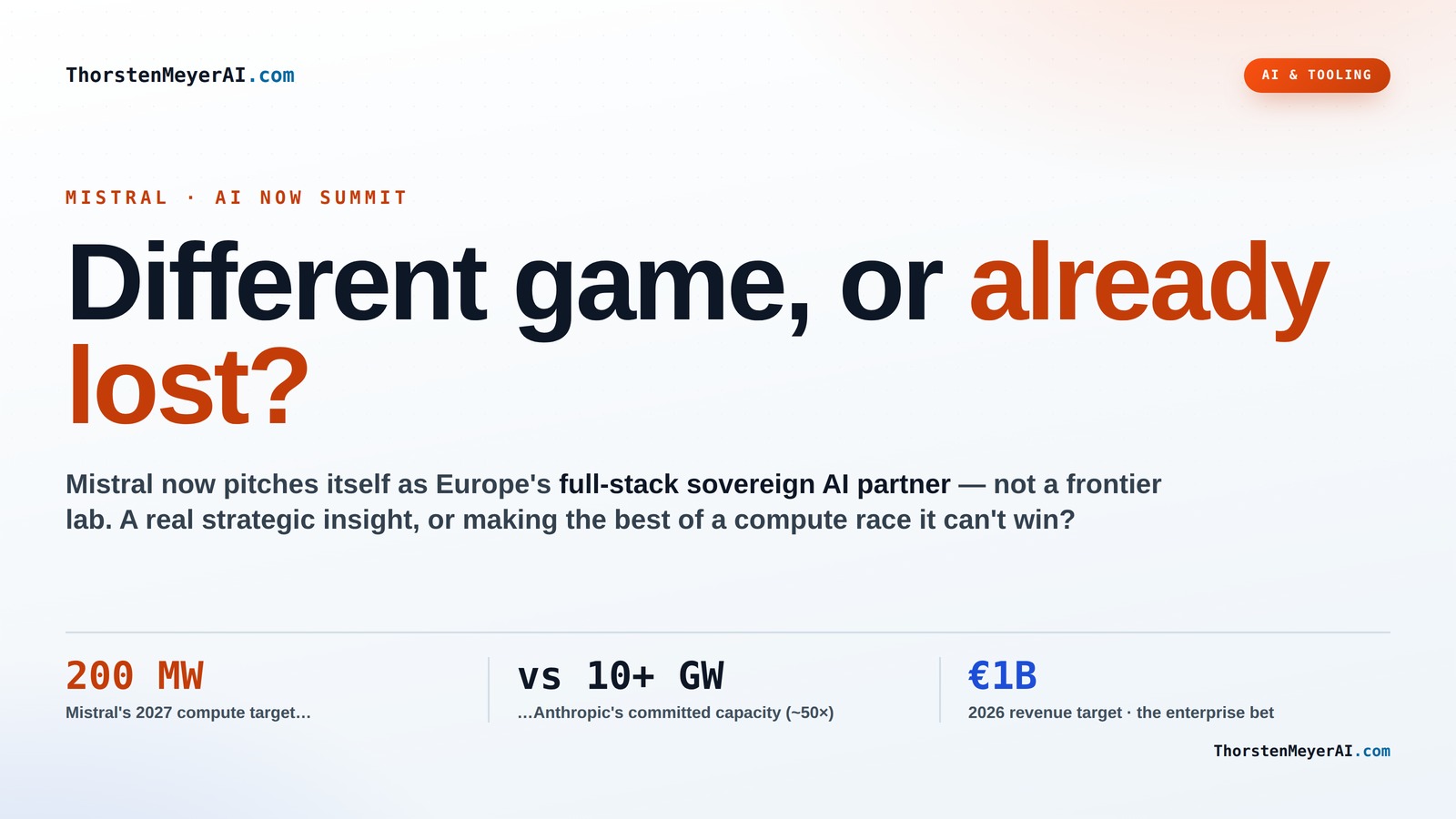
Different game, or already lost?
Mistral now pitches itself as Europe’s full-stack AI provider — compute, models, platform, consultancy — not a frontier-model lab. Is that a real strategic insight, or making the best of a race it can’t win? Both readings fit the same facts.
From model lab to full-stack provider
The clearest signal from the summit wasn’t a model — it was a posture. Heavy on enterprise logos and partnerships (ASML, BNP Paribas, Alexa+), light on new-model announcements. That absence is exactly what skeptics seized on.
Compute
40MW Paris DC + Sweden build · 200MW target by 2027
Models
Open & custom · efficient · you own and run them
Platform
Forge for custom models · Vibe for Work agent
Consultancy
Sales teams, integrators, EU provenance & support
Small & focused, or large & general?
Mistral bets on specialized small models. The claim isn’t that they win a reasoning leaderboard — they don’t. It’s that on the metrics that matter in production agent systems, a purpose-built small model wins. Flip the metric to see the case reverse.
Small specialized vs large general — by what you measure
In token-heavy agentic apps making hundreds of calls, speed/energy/cost compound. Toggle the metric.
Narrow models doing real work
Each is one model doing one thing efficiently — the tangible version of the strategy. Strong on their own terms; the open question is whether the bundle beats a free Chinese open-weight download.
On-prem KYC compliance
Mistral models run inside the bank’s walls for know-your-customer checks. Sensitive financial data never leaves. (BNP was Mistral’s first customer, 2023.)
Voxtral multilingual voice
A focused voice model powering Alexa+ across Europe — speed and efficiency over raw size.
Robostral industrial robotics
Plus a “physics AI” push (via the Emmi acquisition) into aerospace, automotive & semiconductor design and simulation.
Document AI / OCR at scale
Large-scale text extraction — the unglamorous, high-volume enterprise work small models excel at.
The strategy is downstream of the compute gap
Once you see the raw numbers, “why is Mistral behind?” answers itself — and the specialized-small-model strategy starts looking partly like a smart adaptation to a binding constraint, not a pure philosophical choice.
Compute & capital · Mistral vs a frontier leader, this same week
Not a knock — it’s the constraint that forces the efficiency-first, sovereignty-wedge strategy. Adapting intelligently to your position is what good strategy is.
“I want them to win, but I’m worried”
That ambivalence is the most accurate read of where Mistral sits. The enterprise pivot gets read two opposite ways — and both deserve airing.
On-prem, real sales teams, the Koyeb deployment acquisition, EU provenance — exactly what regulated enterprises want, and stickier than consumer mindshare. Targeting €1B revenue in 2026 with 1,000 staff, up from 15 people and one customer in 2023. US closed-API labs structurally can’t match the sovereignty axis.
“Software consultancy with a data center,” not a foundation-model moat. Enterprise B2B is where European startups go when they can’t win consumer or world-scale SaaS. Why pay Mistral on-prem when you could run Qwen free? One paying Le Chat Pro user said the quality gap with frontier labs is now hard to ignore.
Key Takeaways
- Mistral’s sovereignty-focused strategy emphasizes control, open weights, and local deployment—appealing strongly to European regulators and enterprise buyers.
- Its shift from model innovation to full-stack solutions indicates a broader move towards enterprise control and away from just model performance.
- Small, purpose-built models can outperform larger general-purpose models in efficiency, speed, and cost—especially for regulated, local use cases.
- Critics question whether Mistral can match the reasoning and scale of US and Chinese giants, raising the debate: is this a strategic choice or a potential limitation?
- Success depends on balancing technical competitiveness with the growing demand for sovereignty, regulation, and control in AI.
As an affiliate, we earn on qualifying purchases.
What Does Sovereign AI Really Mean? Think Control and Independence
Sovereign AI means having full control over your models and data—no reliance on US or Asian cloud giants. Think of it like owning your house versus renting. You decide who visits, what’s stored inside, and when to upgrade. For European companies, especially banks or defense firms, this control isn’t just nice to have. It’s a must.
For example, BNP Paribas runs Mistral models on-premise, keeping sensitive financial info inside their own servers. This isn’t just about data privacy; it’s about strategic autonomy. When organizations control their AI infrastructure, they reduce exposure to geopolitical risks, such as sudden policy changes or foreign government interference. This independence also allows them to innovate without restrictions imposed by external cloud providers, fostering a more resilient and adaptable AI ecosystem. However, this approach comes with tradeoffs—significant infrastructure costs, the need for specialized expertise, and potential limitations in scaling rapidly compared to cloud-based solutions. The choice to prioritize sovereignty reflects a long-term strategic vision—accepting these tradeoffs for the sake of control and compliance—especially in sectors where trust and security are paramount.

As an affiliate, we earn on qualifying purchases.
Why Europe Is Rooting for Sovereign AI — And Why It Matters
Europe’s push for sovereign AI comes from a deep desire for digital independence. It’s about avoiding monopoly control from US giants like OpenAI, which operate closed APIs. European regulators want models that can run locally, with transparent data handling and clear governance.
Imagine a European bank that fears data leaks or government interference. They prefer models they can host themselves, tweak, and audit. This isn’t just about privacy; it’s about safeguarding economic and national security interests. Sovereignty in AI also aims to prevent dependency on foreign technology, which could be leveraged for geopolitical influence or economic coercion. This strategic stance influences policy, funding, and research priorities across Europe, fostering an ecosystem that values transparency, security, and local innovation. The implications are profound: it could lead to a fragmented AI landscape, where European models are optimized for compliance and control but might lag in raw reasoning power or scale. The challenge is balancing sovereignty with competitiveness—if European models remain less capable, their market share and influence could be limited, affecting Europe's role in shaping global AI standards and technology leadership.

As an affiliate, we earn on qualifying purchases.
Mistral’s Strategy: Open Weights, Full Control, and a Focused Niche
Mistral’s move from a model lab to a full-stack provider isn’t accidental. You can read more about similar shifts in industry insights. They’re betting on open weights, self-hosting, and enterprise control. Their models, like Mistral 7B and Mixtral 8x7B, are designed to be inspected, fine-tuned, and deployed locally.
This strategic choice reflects a deliberate tradeoff between raw performance and control. While larger, closed models like GPT-4 or PaLM might outperform in reasoning or scale, they often come with dependencies on proprietary platforms and cloud services. Mistral’s open weights mean organizations can tailor models precisely to their needs, ensuring compliance with strict regulations and security standards. This approach also reduces vendor lock-in, providing flexibility to switch providers or upgrade systems independently. However, the tradeoff is that these models might not yet match the reasoning depth of larger, proprietary models, especially in complex, multi-turn conversations or reasoning-intensive tasks. The decision to focus on open weights and local deployment signals a long-term vision—prioritizing strategic control and regulatory compliance over brute-force scale, which could reshape market dynamics in Europe and beyond.

As an affiliate, we earn on qualifying purchases.
Small Models, Big Impact: Why Focus on Purpose-Built AI Makes Sense
Mistral champions small, specialized models over giant, all-purpose ones. Instead of chasing GPT-4’s scale, they build models tailored for specific tasks—like OCR, voice, or industrial automation. This isn’t just about efficiency; it’s about strategic advantage. Smaller models can be optimized for particular use cases, enabling faster inference, lower energy consumption, and easier compliance with data regulations. This specialization can lead to higher accuracy in niche applications, making them more appealing for industries with strict security and performance requirements. Learn more about payment processing and fintech insights.
For example, their Voxtral model powers Amazon’s Alexa+ in Europe, handling multilingual voice commands efficiently. These models process hundreds of tokens per second, with lower energy use—crucial for enterprise applications that demand speed, security, and cost-effectiveness. By focusing on purpose-built models, Mistral can provide tailored solutions that outperform general-purpose giants in specific sectors, fostering a more resilient and adaptable AI ecosystem. This approach also reduces the risks associated with large-scale model training, such as high costs and environmental impact, aligning with European values of sustainability and responsible innovation. The tradeoff is that these models may lack the broad reasoning capabilities of larger models but gain in reliability, control, and compliance—key factors for their targeted markets.

Is Mistral Playing a Different Game or Just Falling Behind?
Here's the core question: is Mistral’s focus on sovereignty a strategic choice or a sign it’s losing the race for raw AI power? On one hand, their emphasis on control, open weights, and European markets is a smart differentiation that aligns with regional needs and values. On the other hand, critics argue that Mistral hasn't yet matched the reasoning, reasoning depth, and context handling capabilities of the largest models from OpenAI or Google. This gap could limit their ability to participate in high-end AI applications that demand complex understanding and reasoning at scale.
For instance, while Mistral models excel in efficiency and control, they tend to lag in reasoning accuracy at larger context sizes—something that could be a bottleneck for enterprise or research applications requiring deep comprehension. This performance gap raises questions about whether their sovereignty-focused approach might sacrifice some of the raw reasoning and scale advantages that define the current leadership in AI. The tradeoff involves choosing between strategic control and technical performance. If the market increasingly demands reasoning and scale, Mistral’s approach might struggle to keep pace, risking obsolescence or marginalization in the broader AI ecosystem. Conversely, if control and compliance become the dominant priorities, they may carve out a sustainable niche—though at the expense of broader influence in the global AI race.

What’s Next for Mistral? Opportunities and Risks to Watch
Mistral’s future hinges on their ability to keep pace technically while expanding their sovereignty narrative. Their recent growth shows strong demand from European enterprises hungry for control and compliance. But they face risks—like falling behind in reasoning or scale, and operational complexity from self-hosting.
Consider their plan to build 200MW of European compute capacity by 2027. That’s ambitious, but also expensive, requiring careful strategic planning and significant investment. Meanwhile, the open-weight market continues to evolve fast, with Chinese models like Qwen gaining ground and challenging European ambitions. This rapid evolution could pressure Mistral to innovate swiftly or risk obsolescence. Their success depends on balancing the technical demands of state-of-the-art AI with the strategic need for sovereignty, which may involve tradeoffs between performance, cost, and control. If they can maintain their technical edge while solidifying their position as Europe's trusted sovereign AI provider, they could influence the global landscape—shaping a future where sovereignty and innovation go hand in hand. However, failure to keep up could see them marginalized, especially if larger players leverage their scale to dominate both performance and control.
Frequently Asked Questions
What does 'sovereign AI' really mean in practice?
Sovereign AI means having full control over your models and data—running them on your own servers, managing updates, and ensuring compliance with local regulations. It’s about independence from US or Asian cloud providers and avoiding dependency on closed APIs.
Why do European enterprises prefer open weights over API access?
Open weights allow companies to inspect, fine-tune, and host models locally, meeting strict data privacy and security rules. For regulated industries like banking or defense, this is often non-negotiable, making open weights a strategic priority.
Is Mistral mainly a European story or a globally competitive player?
Right now, Mistral’s strength lies in serving European markets with a sovereignty focus. While its technical performance is promising, it faces stiff competition globally. Their niche is control and regulation, not necessarily outpacing giants in reasoning or scale.
Can Mistral’s small models match the reasoning power of larger models?
Small models are optimized for speed and efficiency, not reasoning complexity. While they excel in specific applications, they generally lag behind large models like GPT-4 in reasoning and context size. The tradeoff is between control and raw power.
Conclusion
Mistral’s real game isn’t just about the models—they’re betting on sovereignty as a strategic advantage. If control, compliance, and local deployment matter more than raw power, they might hold a winning hand. But if size and reasoning capability stay king, they face tough competition.
For now, their focus on European markets and open weights creates a clear, distinct path. The question is whether they can keep pace on the tech front while defending that niche. In AI, it’s not just about the size of the game—it’s about who controls the board.

Columbus Day / Indigenous Peoples' Day Picks
long weekend sales
As an affiliate, we earn on qualifying purchases.