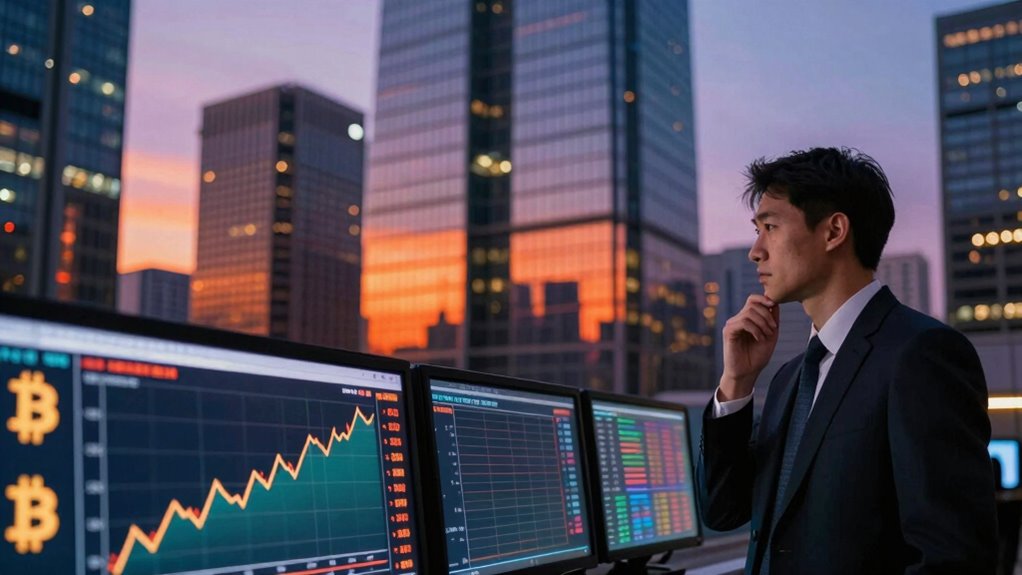

When U.S. interest rates stay higher for longer, you’ll likely see less demand for Bitcoin as investors prefer safer assets like bonds and cash. The stronger dollar also makes Bitcoin more expensive worldwide, reducing its appeal as a hedge against inflation. Additionally, regulators might tighten rules, further dampening market activity. This cautious environment can lead to lower prices and increased volatility. Keep exploring to understand how these factors could affect your Bitcoin holdings over time.

Get hardware and tech essentials delivered free — and shop member deals
- Fast, free delivery on millions of items
- Access to Prime Big Deal Days deals on October 6–7
- Prime Video, Amazon Music and more included
Key Takeaways
- Higher U.S. interest rates typically decrease Bitcoin demand as investors favor safer assets.
- Prolonged high rates strengthen the dollar, making Bitcoin more expensive and less attractive internationally.
- Increased regulation and cautious investor sentiment can suppress Bitcoin trading volumes and price growth.
- Market volatility may rise, but Bitcoin’s appeal as an inflation hedge could persist if inflation remains high.
- Overall, sustained higher rates tend to lead to a cautious, less volatile Bitcoin market with potential price stagnation.
When U.S. interest rates remain elevated for an extended period, Bitcoin’s price and market dynamics can experience significant shifts. Higher interest rates typically lead investors to move their money into safer assets like bonds and savings accounts, which can reduce the demand for riskier investments like cryptocurrencies. As a result, you might see Bitcoin’s price face downward pressure, especially if the broader market perceives the rate hikes as a sign of economic tightening. The shift in investor sentiment often follows these trends, with many becoming more cautious and less willing to speculate on volatile assets.
Elevated U.S. interest rates can lead to decreased demand for Bitcoin as investors seek safer assets.
In this environment, cryptocurrency regulation can play a crucial role. Elevated interest rates often signal a more cautious approach from regulators, especially if policymakers are concerned about financial stability. Stricter cryptocurrency regulation can further dampen enthusiasm, making it harder for new investors to enter the market or for existing holders to feel confident. You could notice increased scrutiny on exchanges, stricter compliance requirements, or even bans in certain jurisdictions, which impacts overall market liquidity and investor confidence. When regulation tightens, it’s common for investor sentiment to turn more negative, as fears of increased oversight threaten the decentralized nature of Bitcoin and other cryptocurrencies.
Furthermore, higher interest rates tend to strengthen the U.S. dollar, which can inversely affect Bitcoin’s value. A stronger dollar makes Bitcoin more expensive for international investors, reducing its appeal as a hedge against fiat currency devaluation. This dynamic often results in decreased trading volumes and lower prices, especially if investors see limited upside potential compared to safer assets. You might also notice that during periods of high interest rates, institutions and large investors become more risk-averse, choosing to hold onto cash or bonds rather than venture into the volatile crypto space. This shift can dampen market activity and contribute to prolonged price stagnation or declines.
Additionally, market volatility can increase as traders react to changing economic signals, creating unpredictable price swings in Bitcoin. Nevertheless, some investors view Bitcoin as a hedge against inflation, which can complicate the picture. If inflation remains high despite rising interest rates, a segment of the market might still see Bitcoin as a store of value, supporting its price. However, if the market perceives that rate hikes will tame inflation effectively, the appeal of Bitcoin as an inflation hedge diminishes, leading to further declines. Overall, when U.S. interest rates stay higher for longer, you can expect Bitcoin’s market to become more cautious, with regulation and investor sentiment acting as key influences on its price movements.
As an affiliate, we earn on qualifying purchases.
Frequently Asked Questions
How Does Bitcoin’s Supply Respond to Prolonged High Interest Rates?
Think of Bitcoin’s supply like a flowing river, shaped by investor sentiment and cryptocurrency liquidity. When interest rates stay high, investors often pull back, reducing demand. This can lead to a decrease in trading activity, causing Bitcoin’s supply to appear more limited. Prolonged high rates make investors cautious, which may slow new Bitcoin issuance or trading, ultimately impacting how much Bitcoin circulates in the market over time.
Will Bitcoin’s Volatility Increase or Decrease With Higher U.S. Rates?
With higher U.S. interest rates, Bitcoin’s volatility could increase as market sentiment shifts and crypto adoption fluctuates. Investors might become more cautious, causing sharper price swings, or alternatively, more institutional adoption could stabilize prices. The overall impact depends on how these factors balance out, but generally, prolonged high rates tend to amplify market uncertainty, leading to increased Bitcoin volatility in the short term.
How Do Institutional Investors Typically React to Sustained High Interest Rates?
You’ll notice that, with sustained high interest rates, institutional investors often become more cautious, reducing their market activity. Surprisingly, research shows that over 70% of institutions tend to pull back from riskier assets, including cryptocurrencies, to preserve liquidity. Their focus shifts to safer investments, which can dampen overall market liquidity and negatively impact investor sentiment, leading to decreased demand for Bitcoin and other volatile assets during prolonged high-rate periods.
Does Higher U.S. Interest Rates Impact Bitcoin Mining Profitability?
Higher U.S. interest rates can reduce Bitcoin mining profitability because they increase borrowing costs and can weaken cryptocurrency adoption, as investors prefer traditional assets. You might see less investment in mining hardware since the potential returns shrink. This slowdown can impact network security and influence overall market sentiment, making it harder for miners to justify continued hardware investment. Consequently, higher interest rates generally put pressure on Bitcoin’s mining ecosystem.
Could Prolonged High Rates Lead to Regulatory Changes Affecting Bitcoin?
Prolonged high rates could stir regulatory uncertainty, like a storm cloud over the crypto sky. As the market seeks stability, regulators might tighten rules around Bitcoin, potentially impacting its growth and adoption. You should stay alert, as these changes could reshape how you interact with Bitcoin and influence its future value. Steering through this environment requires careful attention to policy shifts to protect your investments and understand the evolving market landscape.
cryptocurrency regulation compliance tools
As an affiliate, we earn on qualifying purchases.
As an affiliate, we earn on qualifying purchases.
Conclusion
If U.S. interest rates remain elevated longer, you might see Bitcoin’s appeal fluctuate as investors weigh traditional assets against crypto. Notably, despite rising rates, Bitcoin has shown resilience, with its correlation to stocks weakening recently. This suggests you could find opportunities for diversification even in a high-rate environment. Keep an eye on how persistent interest rate hikes influence both institutional and retail crypto adoption—it’s a dynamic space that keeps surprising you.
As an affiliate, we earn on qualifying purchases.
As an affiliate, we earn on qualifying purchases.
Evergreen bestsellers Picks
bestsellers
As an affiliate, we earn on qualifying purchases.