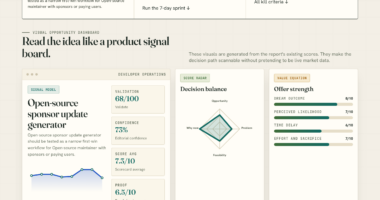
📊 Full opportunity report: Why AI Black Boxes Could Become A Security Weakness For Alliances on ThorstenMeyerAI.com — validation score, market gap, and execution plan.

Get hardware and tech essentials delivered free — and shop member deals
- Fast, free delivery on millions of items
- Access to Prime Big Deal Days deals on October 6–7
- Prime Video, Amazon Music and more included
TL;DR
AI black boxes and complex supply chains threaten NATO security by creating vulnerabilities that are difficult to inspect or control. Dependency on foreign components may undermine military and civilian infrastructure integrity.
Recent security analyses warn that the increasing use of opaque AI systems and complex supply chains could create new vulnerabilities for NATO allies, potentially undermining military and civilian infrastructure. These concerns are gaining attention as alliances expand their reliance on foreign technology and software, raising questions about control and trust in critical systems.
Experts point out that AI ‘black boxes’ — systems whose internal workings are not transparent — pose a significant security risk because they are difficult to inspect, verify, or repair without external permission. NATO officials acknowledge that much of the alliance’s infrastructure depends on civilian assets, including satellites, networks, and logistics software, which are increasingly integrated with AI and foreign components.
Recent policy shifts, such as the UK’s decision to phase out Huawei equipment from 5G networks by 2027, illustrate the recognition that dependency on foreign vendors can become a strategic vulnerability. These dependencies transfer leverage to external actors, especially if the supply chain involves components or software controlled by potential adversaries. The challenge is compounded by the fact that many critical systems rely on proprietary or opaque AI algorithms, often developed and maintained by third-party vendors outside NATO’s direct oversight.
While NATO emphasizes that not all foreign-made equipment is inherently insecure, officials stress that control over software updates, keys, and maintenance must be assured to prevent potential sabotage or espionage. The core issue is whether the alliance can operate, repair, and update systems without external permission, especially if those systems depend on components from strategic competitors.
Friendly fire at alliance scale: what Chinese equipment in NATO networks actually means
Yesterday: Ukraine may have turned a Russian unit’s identification layer against its own jet. Today’s question doesn’t require that to be true. It requires only that the concept be plausible — and then asks what it means when NATO’s own identification layer is built on equipment from a country whose law compels its companies to cooperate with intelligence on demand.
Any Chinese entity — any company, any employee, anywhere — must assist national intelligence work when asked. No carve-out for foreign deployments. No judicial review. No refusal option. When Beijing asks Huawei for access, Huawei must provide it. The law doesn’t distinguish between Shenzhen and Stuttgart. It doesn’t distinguish between civilian and NATO. This is not theoretical. It is operational law.
Requires no reconnaissance. The companies manufactured and installed the equipment. They have the source code, firmware, manufacturing tolerances, and update pipeline — the reconnaissance was completed before the adversary was even identified as one. A stronger position than what InformNapalm claims Ukraine achieved.
The question isn’t whether China will use this access. It’s whether NATO can afford to assume it won’t. Three things follow. Replacement is genuinely hard — banning without building the supply chain produces capability gaps, not security. The identification layer is where the exposure is sharpest — a Chinese motor is a supply-chain risk; a Chinese sensor or processor in an IFF system is an identification-layer risk, the same class the BARS Moscow story made visible. And the open-weight argument applies here — but stops short: open weights give you visibility into the classification model; they don’t give you visibility into the silicon it runs on. NATO has thirty-two members, each with its own procurement history. Together they’ve built an identification layer with distributed, unaudited, legally-accessible dependencies on a potential adversary. BARS Moscow required weeks of reconnaissance. The reconnaissance for NATO’s version was completed in the factory.
Potential Security Risks from Opaque AI and Foreign Supply Chains
This development matters because vulnerabilities in AI black boxes and supply chains could enable external actors to manipulate or disable critical infrastructure during conflicts or crises. As NATO’s reliance on civilian assets grows, so does the risk that adversaries could exploit hidden vulnerabilities, leading to compromised communications, logistics failures, or even targeted cyberattacks. The inability to verify or control AI systems without external approval raises questions about the resilience and independence of alliance infrastructure, potentially undermining military effectiveness and civilian safety.
As an affiliate, we earn on qualifying purchases.
Growing Dependence on Foreign Technology in NATO Infrastructure
NATO’s expanding cooperation with non-member partners like Australia, South Korea, and Japan involves integrating foreign-produced sensors, software, and hardware into its military and civilian infrastructure. These components often contain proprietary AI algorithms and software that are opaque and difficult to inspect or modify without external access. Past incidents, such as the EU’s assessment of Huawei and ZTE’s risks in 2023, have demonstrated how dependencies on foreign vendors can pose strategic vulnerabilities, especially when supply chains are influenced by foreign governments or corporate governance structures.
The UK’s decision to remove Huawei from its 5G networks by 2027 exemplifies the recognition that supply chain dependencies can become costly and complex to unwind once deeply embedded. Experts warn that the broader integration of AI systems with civilian infrastructure—such as energy grids, transportation, and logistics—further amplifies these vulnerabilities, blurring the lines between military and civilian assets.
“We cannot guarantee the future security of Huawei equipment after supply chain changes, leading us to remove it from our networks.”
— UK government spokesperson
supply chain security monitoring tools
As an affiliate, we earn on qualifying purchases.
As an affiliate, we earn on qualifying purchases.
Unclear Extent of AI Black Box Vulnerabilities in NATO Systems
It is not yet clear how widespread or exploitable vulnerabilities in AI black boxes are within NATO’s infrastructure. Specific cases of sabotage or manipulation have not been publicly confirmed, and the technical capabilities of adversaries to exploit these vulnerabilities remain uncertain. Additionally, the effectiveness of current inspection and control measures is still under assessment, and NATO is exploring new strategies to mitigate these risks.
military-grade network security hardware
As an affiliate, we earn on qualifying purchases.
As an affiliate, we earn on qualifying purchases.
NATO Policy and Technical Measures to Address AI Risks
Expect NATO to accelerate efforts to develop standards for AI transparency and control, including stricter supply chain vetting and certification processes. Alliance members are also likely to invest in developing internal AI capabilities that are fully auditable and controllable, reducing reliance on opaque foreign systems. Policy discussions around establishing operational protocols for managing AI vulnerabilities during crises are expected to intensify in the coming months.
foreign component supply chain risk assessment
As an affiliate, we earn on qualifying purchases.
As an affiliate, we earn on qualifying purchases.
Key Questions
What are AI black boxes, and why are they a security concern?
AI black boxes are systems whose internal decision-making processes are opaque or not easily understood. They pose security risks because their lack of transparency makes it difficult to verify, inspect, or repair them without external permission, potentially allowing external actors to manipulate or disable critical systems.
How does supply chain dependency affect NATO security?
Dependence on foreign components or software controlled by potential adversaries can transfer leverage to external actors, making critical infrastructure vulnerable to sabotage, espionage, or disruption during conflicts or crises.
Are all foreign-made systems inherently insecure?
No, not all are insecure. The risk depends on whether NATO can independently inspect, operate, and maintain these systems without external approval. Control over updates, keys, and maintenance is key to security.
What steps is NATO taking to mitigate these risks?
NATO is developing standards for AI transparency, vetting supply chains more strictly, and investing in internal AI capabilities that are fully auditable and controllable to reduce reliance on opaque foreign systems.
Source: ThorstenMeyerAI.com
Fall Picks
fall essentials
As an affiliate, we earn on qualifying purchases.