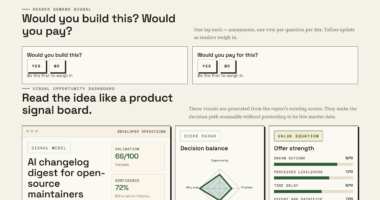

📊 Full opportunity report: Eight Weeks Of AI Innovation: China’s Signal Launches Four Frontier Models on ThorstenMeyerAI.com — validation score, market gap, and execution plan.

Get hardware and tech essentials delivered free with Prime
- Fast, free delivery on millions of items
- Prime Video, Amazon Music and more included
- Member-only deals all year
TL;DR
Over eight weeks in mid-2026, Chinese labs launched four advanced open-weight AI models, marking a significant increase in AI development cadence. These models are accessible, affordable, and impacting global AI strategies.
Chinese AI laboratories have released four frontier-class open-weight models in just over two months, from late April to mid-June 2026, marking a rapid acceleration in AI development. These models, including DeepSeek V4, MiniMax M3, Kimi K2.7-Code, and GLM-5.2, are all downloadable, mostly under permissive licenses, and priced significantly lower than Western API offerings. This surge underscores a shift in the global AI landscape, with Chinese labs leading in open-weight model capability and cadence.
Between late April and mid-June 2026, Chinese research labs released four frontier-class open-weight models, each representing a significant step forward in AI capability and accessibility. Notably, DeepSeek V4, released on April 24, 2026, leads the Chinese field with an overall score of 87 on BenchLM’s July rankings, just six points behind the proprietary leader at 93. DeepSeek V4 features 1.6 trillion total parameters but activates only 49 billion per pass, with a 1-million-token context window, and is priced at the low end of the market, making it highly accessible.
Following it, MiniMax M3 was released on June 1, 2026, and the Kimi K2.7-Code and GLM-5.2 models appeared within days of each other in mid-June. These models are all downloadable, with most under MIT-class licenses, and are part of a broader Chinese effort to rapidly expand open-weight AI capabilities. Chinese labs such as DeepSeek, Z.ai, Moonshot, and Alibaba each focus on different strategic priorities, from cost-effective models to long-horizon stability and broad self-hosting options.
Meanwhile, the Western open-weight AI landscape has seen a decline in major releases, with Meta’s flagship effort stalling and the strongest open-source models, like Ai2’s Olmo 3, trailing behind Chinese counterparts in raw capability. As of mid-2026, four of the five most capable open-weight model families are from Chinese labs, marking a significant shift in global AI power dynamics.
Four Frontier-Class Open Models in Eight Weeks
China’s Release Cadence Is the Story
Same-day-verified market pulse · July 13, 2026
The production line — spring 2026
The board this week — BenchLM overall score, July 2026
Gift & complication — the European read
The gift
Frontier-adjacent capability, permissive licenses, weeks-long refresh cycle. This cadence is what makes serious on-premises AI economically thinkable in 2026.
The complication
Still a dependency — geopolitical, not technical. Hosted Chinese APIs fall under Chinese data law; many Western agencies won’t touch the weights at all. Licensing generosity is a policy, not a law of nature.
The signal: if your infrastructure strategy assumes open models improve slowly, it’s already wrong. If it assumes the current licensing generosity is permanent, it’s unhedged.
Rapid Chinese AI Release Cadence Reshapes Global AI Power
The swift release cycle of Chinese frontier models signifies a dramatic acceleration in AI development, challenging Western dominance in open-weight models. This rapid cadence reduces the capability gap and transforms the economics of self-hosted AI, especially for sovereign or local-first deployments. It also signals a strategic response to hardware scarcity and export controls, with China establishing a dominant position in open-weight AI infrastructure. For developers and policymakers worldwide, this shift impacts AI sovereignty, licensing strategies, and geopolitical considerations, as Chinese models become more capable and accessible within weeks of each other.
As an affiliate, we earn on qualifying purchases.
Chinese AI Development Accelerates Amid Global Shifts
Over the past two years, Chinese labs have significantly expanded their open-weight AI capabilities. In 2024, the Chinese open field was limited to a single lab, but by mid-2026, four major labs—DeepSeek, Z.ai, Moonshot, and Alibaba—each offer distinct models that compete with Western efforts. The recent releases follow a pattern of rapid, frequent launches, contrasting with slower Western development, which has seen efforts like Meta’s stall and open-source models lag behind Chinese counterparts in raw capability. This surge is partly driven by hardware efficiency breakthroughs and strategic responses to US export controls, aiming to establish China as the dominant source of open-weight AI models.
“The Chinese release cadence over eight weeks is unprecedented and indicates a move towards a production line of frontier models, not just isolated releases.”
— an anonymous researcher
As an affiliate, we earn on qualifying purchases.
Uncertain Duration of Chinese Model Leadership and Export Policies
It remains unclear how long the rapid release cadence will continue and whether licensing terms or export policies from China may change. The window for open Chinese models to dominate is potentially temporary, as geopolitical factors and export controls could shift, impacting access and licensing. Additionally, US federal restrictions on Chinese models, such as banning DeepSeek on government devices, complicate their adoption in regulated environments. The sustainability of this rapid development cycle and its implications for global AI leadership are still developing.
As an affiliate, we earn on qualifying purchases.
Next Steps in Chinese AI Deployment and Global Response
Further Chinese model releases are expected in the coming months, with ongoing improvements in capability and licensing. Western AI efforts may attempt to counterbalance this surge through new releases or strategic alliances, but the current trend suggests Chinese labs are establishing a dominant position in open-weight AI. Developers and organizations will need to reassess their infrastructure strategies, considering the rapid pace of open Chinese models and potential geopolitical restrictions. Monitoring export policies and licensing changes will be critical in the near future.
AI development toolkit for programmers
As an affiliate, we earn on qualifying purchases.
As an affiliate, we earn on qualifying purchases.
Key Questions
How do Chinese open-weight models compare to Western ones?
Chinese models like DeepSeek V4 and GLM-5.2 are rapidly closing the capability gap with Western models, with some Chinese models scoring near proprietary leaders on benchmarks. They are also more accessible and affordable, with permissive licenses and larger context windows.
Are these Chinese models usable in regulated environments?
While the weights are downloadable and legal in many jurisdictions, US federal agencies have banned Chinese models like DeepSeek on government devices. Hosted Chinese APIs are subject to Chinese data laws, which may disqualify them for sensitive or regulated workloads in Western countries.
Will this rapid release cycle continue?
It is uncertain. The current cadence appears partly driven by hardware efficiency needs and strategic considerations. Future releases depend on geopolitical developments, licensing policies, and hardware innovations, which could slow or accelerate the pace.
What does this mean for AI sovereignty in Europe?
The rapid Chinese model releases make on-premises AI more economically feasible, but dependencies remain. European organizations may need to adapt their strategies, balancing access to Chinese models with sovereignty concerns and regulatory compliance.
Could Western efforts catch up or surpass Chinese models?
While Western labs are still developing, the current slowdown and Chinese cadence suggest they are lagging behind in speed. However, breakthroughs or policy changes could alter this dynamic in the future.
Source: ThorstenMeyerAI.com
Halloween Picks
halloween
As an affiliate, we earn on qualifying purchases.