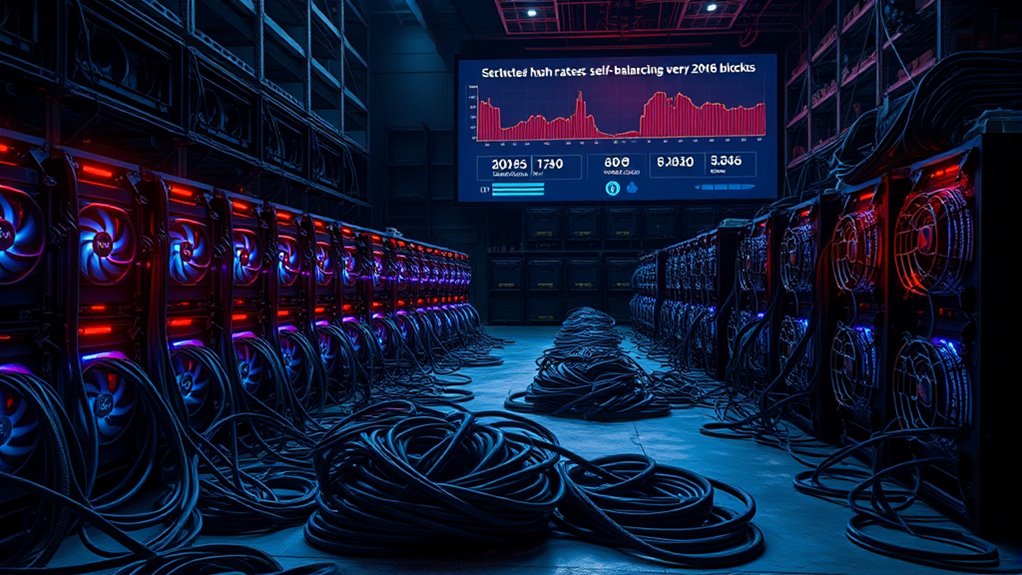

Mining difficulty adjusts every 2,016 blocks—roughly two weeks—to keep your network producing blocks about every 10 minutes. If miners find blocks faster, difficulty increases; if slower, it decreases. This self-balancing system responds automatically to changes in total computing power, ensuring the flow stays steady, preventing inflation, and safeguarding security. Want to understand how this dynamic process maintains stability? Keep exploring to discover more about this intelligent network design.

Get hardware and tech essentials delivered free with Prime
- Fast, free delivery on millions of items
- Prime Video, Amazon Music and more included
- Member-only deals all year
Key Takeaways
- The network adjusts mining difficulty every 2,016 blocks based on the time taken to mine the previous period.
- If blocks are mined faster than 10 minutes, difficulty increases; if slower, it decreases.
- This automatic adjustment maintains a consistent average block time of roughly 10 minutes.
- Changes respond to real-time network hash rate, miner participation, and hardware efficiency.
- The self-balancing mechanism ensures network security, prevents inflation, and stabilizes coin issuance.

Have you ever wondered how Bitcoin maintains a steady rate of new block creation? It all boils down to the concept of mining difficulty, which measures how hard it is to find a new block on the blockchain. Miners need to solve complex math problems to validate transactions and secure the network. The purpose of this difficulty is to keep the block production rate predictable, aiming for roughly one block every 10 minutes, regardless of how many miners are participating or how powerful their hardware becomes. This self-adjusting mechanism prevents rapid, uncontrolled issuance of new coins, which could cause inflation and devalue Bitcoin. It also makes it economically unfeasible for any single entity to dominate the network—an important safeguard against 51% attacks.
Bitcoin’s mining difficulty adjusts every two weeks to keep block creation steady at roughly one every 10 minutes.
The difficulty isn’t set arbitrarily. Instead, it’s recalculated every 2,016 blocks, which is approximately every two weeks. The adjustment depends on how long it took to mine the previous 2,016 blocks. If miners sped up and the average block time drops below 10 minutes, the difficulty increases, making puzzles harder to solve. Conversely, if blocks take longer than 10 minutes, the difficulty decreases to ease the challenge. The adjustment formula compares the total time taken to mine those blocks with the ideal two-week period (about 20,160 minutes). If the actual time is less, difficulty goes up; if more, it goes down. This automatic recalibration keeps the network on track without human intervention. This process is an example of a self-regulating system.
Several factors influence the difficulty setting. The primary one is the total network hash rate—the combined computational power of all miners. When more miners join or existing hardware becomes more efficient, the hash rate increases, prompting the difficulty to rise. Market conditions, such as Bitcoin’s price surges, often attract more miners, which can also push difficulty higher. Conversely, external factors like regulatory crackdowns or rising energy costs can reduce the number of active miners, causing difficulty to drop. The system’s design ensures that, regardless of these shifts, the network continues to produce blocks roughly every 10 minutes. [The difficulty also responds to technological advancements in mining hardware, which can significantly impact the network’s overall hash rate.
As an affiliate, we earn on qualifying purchases.
Frequently Asked Questions
How Does Mining Difficulty Impact Bitcoin’s Overall Security?
Mining difficulty directly impacts Bitcoin’s security by making it increasingly costly and resource-intensive to tamper with the blockchain. When difficulty rises, you’d need even more computational power to alter past transactions or execute double-spends, deterring attacks. This self-adjusting process keeps the network resistant to malicious attempts, ensuring the integrity of transactions. As difficulty adapts, it maintains a secure, decentralized system that’s hard for any single entity to control or compromise.
Can Mining Difficulty Adjustments Influence Transaction Speeds?
Think of mining difficulty as the throttle on a race car—it controls how fast or slow the network runs. While difficulty adjustments don’t directly change transaction speeds, they keep block times steady, like a steady heartbeat. When difficulty rises, blocks take longer, possibly delaying transactions. If it lowers, blocks come faster, risking overload. So, your network stays smooth and reliable, ensuring transactions process predictably every time.
What Happens if Mining Difficulty Becomes Too High?
If mining difficulty becomes too high, you’ll notice several impacts. Your chances of successfully mining a block decrease, lowering your rewards and increasing operational costs. Transaction confirmation times slow down, leading to delays and higher fees as users compete for space. Smaller miners may be forced out, causing centralization. Overall, the network may become less efficient and secure, risking reduced usability and potential vulnerabilities if fewer entities control the mining power.
How Do Miners Respond to Sudden Difficulty Changes?
You respond to sudden difficulty changes by quickly adjusting your mining operations. If difficulty spikes, you might upgrade hardware or optimize your rigs to keep mining profitable. When difficulty drops, you could reduce power use or pause mining if it’s no longer worthwhile. Miners also shift strategies, reallocate hash power, or even exit or re-enter the network based on profitability, ensuring you stay competitive and adapt smoothly to network fluctuations.
Is Mining Difficulty Adjustment Predictable or Random?
Just like clockwork, the mining difficulty adjustment isn’t random; it’s predictable. Every 2,016 blocks, the network automatically recalculates difficulty based on how long it took to mine those blocks. You can count on this process being transparent and rule-based, adjusting difficulty up or down according to measurable data like hash rate and block times. This guarantees the system stays steady, not left to chance or randomness.
As an affiliate, we earn on qualifying purchases.
Conclusion
As you watch the network shift and sway like a busy river, mining difficulty adjusts every 2,016 blocks to keep the flow steady. Picture miners as paddle-wielding boaters, steering through changing currents, ensuring the stream of new blocks remains smooth. This self-balancing dance keeps the blockchain steady and secure, no matter how many boats join or leave the river. It’s a relentless, dynamic rhythm that keeps the entire system humming along seamlessly, no matter what comes downstream.
As an affiliate, we earn on qualifying purchases.
As an affiliate, we earn on qualifying purchases.
Fall Picks
fall essentials
As an affiliate, we earn on qualifying purchases.