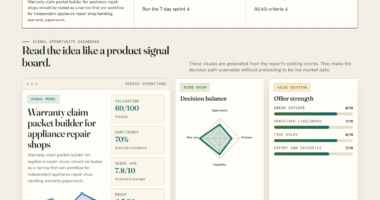

📊 Full opportunity report: Why AI, Once Adopted, Becomes Difficult To Replace on ThorstenMeyerAI.com — validation score, market gap, and execution plan.

Get hardware and tech essentials delivered free with Prime
- Fast, free delivery on millions of items
- Prime Video, Amazon Music and more included
- Member-only deals all year
TL;DR
Despite slow adoption, incumbents in enterprise AI remain difficult to displace because their structural advantages create high switching costs. This inertia acts as a moat, making them resilient against disruption.
Established enterprises that are slow to adopt AI are proving remarkably difficult to displace, despite predictions of rapid disruption. Their structural advantages and embedded data systems create a high barrier for challengers, making these incumbents durable even as they integrate AI gradually.
Recent industry analysis shows that major enterprise AI platforms, such as Microsoft Copilot, Salesforce’s Agentforce, and SAP’s Joule, have become the dominant operational control points within their sectors. These platforms are not only widely adopted but also deeply integrated into core workflows, making them difficult for competitors to dislodge.
Research from consulting firms like BCG indicates that in an AI-driven world, incumbents possess critical structural advantages, including trust, governance, and data control, which create high switching costs. These factors contribute to a ‘moat’ that protects their market position, even while their AI adoption remains slow due to organizational inertia.
By 2026, industry leaders have converged on similar architectures—agents operating on trusted enterprise data with embedded governance—further reinforcing the incumbents’ dominance. Disruptors often mistake slow adoption as vulnerability, but this slowness actually underpins their durability, making rapid displacement unlikely.
Incumbents are painfully slow to adopt AI — and remarkably hard to displace. How can both be true? They’re the same fact wearing two faces.
- 95% of pilots deliver nothing
- The internal customer resists
- Two-year timelines to change
- Built to resist transformation
- Absorb most enterprise AI spend
- Became the “control planes”
- Two years no rival can rip it away
- BCG: “a clear right to win”
Implications of AI-Induced Entrenchment in Enterprises
This analysis reveals that the slow pace of AI adoption in large enterprises does not equate to vulnerability. Instead, their entrenched systems and data governance create high barriers to exit, making them resilient against disruption. For AI challengers, this means that capturing market share requires more than just technological innovation; they must overcome structural and organizational hurdles. Understanding this dynamic is crucial for investors, vendors, and strategists aiming to navigate the evolving enterprise AI landscape.As an affiliate, we earn on qualifying purchases.
How Incumbents Built Durability Through AI Integration
Historically, enterprise systems of record—such as SAP, Microsoft 365, and ServiceNow—have been slow to change due to their complexity and the high costs associated with ripping and replacing core infrastructure. Despite predictions of rapid disruption, these incumbents have effectively absorbed AI into their existing platforms, turning them into 'operational control planes' for enterprise AI.
Throughout 2025 and 2026, major vendors shifted their focus from differentiation to convergence, adopting similar architectures that leverage trusted data, governance, and workflow integration. This shift reinforced the incumbents' positions, as the new AI capabilities became embedded within their core offerings, making replacement more difficult.
Analysts like those from BCG have emphasized that in an AI-first world, incumbents' structural advantages—such as data control and regulatory compliance—are key to maintaining dominance, even if their initial AI adoption was slow.
"The very inertia that makes an incumbent slow to change is the moat that makes it hard to dislodge."
— Thorsten Meyer
As an affiliate, we earn on qualifying purchases.
Unresolved Questions About Disruption and Durability
It remains unclear how long incumbents can sustain their dominance as AI technology and organizational practices continue to evolve. The pace of regulatory changes, shifts in organizational culture, and technological breakthroughs could alter the current landscape. Additionally, some smaller challengers are experimenting with novel AI architectures that might bypass traditional moats, but their impact has yet to be seen.
As an affiliate, we earn on qualifying purchases.
Future Developments in Enterprise AI Competition
Next steps include monitoring how incumbents further embed AI into their core systems and whether challengers can develop innovative approaches to overcome high switching costs. Watch for potential shifts in regulatory environments and customer preferences that could either reinforce or weaken incumbent advantages. Industry leaders are likely to continue converging on similar architectures, making differentiation increasingly challenging.
As an affiliate, we earn on qualifying purchases.
Key Questions
Why are large enterprises slow to adopt AI?
Major factors include organizational inertia, high switching costs, and the complexity of integrating AI into existing core systems, which makes rapid adoption difficult.
Why are incumbents difficult to displace even with AI?
Incumbents benefit from embedded trust, governance, and data control, creating high barriers to exit that protect their market position despite slow AI adoption.
Can challengers still disrupt the market?
Disruptors face significant structural hurdles, but innovations that bypass traditional data and governance moats could change the landscape. Their success depends on overcoming high switching costs and establishing new distribution channels.
What role does data gravity play in this dynamic?
Data gravity—where core data resides—makes it costly and difficult for competitors to replace incumbents, as AI models depend on trusted, governed data that incumbents already control.
Source: ThorstenMeyerAI.com
Fall Picks
fall essentials
As an affiliate, we earn on qualifying purchases.