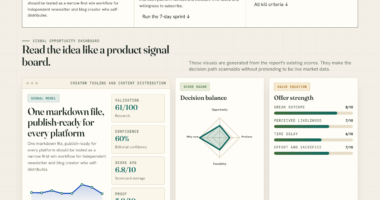

📊 Full opportunity report: The policy menu. There’s no single answer. There’s a menu — and choosing is a values choice in disguise. on ThorstenMeyerAI.com — validation score, market gap, and execution plan.

Get hardware and tech essentials delivered free — and shop member deals
- Fast, free delivery on millions of items
- Access to Prime Big Deal Days deals on October 6–7
- Prime Video, Amazon Music and more included
TL;DR
There is no single correct policy response to the economic changes caused by AI. Instead, there is a menu of options, each aligned with different values. Choosing among them involves moral and societal considerations, not just technical analysis.
Thorsten Meyer’s latest dispatch argues that there is no single answer to managing the economic shifts caused by AI; instead, policymakers face a menu of options, each reflecting different societal values.
Meyer’s analysis outlines four main responses: doing nothing, implementing universal basic income (UBI), promoting broad-based ownership (UBC), and funding through data dividends or sovereign wealth funds. Each option has strengths and weaknesses, and none is definitively correct. The core issue is that these choices are rooted in moral and societal values, not purely technical factors. The debate often collapses into arguments over which response is best, but Meyer emphasizes that the real challenge is selecting the option most robust against uncertainty about whether the labor-share shift is real. The analysis highlights that funding mechanisms—whether taxing workers or wealth—are central to these debates and often overshadow the actual policy choices. Meyer advocates for transparency about these value-based trade-offs and stresses that the decision-making process should focus on minimizing harm under uncertainty.The policy menu.
There’s no single answer.
There’s a menu — and
choosing is a values
choice in disguise.
shift isn’t real, catastrophic if it is
dignifying · fiscally heavy, cause-blind
robust · but slow, concentration-prone
under the question · funds either
The honest service is the menu itself: here are the options, here is what each optimizes for and trades away, here is the funding axis that matters more than the fight everyone is having. The decision is yours, the tradeoffs are real, and the one thing you should not accept is anyone telling you it’s obvious.Thorsten Meyer · The Policy Menu · Post-Labor 03 · Capstone
Why Policy Choices in the AI Era Are Moral Decisions
This analysis underscores that responses to AI-driven economic change are fundamentally moral choices, not purely technical ones. The different policy options reflect societal priorities—security, fairness, agency—and the debate is often clouded by misrepresented facts. Recognizing this shifts the discussion from seeking a single ‘correct’ answer to understanding which options align best with societal values and which are most resilient under uncertainty. For policymakers and the public, this means embracing a transparent menu of responses and acknowledging the moral stakes involved. The debate’s outcome will shape the future distribution of wealth, ownership, and societal stability amid rapid technological change.universal basic income implementation guide
As an affiliate, we earn on qualifying purchases.
As an affiliate, we earn on qualifying purchases.
The Evolution of Economic Responses to AI and Automation
The discussion about managing AI’s economic impact has evolved over recent years, with debates centering on whether broad-based capital ownership, income redistribution, or do-nothing approaches are best. Previous analyses have tested the premise that AI shifts favor capital over labor, but conclusive evidence remains elusive. Meyer’s dispatch builds on earlier work that questioned the certainty of labor-share decline and emphasizes that responses depend on societal values rather than purely economic facts. The series culminates in this final dispatch, which presents a comprehensive menu rather than a single solution, emphasizing the importance of moral judgment in policy choices.“A policy menu is honest only when each option is presented as its strongest advocates would present it and critiqued as its strongest critics would critique it.”
— Thorsten Meyer
As an affiliate, we earn on qualifying purchases.
It remains unclear whether the labor-share shift caused by AI and automation is occurring at a scale significant enough to warrant policy change. The dispatch notes that current evidence is inconclusive, and the effectiveness of each policy option depends heavily on future developments and societal values. The robustness of these responses under different scenarios is uncertain, making it difficult to recommend a definitive course of action.
As an affiliate, we earn on qualifying purchases.
Next Steps in Policy Development and Public Deliberation
Policymakers and stakeholders are encouraged to openly discuss the values underlying each option and consider their resilience under uncertainty. Further research is needed to better understand the labor-share dynamics and the long-term impacts of different policy choices. Public debate should focus on the moral and societal trade-offs, with attention to how funding mechanisms influence the feasibility and fairness of responses. The series suggests that no single policy will be perfect, but transparent, value-driven decision-making can help guide society through the transition.
As an affiliate, we earn on qualifying purchases.
Key Questions
What are the main policy options for managing AI-driven economic change?
The main options include doing nothing, implementing universal basic income (UBI), promoting broad-based ownership (UBC), and funding responses through data dividends or sovereign wealth funds. Each reflects different societal priorities and trade-offs.
Because the evidence about the labor-share shift is uncertain, and societal values play a central role, there is no objectively correct answer. The menu approach allows for transparent comparison of options based on what they optimize for and their trade-offs.
What role do funding mechanisms play in these policy responses?
Funding sources—whether taxing workers or wealth—are central to the debate. They influence the feasibility, fairness, and societal acceptance of each response, often more than the core policy itself.
What remains unknown about the economic impact of AI?
It is still unclear whether the AI-driven shift in labor share is happening at a significant scale, and how different policy options will perform under future uncertainties. More data and research are needed.
Source: ThorstenMeyerAI.com
Fall Picks
fall essentials
As an affiliate, we earn on qualifying purchases.