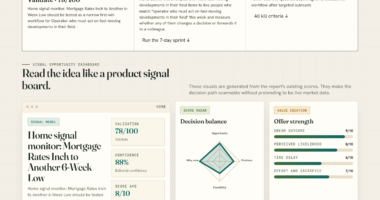

📊 Full opportunity report: The conversion. What turning the largest nonprofit into a company did to charity law. on ThorstenMeyerAI.com — validation score, market gap, and execution plan.

Get hardware and tech essentials delivered free with Prime
- Fast, free delivery on millions of items
- Prime Video, Amazon Music and more included
- Member-only deals all year
TL;DR
OpenAI restructured from a nonprofit to a for-profit entity, maintaining control instead of selling assets. Authorities approved this model, raising questions about legal and ethical implications. The move could influence future charity conversions.
OpenAI’s transformation from a nonprofit to a for-profit company was approved on October 28, 2025, marking a significant departure from traditional charity-to-company conversion methods. Unlike established practices, OpenAI retained control of its assets and governance, rather than selling assets to independent foundations. This move raises questions about the legal and ethical boundaries of charitable asset law and could set a new precedent for future conversions.
Historically, nonprofit-to-profit conversions in sectors like healthcare involved divestiture: charities sell their assets at fair market value, funding independent foundations that continue their mission. Examples include Blue Cross of California and Health Net, which transferred assets and exited entirely, ensuring compliance with laws protecting charitable assets.
In contrast, OpenAI’s conversion kept the nonprofit, now called the OpenAI Foundation, in control of a substantial equity stake worth roughly $130 billion. The organization did not sell its assets or transfer them to an independent steward. Instead, it retained control over the for-profit entity, which is governed by the same nonprofit. Authorities, including California’s Attorney General Bonta and Delaware’s Kathy Jennings, approved this structure after nearly a year of investigation, based on the representation that nonprofit control was preserved.
Legal experts note that this approach diverges from the traditional asset divestiture model, which is designed to uphold three core principles: the asset lock, private-inurement rule, and fair-market-value rule. OpenAI’s model appears to sidestep these protections by maintaining control, raising concerns about whether charitable assets are truly protected or effectively transferred into a private-equity style structure. The approval was based on a paper-based assessment of control, without verifying whether the nonprofit’s actual influence over the for-profit was genuine or nominal.
The conversion.
What turning the largest
nonprofit into a company
did to charity law.
held, not divested for cash
independent foundations (Blue Cross)
that nonprofit control is preserved
set by settlement, not adjudication
- Charity sells assets at appraised fair value
- An independent foundation inherits the proceeds (Blue Cross → $3B+)
- The charity exits the for-profit entirely
- Protection = the value leaves the for-profit’s control
- Foundation keeps ~$130B equity, not cash
- Keeps controlling the OpenAI Group PBC
- No exit — the value stays inside the company
- Protection = nominal nonprofit control of the for-profit
The conversion redefined what a nonprofit can become — and did so by acquiescence rather than adjudication, on a representation the enforcers accepted rather than a standard a court imposed. The experiment is now running, and the next decade of conversions is watching the result.Thorsten Meyer · The Conversion · AI Governance 05
Legal and Ethical Implications of Control-Retention Model
This move could fundamentally alter the landscape of charity law by establishing a precedent where nonprofits retain control over valuable assets without divesting them. If widely adopted, it may weaken the legal protections that prevent private enrichment and ensure assets serve charitable purposes. The core concern is whether the nonprofit truly controls the for-profit or merely appears to, which has profound implications for the integrity of charitable assets and future regulatory oversight.
Supporters argue that this structure allows charities like OpenAI to stay actively engaged in mission-critical decision-making, potentially better serving their goals. Critics contend it undermines longstanding legal safeguards designed to prevent private inurement and asset diversion, risking broader erosion of trust in charitable institutions.
nonprofit asset management software
As an affiliate, we earn on qualifying purchases.
As an affiliate, we earn on qualifying purchases.
Traditional Charitable Asset Laws and Conversion Practices
For decades, charity-to-company conversions have followed a well-established legal framework, especially in healthcare. The process involves selling assets at fair market value, funding independent foundations, and relinquishing control, thus protecting the assets and ensuring compliance with laws like the charitable trust doctrine, private-inurement rule, and fair-market-value rule.
In the 1990s, California’s healthcare sector saw widespread use of this approach, with organizations like Blue Cross and Health Net converting by divestiture, creating independent foundations that continued their missions. These conversions were scrutinized and approved because they adhered strictly to the legal requirements, ensuring assets remained dedicated to charitable purposes.
OpenAI’s case diverges from this pattern. Instead of divesting assets, the nonprofit retained its equity stake and control, with authorities approving the structure based solely on representations of control preservation. This shift raises questions about whether the legal protections that have historically safeguarded charitable assets are still effective when control is retained rather than divested.
“OpenAI’s conversion did not follow the established divestiture playbook—selling assets and creating independent foundations—but instead used a control-retention model, which could weaken the protections that charity law was designed to uphold.”
— Thorsten Meyer
charity governance compliance tools
As an affiliate, we earn on qualifying purchases.
As an affiliate, we earn on qualifying purchases.
Legal Validity and Future Risks of Control-Retention Conversions
It remains unclear whether the authorities’ approval fully ensures that the nonprofit genuinely controls the for-profit entity or if the structure merely appears to do so. The key issue is whether the nonprofit’s influence is real or nominal, which cannot be verified until conflicts or disputes arise. The long-term legal implications and potential for future challenges are still uncertain.
legal compliance software for nonprofits
As an affiliate, we earn on qualifying purchases.
As an affiliate, we earn on qualifying purchases.
Monitoring, Legal Challenges, and Regulatory Developments Ahead
Regulators and watchdogs will likely scrutinize OpenAI’s ongoing governance to assess whether the nonprofit truly controls the for-profit. Future legal challenges or legislative responses could emerge if questions about influence and asset protection intensify. Additionally, other charities may consider adopting similar models, prompting broader legal and policy debates about the boundaries of charitable control and asset protection.
As an affiliate, we earn on qualifying purchases.
Key Questions
How does OpenAI’s conversion differ from traditional charity-to-company conversions?
Unlike traditional conversions that involve selling assets and creating independent foundations, OpenAI retained control of its assets and governance, avoiding asset divestiture and instead maintaining a controlling stake within the nonprofit structure.
What legal rules are potentially being bypassed in OpenAI’s conversion?
The asset lock, private-inurement rule, and fair-market-value rule, which are designed to protect charitable assets from private benefit and ensure assets are used for charitable purposes, are potentially weakened by this control-retention approach.
Authorities approved based on representations that the nonprofit retained control, but whether this control is genuine or nominal remains unverified, raising questions about the robustness of the approval process.
Could this set a precedent for other charities?
Yes, if the control-retention model becomes more common, it could challenge existing legal protections and reshape how charitable assets are managed during conversions.
What are the risks if the nonprofit does not genuinely control the for-profit?
The main risk is that charitable assets could be diverted or used for private benefit, undermining legal protections and eroding public trust in charitable organizations.
Source: ThorstenMeyerAI.com
Halloween Picks
halloween
As an affiliate, we earn on qualifying purchases.