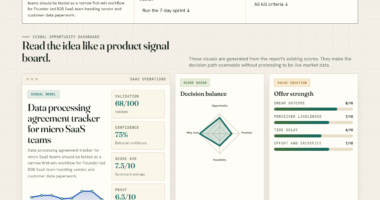
📊 Full opportunity report: Readiness: Before You Fund the Answer on ThorstenMeyerAI.com — validation score, market gap, and execution plan.

Get hardware and tech essentials delivered free with Prime
- Fast, free delivery on millions of items
- Prime Video, Amazon Music and more included
- Member-only deals all year
TL;DR
Organizations can now assess their AI deployment readiness in just 20 minutes using a diagnostic tool. This helps prevent costly failures by identifying weaknesses before funding AI projects. The process is simple, fast, and designed to be trustworthy.
A new diagnostic tool now enables organizations to evaluate their AI deployment readiness in just twenty minutes before committing funding. This approach aims to prevent costly failures that often occur months after initial implementation, by providing an honest assessment of whether the organization is truly prepared for AI integration. The tool’s simplicity and focus on actionable insights make it a potential game-changer in enterprise AI projects.
The diagnostic evaluates organizations based on their business type—data-rich, regulated, or document-driven—and identifies specific failure modes that could undermine AI success. It produces a report with six key elements: a readiness verdict, an identification of the organization’s AI maturity type, a percentile comparison against peers, calibration to sector-specific data realities, direct quotes from organizational responses, and a concrete action plan for immediate next steps. The entire process requires only a corporate email and twenty minutes, making it accessible and low-cost.
Unlike traditional assessments, which often stop at diagnosis, this tool emphasizes actionable steps that organizations can implement within thirty days. It does not sell services or products; its primary goal is to provide honest, unbiased insight into whether the organization is truly prepared for AI deployment. The assessment is designed to be transparent and trustworthy, with no passwords or social logins required.
Before You Fund the Answer
Most world-model AI implementations look clean for a year, then decision quality erodes where no dashboard can see it. Twenty minutes and a corporate email tell you — before you sign — whether the money will compound or quietly evaporate.
A clear tier framed in language a CFO will accept — plus your percentile against peers in your sector and size band, so a score becomes a position you can take to the board.
+ twenty minutes
- No follow-up machine — no vendor in your inbox next week.
- No “book a call.” The output is an action you can take without it.
- No vendor scorecard. It doesn’t sell the implementation it assesses.
- No thumb on the scale toward “you’re ready, let’s talk.”
- Subtraction, pointed at a decision. Strip the vendor theater and dashboard-green comfort until the few things that decide success are visible.
- Independence is the product. A diagnostic that deletes your email has nothing to gain from any verdict but the true one — including “not ready.”
- The shift it’s built for. AI is moving from describing to predicting and acting; readiness is a question you answer before deployment, not during it.
- Find out before you fund the answer. The only thing more expensive than this assessment is learning the answer the slow way.
Independent commentary, produced with AI assistance under human editorial oversight. The views are the author’s own and may change. Readiness is a diagnostic tool, not business, financial, legal, or technical advice; its verdict is one input, not a substitute for due diligence. Regulatory references are named as examples, not legal guidance. Product, model, and company names are trademarks of their respective owners; mention does not imply endorsement.
Why Early Readiness Checks Are Critical for AI Success
This tool addresses a common yet often overlooked issue: organizations frequently commit to AI projects without understanding their actual preparedness. As Thorsten Meyer explains, most failures in enterprise AI are invisible for months, as the system quietly begins making judgment calls that diverge from organizational intent. By the time problems surface through metrics, the damage has already been done, and fixing it is costly and time-consuming. Early assessment allows organizations to identify and address weaknesses proactively, saving resources and avoiding strategic missteps.
In practical terms, this means fewer failed projects, better resource allocation, and more realistic expectations about AI’s impact. It also fosters a culture of honest self-assessment, ensuring that organizations only proceed when truly ready, rather than rushing into deployment based on optimism or incomplete understanding.
As an affiliate, we earn on qualifying purchases.
The rise of enterprise AI has led many organizations to jump into projects without fully understanding their internal capabilities or limitations. Historically, failures have often gone unnoticed for a year or more, as dashboards remain green and demos impress stakeholders. The real issues—such as decision-making erosion and uninstrumented blind spots—manifest gradually, often over multiple quarters. This delayed realization results in wasted budgets and strategic misalignment.
According to Thorsten Meyer, most failed implementations are only recognized after significant investment, when the damage to judgment and decision quality becomes evident. The new diagnostic tool aims to change this pattern by providing a quick, honest snapshot of readiness before any funding is committed, thus shifting the focus from reactive fixes to proactive prevention.
“Most failed AI implementations don’t look like failures for about a year. The dashboards stay green. The demos land. The board is pleased. The real damage is invisible by design and takes months to surface.”
— Thorsten Meyer
As an affiliate, we earn on qualifying purchases.
Unconfirmed Aspects of the Readiness Assessment
It is not yet clear how widely adopted the diagnostic tool will become or how organizations will respond to its recommendations. The long-term impact on reducing AI failures and the accuracy of the assessment across diverse sectors remain to be validated through broader use and empirical data.As an affiliate, we earn on qualifying purchases.
Next Steps for Adoption and Validation
The diagnostic tool is currently being promoted to early adopters, with plans to gather feedback and refine its algorithms. Organizations interested in early access can participate in pilot programs, which will help validate its effectiveness across different industries. Over the coming months, further studies and case reports are expected to demonstrate how early readiness assessments influence project outcomes and organizational decision-making.
As an affiliate, we earn on qualifying purchases.
Key Questions
How accurate is the diagnostic tool in predicting AI project success?
The tool provides an honest, sector-calibrated assessment based on organizational responses and data realities. While promising, its predictive accuracy will improve as more organizations use it and provide feedback.
Can this assessment be used for all types of AI projects?
It is designed primarily for enterprise AI deployments involving decision-making systems. Its effectiveness varies depending on the organization’s sector and maturity, but it aims to identify key failure modes across different business types.
Is the assessment process confidential?
Yes. The process requires only a corporate email and takes twenty minutes, with no passwords or social logins involved. Results are based on responses and are kept confidential.
Will organizations receive specific recommendations after the assessment?
Yes. The report includes three concrete actions tailored to the organization’s weakest dimension, enabling immediate next steps within thirty days.
Will this diagnostic eliminate all risks associated with AI deployment?
No. It reduces the risk of unforeseen failures by providing early insights, but AI projects inherently carry risks that require ongoing management and oversight.
Source: ThorstenMeyerAI.com
Halloween Picks
halloween
As an affiliate, we earn on qualifying purchases.