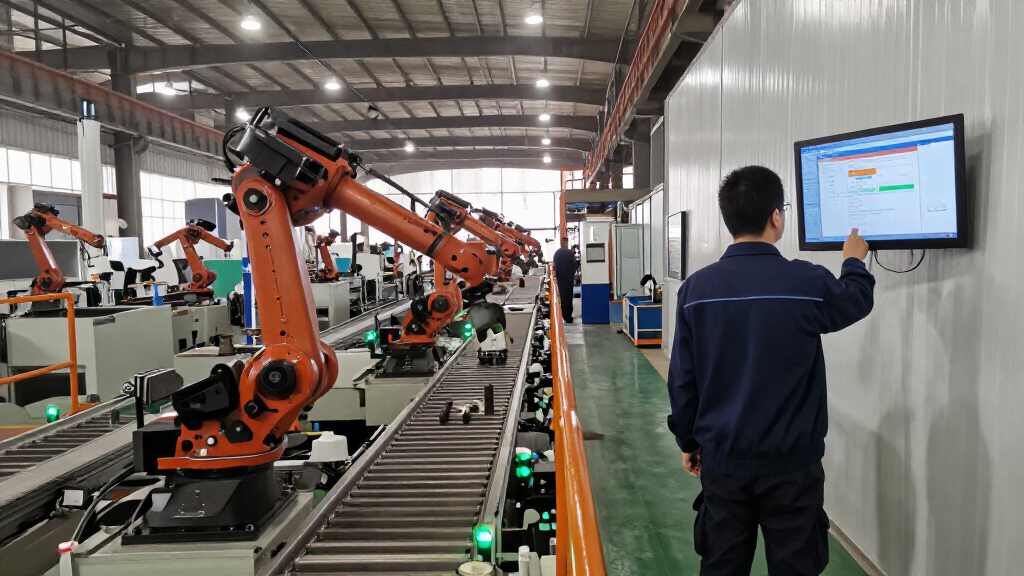

🔍 Read the full analysis: Factory Work In A New Era: Where AI Fits on ThorstenMeyerAI.com

Get hardware and tech essentials delivered free with Prime
- Fast, free delivery on millions of items
- Prime Video, Amazon Music and more included
- Member-only deals all year
TL;DR
A November 8 report from ThorstenMeyerAI.com traces factory employment and output in the United States, Germany and China. Its U.S. data show fewer factory jobs than in 1979, alongside substantially higher output through 2007; the source does not establish how much of the employment decline is due to AI.
ThorstenMeyerAI.com published a report November 8 tracing manufacturing employment and output in the United States, Germany and China. Its U.S. figures show factory employment below its 1979 peak while output rose through 2007. The report provides historical context for debates about AI and factory work, but it does not quantify AI’s effect on jobs or establish that AI caused the changes described.
In the United States, factory payroll employment reached a series high of 19.553 million in June 1979, according to the report’s account of Bureau of Labor Statistics data. The count was 12.7 million in October 2026, a preliminary figure representing 8.0% of payroll jobs. The report says the share of payroll employment in factories peaked earlier, at 38.8% in November 1943, and had fallen to 21.7% by June 1979.
Manufacturing output followed a different path for much of that period. Using the Federal Reserve’s industrial production index, the report puts U.S. factory output at 50.4 in June 1979 and 98.4 in September 2026, with the index referenced to 2017=100. That is about 1.95 times the 1979 level. The report also notes a limit to the trend: output peaked at 108.6 in December 2007 and remained about 9% below that level in September 2026.
The report says U.S. factory employment fell by almost six million between January 2000 and February 2010, from 17.3 million to 11.4 million. It cites economists’ estimates that rising Chinese imports cost up to about one million U.S. factory jobs from 1999 to 2011. That estimate is not a complete account of the decline, and the report does not attribute the remaining job losses to any single cause.
What Factory History Says About AI
The figures matter because claims about AI replacing factory workers are arriving amid a longer shift in manufacturing employment. The report documents that this shift began well before current AI tools: U.S. factory employment started retreating from its 1979 high, and the report says the decline that accelerated around 2000 preceded China’s entry into the World Trade Organization by 22 years. That timing cautions against treating AI as an explanation for the entire historical decline.
The output figures also complicate any simple equation between fewer factory jobs and less manufacturing. U.S. production rose substantially between 1979 and its 2007 high while employment fell, but it has not exceeded that high since, according to the cited series. For workers, employers and policymakers, the distinction matters: changes in production, staffing and technology are related, but they are not interchangeable measures. The report does not say how AI will affect future hiring, productivity, pay or working conditions.
Products Worth Considering

Apple MacBook Pro 16.2-inch with M5 Pro, 18-core CPU, 20-core GPU, 64GB Memory, 1TB SSD, Space Black

Apple MacBook Pro 16.3-inch with PROLED XDR Display, Silver

Logitech MX Mechanical Wireless Illuminated Keyboard, Tactile Quiet, Graphite
As an affiliate, we earn on qualifying purchases.
Three Countries, Different Measures
The report compares the United States with Germany and China, while noting that the countries’ statistics do not describe exactly the same categories. In Germany, the cited measure covers the producing sector, including factories, construction, energy, water and mining. It accounted for 49.2% of employment in West Germany in 1965 and 22.9% in Germany in 2025. The report notes classification changes in 1970 and 1991, which limit direct comparisons across the full period.
For China, the report gives a peak of 232 million industry and construction jobs in 2012. It argues that factory employment has passed a peak there too, though its supplied account does not provide a later job count for comparison. The measures and years differ across countries, so these figures should be read as national trends, not as a like-for-like ranking of factory employment.
The U.S. employment series described in the report comes from the BLS Current Employment Statistics program, which counts jobs on employer payrolls outside farming. It does not count self-employed workers or people employed in private households. The historical series begins in January 1939. Output figures come from a separate Federal Reserve index, so comparing jobs with production offers broad context rather than a direct measure of each worker’s productivity or hours.
“The number to remember is 19.6 million.”
— ThorstenMeyerAI.com report
AI’s Employment Effect Is Unmeasured
The report’s historical figures do not isolate AI’s effect on factory employment. They provide no estimate of jobs already displaced or created by AI, no comparison between factories adopting AI and those that have not, and no projection of future staffing. The employment and output series also measure different things, and the report’s estimate of import-related job losses is presented as a partial contribution rather than a full explanation.
The October 2026 U.S. employment figure is preliminary and may be revised. The report’s supplied material also does not give later China employment data, detailed comparisons of AI adoption across the three countries, or evidence about how automation affects wages, job quality and the mix of tasks inside factories. Those questions remain open.
Watch Data and Workplace Evidence
The next steps are to track revisions to the October 2026 BLS payroll estimate and subsequent releases of U.S. factory employment and industrial production data. Those updates can show whether recent job and output trends continue, but they will not by themselves establish that AI caused a change.
To measure AI’s workplace effects, readers would need more direct evidence, such as company disclosures on deployment, staffing and output, alongside research comparing affected and unaffected roles over time. The report does not announce a new study or give a timetable for such evidence. For now, it offers a historical baseline, not a verdict on how AI will reshape factory employment.
Key Questions
What is the main development in the report?
ThorstenMeyerAI.com published a historical account of factory employment and output in the United States, Germany and China. It places current discussion of AI against long-running changes in manufacturing work.
How many people worked in U.S. factories at the 1979 peak?
The report gives a seasonally adjusted peak of 19.553 million payroll jobs in June 1979, often rounded to 19.6 million.
Does the report show that AI caused factory job losses?
No. It does not measure AI’s contribution to employment changes. It describes job losses over several decades and discusses trade as one factor in a particular period.
Did U.S. factory output keep rising after 2007?
Not according to the figures in the report. U.S. factory output peaked in December 2007 and was about 9% below that peak in September 2026.
Are the country comparisons directly equivalent?
No. The report says national measures differ. Germany’s cited producing-sector category includes construction, energy, water and mining, and the employment figures cited for each country cover different years and definitions.
Source: ThorstenMeyerAI.com