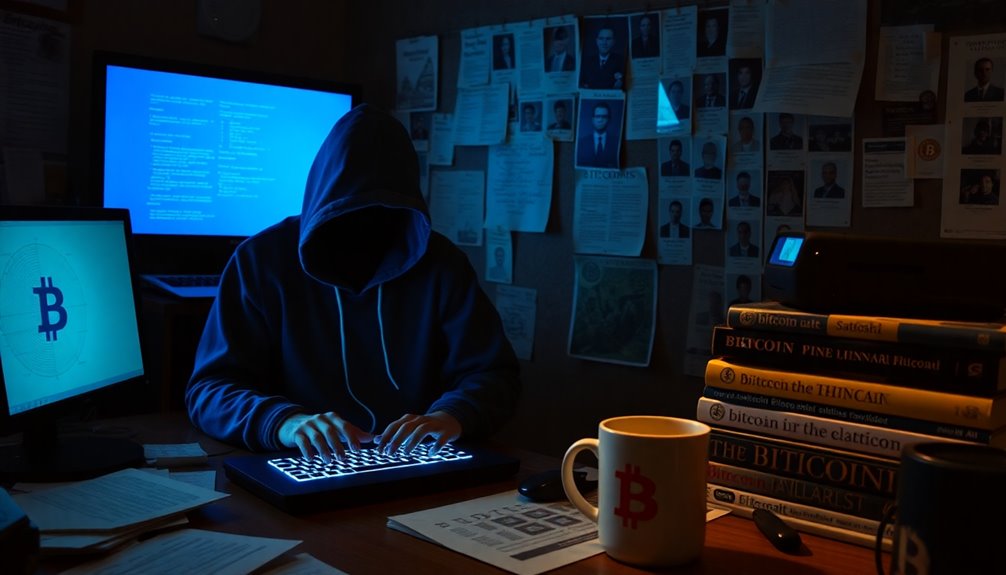

You've likely heard about the ongoing quest to uncover Satoshi Nakamoto, the elusive figure behind Bitcoin. Despite countless theories and potential candidates, the mystery endures. Each new lead sparks intrigue, but the truth remains just out of reach. What if the identity of this revolutionary creator is closer than we think? The implications could reshape the very foundation of cryptocurrency. What's your take on the latest contenders?

Get hardware and tech essentials delivered free with Prime
- Fast, free delivery on millions of items
- Prime Video, Amazon Music and more included
- Member-only deals all year
While Bitcoin has revolutionized the world of finance, the identity of its mysterious creator, Satoshi Nakamoto, remains shrouded in intrigue. You might find it fascinating that Nakamoto published a white paper in October 2008, outlining a revolutionary digital currency. The first block of the Bitcoin blockchain, dubbed the Genesis Block, was mined in January 2009, and it even contained a reference to a UK newspaper headline, hinting at the economic climate of the time.
From 2007 until mid-2010, Nakamoto worked tirelessly on Bitcoin's code, collaborating with other developers, but then vanished without a trace, leaving the world to ponder who they really are. In fact, Nakamoto's open-source implementation of Bitcoin began in 2009, allowing public access to its code, which further fueled interest and speculation. Interestingly, the advent of Bitcoin has also led to the development of Bitcoin IRA accounts, allowing investors to secure their future with cryptocurrency.
The use of British English in Nakamoto's code comments and forum posts has fueled speculation about their origins. Some suggest that the name "Satoshi Nakamoto" could represent a single individual or even a group of people. Among the most discussed candidates is Hal Finney, a cryptographic pioneer and the first person to use Bitcoin software.
You may have heard whispers linking Nick Szabo, known for his work on "bit gold," to Nakamoto, though Szabo has consistently denied any connection. Then there's Craig Wright, an Australian who controversially claimed to be Nakamoto, only to be dismissed in a UK court. Dorian Nakamoto, a Japanese-American man, was also mistakenly identified, simply due to his name.
Recent investigations haven't quelled the curiosity. A documentary suggested Peter Todd as a potential candidate, but he denied involvement. Cryptographic analyses have sought to connect Nakamoto to specific individuals through writing styles or transaction patterns, yet no definitive links have emerged.
The Bitcoin community remains skeptical of anyone claiming to be Nakamoto without solid evidence. Speculative mentions of public figures, like Elon Musk and Paul Le Roux, have surfaced, but those individuals have also denied any ties.
Despite the relentless pursuit, Nakamoto's identity remains a tantalizing mystery. Bitcoin itself has emerged as the largest cryptocurrency, inspiring thousands of others while facing regulatory scrutiny and environmental concerns. Its value has fluctuated dramatically, peaking at over $68,000 per coin.
As you can see, Bitcoin represents a decentralized financial system, capturing the imagination of libertarians and tech enthusiasts alike. The hunt for Satoshi Nakamoto continues, but for now, the true mind behind Bitcoin remains elusive, adding to the allure of this groundbreaking innovation.
As an affiliate, we earn on qualifying purchases.
As an affiliate, we earn on qualifying purchases.
As an affiliate, we earn on qualifying purchases.
As an affiliate, we earn on qualifying purchases.
Halloween Picks
halloween
As an affiliate, we earn on qualifying purchases.