

As Bitcoin’s volatility hits a five-year low, it reflects increased adoption and market maturity, driven by more institutional involvement, clearer regulations, and broader acceptance. This has reduced sharp price swings and correlated risks, bringing its risk profile closer to traditional assets. Although volatility still remains above stocks and gold, ongoing growth suggests stability could improve further. If you want to understand the factors shaping these trends, there’s more to explore below.
Key Takeaways
- Bitcoin’s 30-day implied volatility index has fallen below 50%, reaching levels not seen in the past five years.
- Increased institutional adoption and broader acceptance have stabilized demand, reducing overall market volatility.
- Market maturity, including regulatory clarity and ETF participation, contributes to lower price swings.
- The decline in correlation with risk assets indicates Bitcoin is behaving more like a mature, less volatile asset.
- Ongoing growth and liquidity improvements are likely to sustain the low volatility environment, despite potential macro shocks.
Top picks for "bitcoin volatility index"
Open Amazon search results for this keyword.
As an affiliate, we earn on qualifying purchases.
Current Volatility Trends in Bitcoin

Recent data shows that Bitcoin’s volatility has markedly decreased, reaching levels not seen in years. You’ll notice that its daily standard deviation now hovers around 2.1% in 2025, a significant drop from approximately 5.3% in 2021. While still higher than traditional assets like gold and stocks, it’s trending closer to commodity-like levels. The 30-day implied volatility index remains above 50%, indicating ongoing uncertainty, but it’s stabilized after recent macro shocks. Bitcoin’s realized volatility has found a floor near 29%, showing less extreme swings despite market fluctuations. This decline reflects increased institutional adoption, higher market capitalization, and growing liquidity, which collectively dampen abrupt price movements. Additionally, the volatility measures have become more stable due to advancements in trading and risk management strategies. Overall, Bitcoin’s current volatility suggests a more mature market, though it remains more volatile than traditional assets.
Historical Fluctuations and Market Cycles
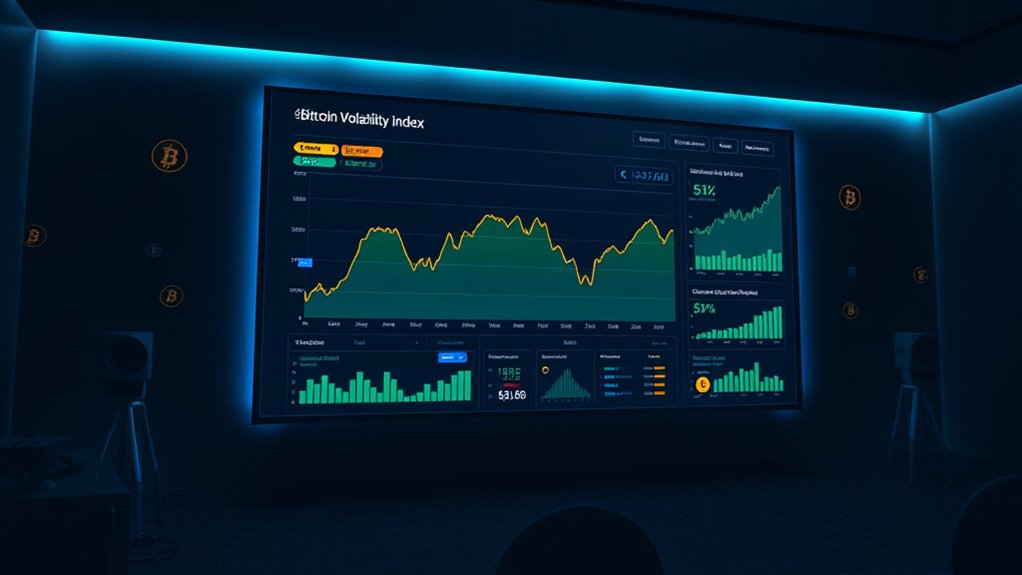
Bitcoin’s historical volatility has experienced significant fluctuations aligned with its market cycles, reflecting periods of rapid growth and sharp declines. During early cycles, volatility averaged around 8–9%, with daily swings of over 5%. Major price surges, like the 2017 bull run, saw volatility spike sharply, followed by steep declines during corrections. In 2020 and early 2021, volatility nearly doubled as institutional interest surged, and the market experienced rapid price movements. As adoption increased and market maturity progressed, volatility gradually declined, reaching lows in 2023 and 2024, with averages around 4–5%. These fluctuations mirror Bitcoin’s evolving market phases—initial speculation, mainstream acceptance, and now a more stabilized, mature asset class. Understanding these patterns helps you gauge market sentiment and potential risks during different phases. market cycles influence how traders and investors interpret volatility trends, enabling more informed decisions.
Key Drivers Behind the Decline in Volatility
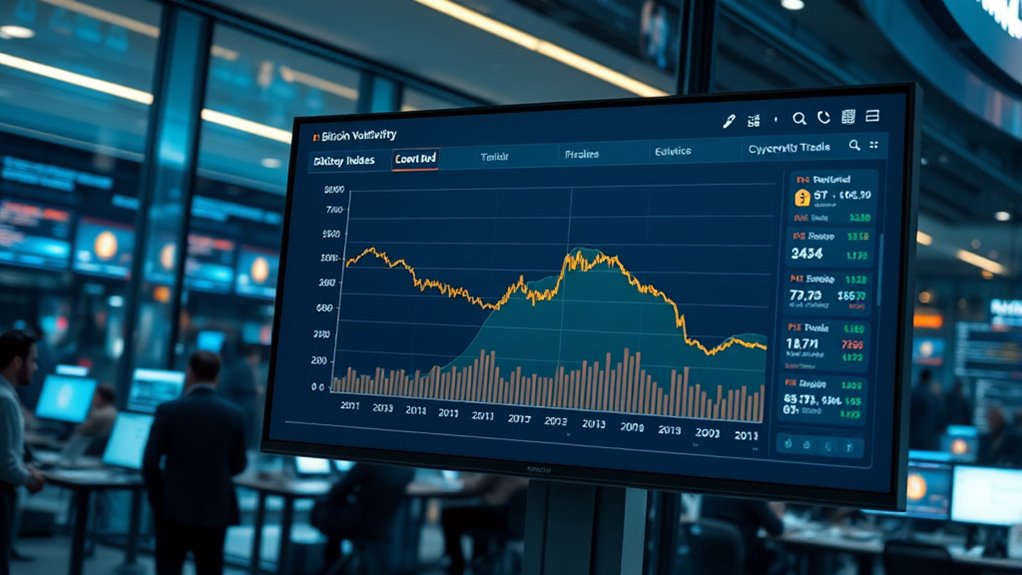
You can see that increased institutional adoption has played a major role in reducing Bitcoin’s volatility, as larger players bring stability and liquidity. Market maturity, with growing capitalization and clearer regulations, further dampens wild price swings. Together, these factors have shifted Bitcoin toward a more stable, mainstream asset, even amid macroeconomic shocks.
Institutional Adoption Impact
The rise of institutional adoption has played a pivotal role in driving down Bitcoin’s volatility by bringing more market stability and credibility. As major firms and funds embrace Bitcoin, they create a more resilient market with fewer sharp swings. This shift is evident in several ways:
- Increased liquidity from institutional players reduces price gaps and short-term spikes.
- Regulatory clarity encourages long-term holding, discouraging panic trading.
- Growing mainstream acceptance leads to steadier demand, lessening speculative swings.
- The integration of Kia Tuning options into vehicle customization demonstrates the broader trend of mature and sophisticated markets influencing stability.
With institutions viewing Bitcoin as a viable asset class, market behavior becomes less driven by retail hype and more by strategic allocations. This progression has contributed substantially to the lower volatility levels seen today, signaling maturity and increased confidence in Bitcoin’s role within traditional finance.
Market Maturity Effects
As the market matures, several key drivers have notably contributed to the decline in Bitcoin’s volatility. Increased mainstream acceptance and institutional involvement have stabilized trading patterns. Rising market capitalization, now over $1 trillion, and improved liquidity reduce sharp swings. Regulatory clarity and integration into traditional finance lessen speculative activity. Market participants are more committed, evidenced by declining Reserve Risk Ratios, indicating stronger holder conviction. This maturation process aligns Bitcoin closer to traditional assets.
| Driver | Effect | Market Impact |
|---|---|---|
| Institutional Adoption | More stable trading, less panic selling | Reduced short-term volatility |
| Liquidity Growth | Larger trading volume dampens swings | Smoother price movements |
| Regulatory Clarity | Less uncertainty, more confidence | Lower speculative spikes |
| Mainstream Integration | Diversification, risk management | Decreased abrupt shifts |
Indicators of Market Maturity and Adoption

Indicators of market maturity and adoption reveal significant progress in Bitcoin’s integration into mainstream finance. You can see this through key signs:
- Inclusion in mainstream portfolios — Bitcoin is now a regular component in institutional asset mixes, with increasing ETF flows and on-chain metrics backing demand.
- Evolving regulatory frameworks — Clarifications and guidelines are emerging, making it easier for institutions to participate without legal uncertainties.
- Reduced correlation with risk assets — While still positive, Bitcoin’s correlation with stocks and bonds has weakened, reflecting a maturing market with distinct risk profiles.
- Increased adoption of AI-based analysis is helping investors better interpret market signals and assess Bitcoin’s long-term viability.
These indicators show Bitcoin is progressing from a speculative asset to a more integrated, institutionalized part of the financial landscape, signaling deeper market acceptance and stability.
Comparative Analysis With Traditional Assets
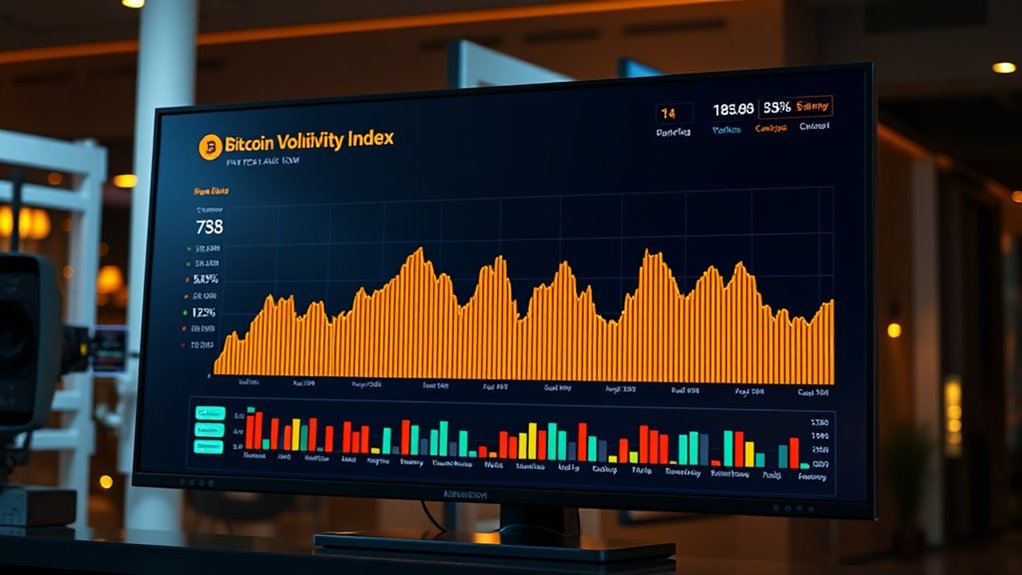
You’ll notice that Bitcoin’s volatility gap with gold and stocks has narrowed, signaling increased market maturity. At the same time, its risk-return profile is shifting as it behaves more like traditional assets during macro events. Although Bitcoin remains more volatile overall, evolving correlation trends suggest its role in diversified portfolios is growing more aligned with conventional investments. Additionally, understanding and managing emotional responses related to market fluctuations can contribute to more resilient investment strategies.
Volatility Gap Narrows
The gap in volatility levels between Bitcoin and traditional assets is steadily narrowing, reflecting a maturing market. As Bitcoin’s daily standard deviation drops to around 2.1% in 2025, it’s approaching commodity-like levels. You should note these key points:
- Bitcoin’s volatility remains higher than gold and stocks but has decreased appreciably over five years.
- The implied volatility index for Bitcoin (above 50%) is still above the S&P 500’s VIX below 20%, but both show signs of stabilization.
- Institutional adoption, increased market cap, and liquidity have contributed to reducing Bitcoin’s volatility gap with traditional assets.
This convergence signals growing market maturity, with Bitcoin acting more like a traditional asset while still maintaining its unique risk profile.
Risk-Return Dynamics Shift
As Bitcoin’s risk-return profile evolves, its relative attractiveness compared to traditional assets is shifting noticeably. You’ll notice that, despite still being more volatile than gold or stocks, Bitcoin’s risk profile has become more aligned with commodities and certain high-growth assets. Its recent lower volatility, combined with substantial price gains during adoption milestones, suggests a better risk-adjusted return. Institutional investors now view Bitcoin not just as a speculative asset but as a diversification tool, balancing risk and reward more effectively. While volatility remains higher than traditional assets like the S&P 500, the narrowing gap indicates a maturing market. You can expect this trend to continue as increased adoption, liquidity, and regulatory clarity improve Bitcoin’s risk-return dynamics, making it a more integrated component of diversified portfolios. Additionally, market maturity has contributed to decreased volatility and enhanced investor confidence.
Correlation Trends Evolve
While Bitcoin’s correlation with traditional assets has historically been variable, recent trends show a notable decline in its linkage with risk-on markets like tech stocks and high-yield bonds. This shift indicates that Bitcoin is becoming less dependent on overall market sentiment, offering a potential diversification benefit. You should note these key developments:
- Correlation with equities has weakened from highs of 0.6–0.8 to around 0.2–0.3, suggesting more independence.
- The relationship with gold remains positive but has moderated, reflecting growing differentiation.
- During macro shocks, Bitcoin often moves independently, showing resilience when traditional markets falter.
- As Bitcoin matures, its market behavior increasingly resembles that of alternative assets rather than traditional risk assets.
This evolving correlation pattern underscores Bitcoin’s increasing maturity and its emerging role as a hedge or alternative asset.
Impact of Institutional Participation and Regulation

Institutional participation has played a pivotal role in reducing Bitcoin’s volatility by bringing greater market stability and liquidity. As more institutions enter the space—through products like spot ETFs, custody solutions, and integration into traditional portfolios—they create a more resilient market with less speculative frenzy. Their long-term investment horizon dampens sharp price swings, while increased liquidity allows for smoother trading and easier price discovery. Regulatory clarity further boosts confidence, encouraging institutional players to participate without fear of sudden policy shifts. This influx of institutional capital shifts market dynamics from a retail-driven, volatile environment to one characterized by stronger conviction and less panic selling. As a result, Bitcoin’s price movements become more measured, reflecting a maturing market with reduced short-term shocks.
Future Prospects and Potential Risks

Looking ahead, Bitcoin’s future prospects hinge on continued institutional adoption and evolving regulatory frameworks that could further diminish its volatility. While recent trends show a structural shift, risks remain. You should watch for:
- Volatility mean reversion: Although the current floor is around 29%, past cycles suggest volatility could spike again unexpectedly.
- Liquidity and market shocks: Liquidity issues or macroeconomic shocks could trigger sudden price swings, especially during periods of low trading volume.
- Regulatory uncertainties: New policies or bans could disrupt market stability, leading to increased volatility and affecting long-term adoption.
Staying alert to these factors helps you understand how Bitcoin’s risk profile might evolve amid ongoing growth and potential turbulence.
Monitoring Metrics for Volatility Regimes

Monitoring specific metrics can provide valuable insights into Bitcoin’s current volatility regime and help anticipate potential shifts. Keep an eye on the 30-day implied volatility index (IV), which recently stabilized above 50%. Although higher than traditional assets, this level indicates market expectations of moderate future swings. Also, track realized volatility, currently around 29%, as it tends to revert to its mean after spikes. The Reserve Risk Ratio, reflecting holder conviction, offers clues about future stability—low ratios suggest strong confidence and less selling pressure. On-chain metrics, like HODL Bank activity, reveal whether long-term holders are accumulating or capitulating. By analyzing these indicators collectively, you can better gauge whether Bitcoin’s volatility will remain subdued or if new risk factors might trigger regime changes.
Frequently Asked Questions
How Might Geopolitical Events Influence Bitcoin’s Future Volatility?
You might see geopolitical events cause short-term spikes in Bitcoin’s volatility, especially during crises or sanctions. However, as adoption and institutional involvement grow, Bitcoin’s overall volatility could stabilize, lessening the impact of global tensions. Still, unpredictable geopolitical shifts can trigger quick price swings, so remain cautious. Keep an eye on macro risk factors and on-chain indicators, as they can signal whether Bitcoin is entering a more stable or turbulent period.
What Role Do Retail Investors Play in Current Volatility Levels?
You play a significant role in shaping Bitcoin’s current volatility levels. As a retail investor, your increased participation and demand contribute to market stability, especially when combined with institutional confidence. When you hold long-term positions or avoid panic selling during shocks, you help reduce sudden price swings. Your collective behavior fosters a more mature market, lowering volatility over time, as mainstream acceptance and less speculative trading become dominant features.
Could Technological Developments Impact Bitcoin’s Market Stability?
Technological developments could considerably impact Bitcoin’s market stability. For example, the rise of layer 2 solutions like the Lightning Network has improved transaction speed and reduced fees, fostering greater mainstream adoption. When such innovations enhance user experience and security, they attract more institutional and retail investors, which can help stabilize prices. Conversely, vulnerabilities or delays in technological upgrades might cause short-term volatility, emphasizing the importance of continuous technological progress for market confidence.
How Does Bitcoin’s Volatility Compare During Bull Versus Bear Markets?
During bull markets, you’ll notice Bitcoin’s volatility spikes as prices surge rapidly, leading to larger daily swings. In contrast, bear markets see lower volatility, with steadier declines and less dramatic price swings. You may experience calmer trading during downturns, but be aware that sudden macro shocks can still cause temporary spikes. Overall, volatility tends to be higher in bullish phases due to increased speculation, while it stabilizes during bearish periods.
What Are the Implications of Decreasing Volatility for Bitcoin’s Long-Term Value?
Decreasing volatility could act like a steadying hand on Bitcoin’s long-term value, making it more appealing for mainstream investors. As price swings soften, the asset becomes less of a rollercoaster and more of a reliable part of diversified portfolios. This stability may foster greater trust, encouraging institutional participation and driving adoption. Over time, this smoother ride could solidify Bitcoin’s role as a resilient store of value, boosting its legitimacy and long-term prospects.
Conclusion
As Bitcoin’s volatility reaches new lows, you see stability emerge from uncertainty, confidence grow from doubt, and maturity take hold from chaos. You witness a market evolving, a technology advancing, and adoption spreading. Embrace this moment of calm, for it signals progress, resilience, and potential. Stay alert, stay informed, and trust the journey, knowing that each steady step forward brings you closer to a more secure, more promising future in the world of cryptocurrency.