
You’ve likely seen headlines claiming Bitcoin’s death many times, but despite setbacks like exchange hacks, bans, and crashes, it keeps bouncing back stronger. Major events triggered these obituaries, yet each decline led to a new high, proving its resilience. Over time, media narratives have shifted from alarmism to recognition, solidifying Bitcoin’s role as a mainstream asset. To understand how it defies death predictions and evolves, explore what causes these cycles to continue and what it means for its future.
Key Takeaways
- Bitcoin has faced numerous “death” headlines since 2010, often triggered by hacks, regulatory bans, or market crashes.
- Major declines, like Mt. Gox’s hack and the 2018 crash, repeatedly prompted obituary headlines but were followed by rapid recoveries.
- Despite frequent predictions of Bitcoin’s demise, its resilience has led to new all-time highs, demonstrating market maturation.
- Media narratives shifted from alarmist to recognizing Bitcoin as a legitimate, mature asset by 2025, reinforcing its long-term viability.
- Bitcoin’s ability to recover from crises underscores its enduring legacy and evolution as a resilient global financial asset.
The Origins of the “Bitcoin Is Dead” Meme

The “Bitcoin is dead” meme started around 2010 when early skeptics questioned the cryptocurrency’s viability. Back then, Bitcoin was still new, and many doubted it could survive beyond speculative trading. Media outlets and critics highlighted its lack of real-world adoption, extreme price volatility, and security concerns. Whenever Bitcoin experienced major setbacks—like exchange hacks or regulatory crackdowns—these critics proclaimed its demise. Websites like 99bitcoins began tracking these headlines, turning them into a recurring joke within crypto circles. Despite the frequent death announcements, Bitcoin kept bouncing back, proving its resilience. This cycle of declaring Bitcoin dead and its subsequent recovery became a defining feature of its history, fueling the meme and shaping public perception for over a decade. The persistent public skepticism contributed to the meme’s longevity, even as Bitcoin continued to grow and adapt.
Major Events That Sparked Obituaries From 2013 to 2022

Major events like regulatory crackdowns, exchange hacks, and market crashes have repeatedly sparked headlines declaring Bitcoin dead. These incidents often lead to sharp price drops and widespread fear, fueling the obituary meme. Yet, each time, Bitcoin tends to recover and even reach new heights, defying the predictions. Additionally, the transformative power of decluttering demonstrates how clearing out unnecessary clutter can bring clarity and renewed focus, much like Bitcoin’s resilience in bouncing back from setbacks.
Regulatory Crackdowns and Bans
Regulatory crackdowns and bans have frequently sparked headlines declaring Bitcoin’s demise, especially during moments of governmental intervention. When authorities tighten rules or target exchanges, it fuels fears of collapse. For example, China’s 2013 ban on financial institutions transacting Bitcoin caused a swift price drop and headlines proclaiming its end. Similarly, the Mt. Gox hack in 2014, combined with Japan’s regulatory stance, fueled obituaries. In 2022, bans and restrictions from multiple countries, along with SEC rejections of ETFs, reignited fears. These events often trigger sharp declines, yet Bitcoin consistently recovers. The table below highlights key regulatory events:
| Year | Event | Market Impact |
|---|---|---|
| 2013 | China’s ban | Price drops, headlines |
| 2014 | Mt. Gox hack | Sharp selloff, recovery |
| 2018 | US SEC rejection | Volatility spike |
| 2022 | Global bans | Short-term dips |
Exchange Hacks and Failures
Exchange hacks and failures have repeatedly triggered headlines declaring Bitcoin’s death, often causing sharp price declines and shaken investor confidence. The Mt. Gox hack in 2014, where 744,000 BTC were stolen, caused a 55% price plunge and widespread panic. Similarly, the Coincheck breach in 2018 resulted in $530 million lost and fueled fears of systemic collapse. In 2022, the FTX bankruptcy shocked markets, wiping out billions and igniting doubts about crypto security. These failures highlight vulnerabilities in exchanges rather than Bitcoin itself. Despite these setbacks, Bitcoin has resiliently rebounded each time, recovering within months. These incidents reinforce the narrative that exchange failures threaten confidence but rarely lead to Bitcoin’s permanent demise, as the ecosystem adapts and strengthens security measures.
Market Crashes and Sentiment
Throughout 2013 to 2022, several market crashes deeply shook investor confidence and sparked headlines declaring Bitcoin’s imminent demise. Major crashes, like China’s 2013 ban, the Mt. Gox hack in 2014, and the 2018 bubble burst, triggered widespread panic and obituaries. The 2020 COVID-19 crash wiped nearly 40% in days, prompting fears of permanent decline. The 2022 crypto winter, fueled by Terra/Luna collapse and FTX bankruptcy, intensified negative sentiment. Each dip led to media claims that Bitcoin was finished, yet prices consistently rebounded within months or a year. These crashes often coincided with sharp drops of 40% or more, but Bitcoin’s resilience kept it alive, eventually reaching new all-time highs and solidifying its reputation as a volatile but enduring asset. Additionally, despite these setbacks, investor interest in innovative blockchain technology and decentralized finance platforms has continued to grow, supporting Bitcoin’s ongoing relevance.
How Price Swings Have Triggered Repeated Predictions of Bitcoin’s Demise
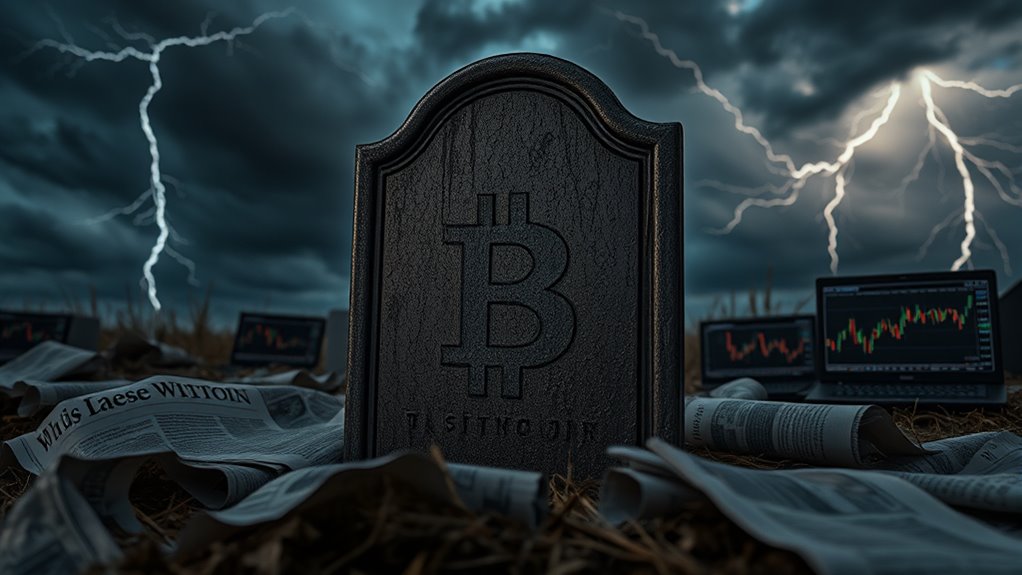
Significant price swings in Bitcoin have repeatedly sparked predictions of its demise. When Bitcoin experiences sharp declines—like the 2014 Mt. Gox hack or the 2018 crash—media outlets and skeptics often declare it finished. These rapid drops, sometimes exceeding 40% within days, fuel fears that Bitcoin can’t sustain itself. Yet, history shows that each time, Bitcoin bounces back stronger, reaching new highs months or years later. The volatility feeds the narrative that Bitcoin’s lifespan is limited, but these swings are part of its maturation process. Every time the price plunges, it triggers headlines predicting the end, only for Bitcoin to prove its resilience. This cyclical pattern keeps fueling predictions of its death, even as its fundamentals and adoption continue to grow. Interestingly, this pattern of volatility and recovery is characteristic of dynamic market cycles, which are typical in emerging assets.
The Resilience of Bitcoin: Recoveries After Each Predicted Death

Despite countless predictions of Bitcoin’s demise, it consistently proves its resilience by bouncing back stronger each time. When headlines scream “Bitcoin is dead,” you might think it’s the end, but history shows otherwise. After major crashes—like Mt. Gox or the 2018 bear market—Bitcoin often hits new highs within a year or two, surprising skeptics. Its ability to recover is fueled by growing adoption, institutional interest, and macroeconomic factors. Even during crises like the 2022 crypto winter, Bitcoin’s fundamental strength shines through, leading to rapid rebounds. Today, with prices above $108,000 and declining volatility, you see a mature asset that learns from setbacks. Bitcoin’s resilience isn’t just about bouncing back—it’s about transforming each “death” into a stepping stone for future growth. Additionally, its price recovery patterns demonstrate a consistent trend of resilience, reinforcing confidence among investors.
The Evolution of Media Narratives and Market Perception

Over time, media narratives around Bitcoin have shifted from alarmist predictions of its death to more nuanced discussions of its evolving role in the financial landscape. Early headlines labeled it a scam or bubble, often citing security issues or lack of adoption. Now, coverage recognizes Bitcoin as a mature asset, with mainstream outlets comparing it to gold or stocks. This shift influences market perception, making investors more confident despite occasional dips. Additionally, the media framing surrounding Bitcoin has contributed to its increasing legitimacy among mainstream financial institutions. Below is a snapshot of this evolution:
| Era | Media Focus | Market Perception |
|---|---|---|
| Early (2010–2014) | Speculative, security concerns | Risky, untrustworthy |
| Mid (2015–2018) | Adoption and regulation debates | Volatile but promising |
| Recent (2019–2025) | Institutional interest, macro role | Resilient, asset class evolution |
| Post-Obituaries | Rebounds and growth after setbacks | Growing legitimacy and stability |
| Current (2025) | Maturation, correlation with traditional assets | Recognized as a diversified investment |
The Shifting Role of Bitcoin in the Global Financial Ecosystem

You’ve seen how Bitcoin’s reputation has evolved from a fringe experiment to a mainstream asset. Its growing adoption and role in portfolio diversification are shifting how investors and institutions view it within the global financial system. As its influence expands, Bitcoin’s importance in risk management and macroeconomic strategies continues to grow. The increasing recognition of Bitcoin’s eco-friendly potential through sustainable practices like Suprem fabric highlights the broader trend toward environmentally conscious innovation in financial technologies.
Mainstream Adoption Trends
Mainstream adoption of Bitcoin has accelerated markedly, transforming it from a niche digital asset into a recognized component of the global financial ecosystem. You now see Bitcoin integrated into financial services, with major exchanges offering custody and trading options. Institutional investors and corporations are increasing their holdings, viewing Bitcoin as a hedge and diversification tool. Payment processors like PayPal and Square enable users to buy, sell, and spend Bitcoin easily. Regulatory clarity is improving, fostering broader acceptance. Media coverage is more balanced, framing Bitcoin as a legitimate asset class rather than a speculative gamble. As a result, everyday investors are becoming comfortable holding Bitcoin alongside traditional assets, shifting its role from fringe innovation to a mainstream financial instrument.
Asset Diversification Role
As Bitcoin matures, it increasingly serves as a vital tool for diversification within investment portfolios. You now see it as a hedge against traditional assets, especially during economic uncertainty. Its low correlation with stocks and bonds makes it valuable for reducing overall risk. Investors are blending Bitcoin with commodities and real assets to balance volatility and growth. Unlike earlier years, when Bitcoin was viewed mainly as speculative, it’s now recognized for its macro hedge qualities, especially amid inflation and currency devaluations. As a result, institutions and individual investors alike include Bitcoin to diversify and strengthen their portfolios. This evolving role reflects Bitcoin’s shift from a fringe asset to a mainstream component of comprehensive investment strategies.
What 2025 Tells Us About Bitcoin’s Enduring Legacy

Despite numerous predictions of Bitcoin’s demise over the years, 2025 demonstrates that its resilience and evolving role in global finance are undeniable. You can see that Bitcoin’s ability to rebound after each “death” proves its staying power. Its market maturity, lower volatility, and growing correlation with traditional assets highlight its transformation from a speculative asset to a recognized financial tool. The fact that Bitcoin trades above $108,000 with a $2.1 trillion market cap shows widespread acceptance. Even with recent dips, technical signals suggest upward momentum. Bitcoin’s endurance reflects its role as a macro hedge, a diversification asset, and a symbol of financial sovereignty. Its persistence amid regulatory challenges and market turbulence cements its legacy as a resilient, evolving asset class. Inspiration from inspirational quotes about fatherhood underscores the importance of perseverance and resilience in overcoming challenges.
Frequently Asked Questions
Why Do Media Outlets Repeatedly Declare Bitcoin’s Death Despite Its Resilience?
Media outlets declare Bitcoin’s death repeatedly because sensational headlines grab attention, especially during volatile or challenging times. They often focus on drops, hacks, or regulatory setbacks to attract clicks and viewers. However, you should see these obituaries as temporary setbacks. Despite these claims, Bitcoin’s resilience, increasing adoption, and historical rebounds prove it’s more than just a fleeting trend—you’re witnessing a persistent, evolving asset that defies death proclamations.
How Have Bitcoin’s Major Crashes Historically Influenced Public Perception?
Have you ever wondered how a storm can shake a tree but not break it? Major crashes have historically damaged public perception, sparking fears and doubts about Bitcoin’s future. Yet, each time, resilience kicks in—prices rebound, trust rebuilds, and the narrative shifts. These crashes act like tempests, temporarily darkening the sky, but Bitcoin’s roots run deep, allowing it to regrow stronger and continue its journey upward.
What Role Do “Bitcoin Is Dead” Headlines Play in Market Psychology?
You might see “Bitcoin is dead” headlines as fear-mongering, but they actually influence market psychology by fueling doubt and panic among investors. These headlines often come after sharp price drops, prompting some to sell or hesitate to buy. However, history shows that Bitcoin recovers from these headlines, reinforcing that such declarations are temporary and often driven by media hype rather than fundamentals. Stay focused on long-term trends instead.
How Has Bitcoin’s Market Maturity Affected the Frequency of Obituaries?
You’ll notice that as Bitcoin matures, the frequency of obituaries has decreased markedly. The market’s increased stability, reduced volatility, and broader institutional acceptance mean major crashes now don’t trigger widespread predictions of doom. Instead, dips are seen as part of normal cycles rather than signs of imminent failure. This maturity helps you stay more confident, understanding that Bitcoin’s resilience and growing adoption make it less likely to be declared dead with each downturn.
Will Bitcoin’s Narrative as a “Failed Asset” Persist Into 2025 and Beyond?
Yes, Bitcoin’s narrative as a “failed asset” will likely persist into 2025 and beyond, especially among skeptics and regulators. However, your view should consider its resilience, increased mainstream adoption, and evolving market role. Despite occasional doubts, Bitcoin’s proven ability to rebound from setbacks and its growing integration into diversified portfolios suggest the narrative will shift from failure to recognition of its long-term value.
Conclusion
As you watch Bitcoin’s saga unfold, it’s clear the “death” headlines are just echoes in a storm that never truly settles. Like a phoenix rising from ashes, Bitcoin keeps reborn, defying expectations and rewriting its story with each new chapter. Instead of fearing its end, recognize the resilience that fuels its journey. Bitcoin’s legacy isn’t written in obituaries, but in its relentless ability to reinvent itself amid the chaos.