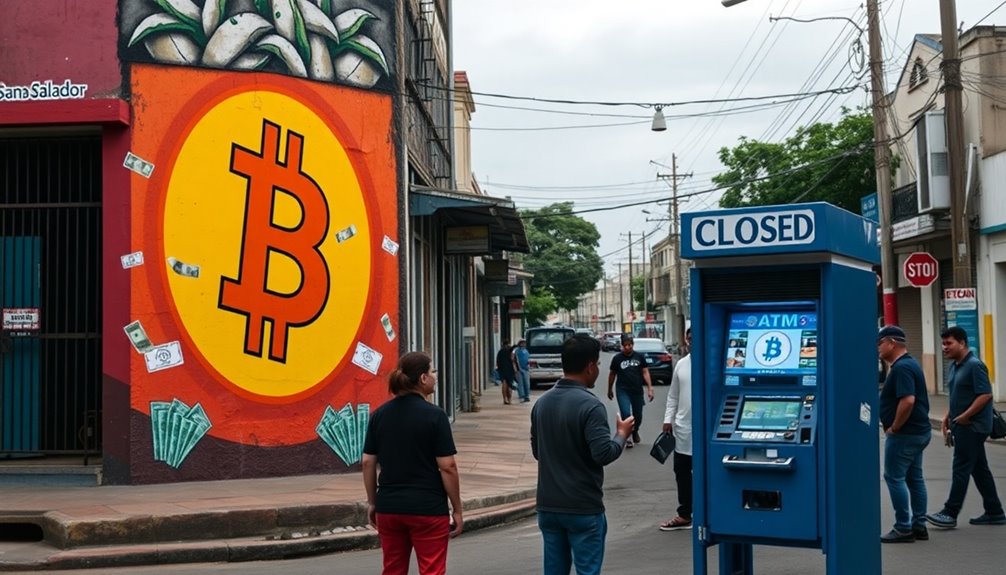

You've likely heard about Bitcoin losing its legal tender status in El Salvador, and it's raised quite a few eyebrows. Many users and businesses are concerned about what this means for the future of cryptocurrency in the country. With Bitcoin's initial promise of financial inclusion now clouded by volatility, it seems the landscape is shifting. How will this affect everyday transactions and the broader acceptance of digital currencies? The implications could be far-reaching.
Since El Salvador made headlines by adopting Bitcoin as legal tender on September 7, 2021, the country's relationship with the cryptocurrency has evolved dramatically. Initially, the government pushed Bitcoin to enhance financial inclusion and reduce remittance fees, even introducing the Chivo wallet, which offered $30 in Bitcoin to new users. However, public sentiment was largely negative; over 70% of the population opposed its adoption. The excitement quickly turned to concern as Bitcoin's volatility became evident, raising questions about its practicality as a stable currency.
El Salvador's Bitcoin adoption faced widespread opposition, as volatility raised doubts about its effectiveness as a stable currency.
Recently, the Legislative Assembly reversed Bitcoin's legal tender status, allowing businesses to choose whether to accept it. This shift came as part of a deal with the International Monetary Fund (IMF) for a $1.4 billion loan aimed at stabilizing El Salvador's economy. Now that Bitcoin's use is voluntary, you might find that many businesses are hesitant to embrace it, given its tumultuous market performance. This change reflects the government's acknowledgment of the financial risks linked to Bitcoin, which the IMF has criticized extensively.
Despite the removal of its legal tender status, the Salvadoran government continues to hold over 6,000 Bitcoins, valued at approximately $577 million. While they still accumulate Bitcoin, the public's limited adoption remains concerning; by 2024, only about 8% of Salvadorans reported using it for payments. The government's involvement with the Chivo wallet is also winding down, which might leave you wondering about the future of Bitcoin transactions in the country. The Chivo wallet was downloaded by three million people, representing 46% of the population, but this has not translated into widespread usage for payments.
The reaction to Bitcoin's initial adoption was mixed, with over 1,000 people protesting against it due to volatility concerns. International critics also raised alarms about environmental impacts and transparency issues, questioning the wisdom of embracing such a controversial currency. Additionally, allegations of corruption and fraud during the rollout of Bitcoin further complicated the narrative, leaving many Salvadorans confused about its benefits.
As you navigate this changing landscape, it's essential to stay informed. The government's strategy has included incentives for using the Chivo wallet, such as discounts at some gas stations for payments made through the app. However, with Bitcoin's status as legal tender now stripped away, you may need to reconsider how you approach this digital currency. The landscape is evolving, and understanding these changes will be crucial as El Salvador continues to explore its relationship with Bitcoin.
Top picks for "bitcoin legal currency"
Open Amazon search results for this keyword.
As an affiliate, we earn on qualifying purchases.