
🔍 Read the full analysis: What You Gain—and Give Up—in Privacy With XREAL AURA And Gemini on ThorstenMeyerAI.com

Get hardware and tech essentials delivered free with Prime
- Fast, free delivery on millions of items
- Prime Video, Amazon Music and more included
- Member-only deals all year
TL;DR
Google and XREAL launched AURA on Oct. 28, a pair of see-through Android XR glasses with Gemini and an optional feature that shares the wearer’s view. That can let Gemini answer questions about objects and screens, but it also raises questions about recording bystanders and how XREAL’s described always-on visual processing works.
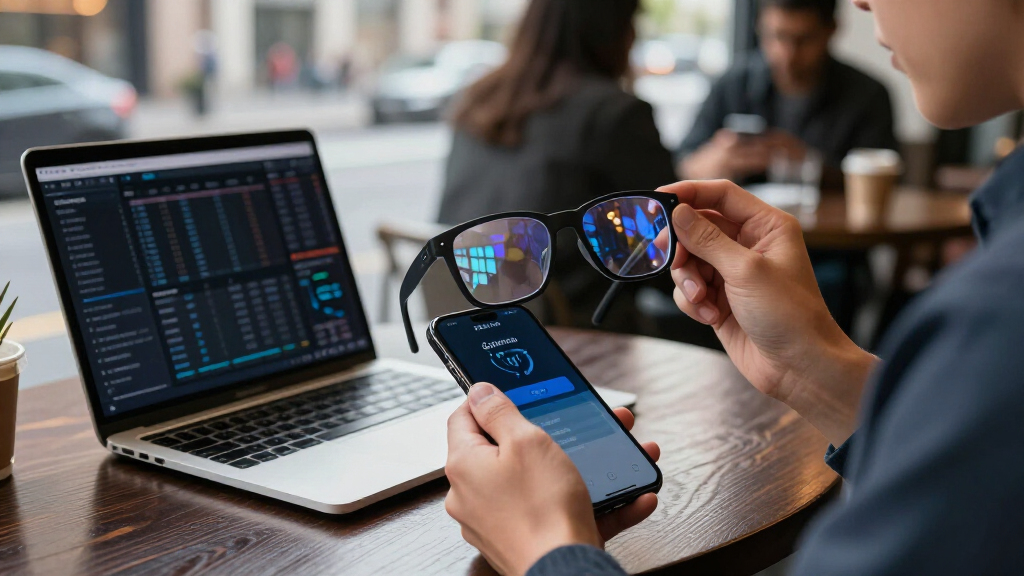
Google and XREAL launched AURA on October 28, a pair of see-through glasses running Android XR with Gemini built in and an optional feature that lets the assistant view the wearer’s surroundings and digital screens. The launch puts AI assistance into a camera-equipped device worn in public, raising practical questions about consent, bystanders and data handling even as the companies describe controls for sharing the view.
AURA uses two small displays behind transparent lenses, so users can see the room directly while placing digital windows over it. The glasses connect by cable to a separate puck that houses the processor and battery. XREAL lists the glasses at under 95 grams and the puck at 265 grams, with a 70-degree field of view. Google and XREAL say the device supports Android apps and more than 150 apps designed for XR.
Gemini can answer questions about apps and screens without receiving a live view of the room, according to the source material. To ask about physical objects, users must turn on view sharing in the Gemini app. Google’s help page says the shared view can include both “digital content on your device and physical space visible from your device.” One example on that page asks which fruit at a stand has the most fiber; Gemini can also mark relevant objects with a box.
The stated launch price is $1,099 for 12 GB of memory and 256 GB of storage, or $1,299 for 16 GB and 512 GB, during a limited-time offer through December 2026. XREAL previously announced higher prices of $1,279 and $1,499, and says customers who paid those prices will receive the difference back. Google says orders opened in the United States, Canada and South Korea on October 28, with Japan opening November 2; shipping is expected from mid-November. XREAL says more markets are planned for 2027, without dates.
Infographic 01 · XREAL AURA in plain words
Light glasses, a heavy puck, and Gemini in between.
AURA splits the device in two: what has to sit on your face, and what can ride in your pocket. All figures are XREAL’s and Google’s own.
On your head: the glasses
You see the real room through the lenses. The apps float on top.
- Two Sony micro-OLED displays, 1920 × 1200 pixels per eye, up to 120 Hz
- Lenses darken in five steps, by hand or automatically
- Two tracking cameras for your hands and position
- One high-resolution camera with a privacy LED
- Speakers next to each ear, four microphones
- Two sizes for the distance between your eyes, prescription lenses possible
In your pocket: the puck
The heavy parts, on a cable.
- Qualcomm Snapdragon Reality Elite chip (debuts in AURA)
- 12 GB / 256 GB or 16 GB / 512 GB
- 4,455 mAh battery, a small fan
- Touchpad and fingerprint button
- Second USB-C port: power, or a laptop’s video signal (“Wired Mirroring”)
What Gemini does
- Helps across your apps and windows
- With view sharing on: sees your screens and the room
- Can mark an object with a box
Google docs
Makers’ claims
- “3 ms” motion-to-photon latency
- “48 TOPS” of AI processing
- “Always-on AI visual processing” in the X1S chip, not explained
vendor figures
Not published
- An official battery-life figure
- Independent full reviews (only demos so far)
- Prices in Canada, Japan, Korea in this article
XREAL told Android Authority: about 4–5 h of streaming (single source).
A laptop screen you wear like sunglasses, with the computer in your pocket.Thorsten Meyer · my reading
Sources: XREAL specs, accessed 29 Oct 2026; XREAL, 28 Oct 2026; Google, 28 Oct 2026; Android Authority, 6 Sep 2026.
Powered by Thorsten Meyer AI
Gemini Moves Into Public Spaces
AURA makes the privacy question less abstract: a user may ask Gemini about a menu, a product or a screen while people nearby are visible to the device. The potential benefit is immediate, hands-free help grounded in what the wearer is seeing. The corresponding concern is that other people may enter the shared view without knowing, particularly in workplaces, shops or shared homes.
Google’s help page advises users to ask people for permission before including them in a view shared with Gemini. That guidance puts some responsibility on the wearer, but it does not resolve how consent can work in a public place or how an organization should handle the glasses at work. Businesses may need rules for cameras and AI features before employees bring AURA into meetings or customer-facing settings.
The product also differs from enclosed mixed-reality headsets: AURA’s transparent lenses let the wearer see the physical room directly, rather than relying on a camera feed to show it. That distinction does not remove privacy concerns, because Gemini’s view-sharing feature can still expose physical surroundings to the assistant. AURA costs less than the cited Apple Vision Pro and Samsung Galaxy XR prices, but it remains an early product with no official battery-life figure in the supplied material.
Products Worth Considering

LG 27G810A-B 27-inch UltraGear 4K UHD IPS Gaming Monitor

Ledger Nano Gen5 Crypto Wallet with Touchscreen, Black
Logitech MX Creative Console with 9 Customizable Keys, Graphite
As an affiliate, we earn on qualifying purchases.
AURA is built around a wired arrangement. The glasses contain Sony micro-OLED displays rated at 1920 by 1200 pixels per eye and up to 120 Hz, while a cable connects them to a pocket-sized puck with a Qualcomm Snapdragon Reality Elite chip, memory and a 4,455 mAh battery, according to the supplied product information. The puck also has a touchpad, fingerprint button and USB-C connection for power or a laptop video signal.
Users can place Android apps around them, watch video on a virtual screen, play supported games or mirror a laptop display over USB-C. For physical-world questions, Google describes a separate step: the wearer turns on view sharing, and the room must be visible through the clear lenses. The source says hand-tracking images are handled separately; Google’s Android XR help material states they are processed in real time and deleted, not stored on the device or sent to Google.
That distinction matters because hand tracking and Gemini view sharing are different functions. A statement about the handling of hand-tracking images does not, by itself, explain how information shared with Gemini is retained or used. The supplied material says Gemini activity is kept for 18 months by default, but does not provide further detail on the treatment of every image or session associated with AURA.
Open Questions About Visual Processing
The supplied material does not explain what XREAL means by its X1S chip’s “always-on AI visual processing,” a phrase listed on the company’s specifications page. It does not say what that processing does to camera data, whether the privacy light is active during every relevant operation, or whether any information leaves the glasses independently of a user-initiated Gemini share. Those details should not be inferred from Google’s separate statement about hand-tracking images.
Other practical details are also missing. The source provides no official battery-life estimate and says the hands-on demonstrations available before launch used supervised pre-release units. It is not clear how the final retail product will perform in ordinary use, how the view-sharing controls appear to nearby people, or how Gemini activity retention applies to each kind of shared visual input.
Launch Markets and Buyer Questions
Orders are scheduled to open in Japan on November 2, after the October 28 openings in the United States, Canada and South Korea. XREAL says shipping should begin in mid-November and that additional countries may follow in 2027, but it has not supplied dates for those markets. The promotional prices are stated to run through December 2026.
Before wider workplace or consumer use, the main unanswered issue is how the companies will explain visual processing and data retention in detail. Buyers and organizations can review the settings and official help materials, but the supplied information does not settle every question about camera operation. XREAL’s statement about the X1S processing, and clearer information on what is sent to Gemini and when, would help users make informed decisions.
Key Questions
Does Gemini see everything through AURA all the time?
The supplied material says Gemini receives the wearer’s full view when view sharing is turned on. It does not establish that Gemini continuously receives the view when sharing is off. XREAL’s description of “always-on AI visual processing” is not explained in the available information.
What can Gemini access when view sharing is enabled?
Google’s help page says the shared view may include digital content on the device and the physical space visible through it. This can let Gemini respond to questions about objects or screens and mark an object in the view.
Are hand-tracking images sent to Google?
Google’s Android XR help material says hand-tracking images are processed in real time and deleted, and are not stored on the device or sent to Google. That statement is about hand tracking; it does not answer every question about visual information shared with Gemini.
How much does XREAL AURA cost?
The limited-time prices through December 2026 are $1,099 for the 12 GB/256 GB configuration and $1,299 for the 16 GB/512 GB configuration. XREAL says buyers who paid the earlier announced prices will receive the difference back.
When will AURA be available?
Google says orders opened October 28 in the United States, Canada and South Korea, and are due to open in Japan on November 2. Shipping is expected from mid-November; additional market dates have not been announced.
Source: ThorstenMeyerAI.com