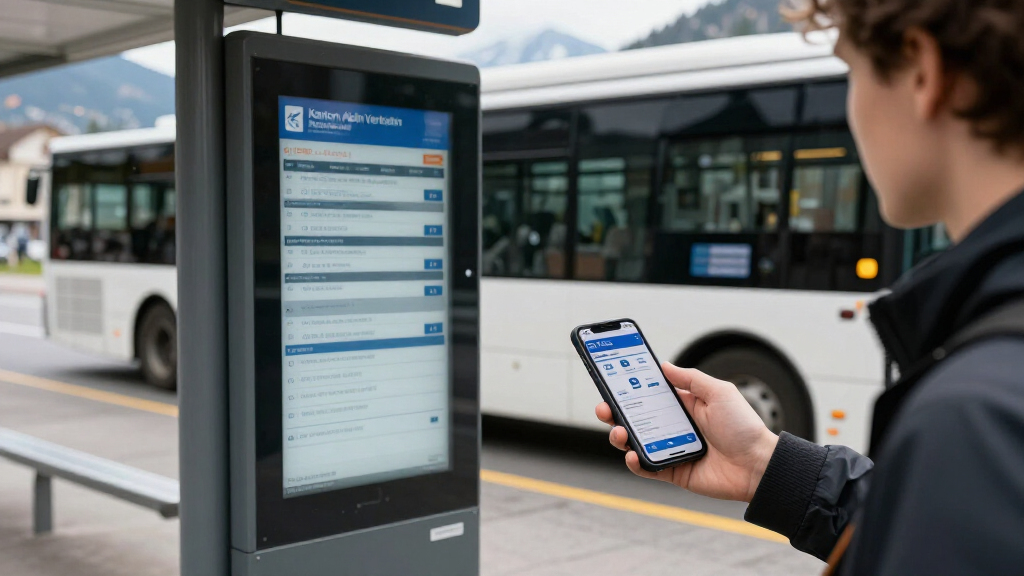

📊 Full opportunity report: How AI Technology Facilitated 'Kanton Alpin Verkehrsbetriebe' on ThorstenMeyerAI.com — validation score, market gap, and execution plan.
TL;DR
Kanton Alpin Verkehrsbetriebe has implemented advanced AI technology to develop a meticulously precise digital simulation of a Swiss alpine railway station. This project emphasizes Swiss International Style design and real-time synchronization, demonstrating AI’s role in transit visualization.
Kanton Alpin Verkehrsbetriebe has unveiled a fully digital, AI-facilitated simulation of a Swiss alpine railway station. This project, created using a code-based approach without external assets, highlights the role of AI technology in enhancing transit visualization and precision, marking a notable advancement in Swiss transportation digital interfaces.
The project features a meticulously crafted, real-time SVG clock and a split-flap departure board, both driven by AI-generated code and synchronized with actual time. The interface adheres strictly to Swiss International Style, employing CSS grid, SVG, and JavaScript to produce a seamless, high-fidelity digital replica. All visual components, including pictograms, maps, and schematics, are generated through code, ensuring exactness and clarity. The station’s digital experience is hosted on a single webpage, designed to be flawless across multiple screen sizes, with no external assets or frameworks involved.
This initiative was developed following a rigorous three-phase process: initial construction based on strict design principles, external critique for refinement, and final validation by an art director. The project exemplifies how AI can facilitate precision in transit design, emphasizing aesthetic discipline and technical accuracy. The site is accessible publicly, inviting viewers to experience the simulation firsthand.
How AI Technology Facilitated ‘Kanton Alpin Verkehrsbetriebe’
A meticulously precise digital simulation of a Swiss alpine railway station shows how AI-generated code, real-time synchronization and disciplined visual systems can turn a single webpage into a high-fidelity transit experience.
A station built as a living digital system
Instead of assembling photographs, icon packs or frameworks, the project uses AI-assisted code to construct every visible component. The result follows Swiss International Style principles: ordered grids, precise typography, functional geometry and rigorous clarity.
Real-time station clock
An SVG clock is generated and synchronized with actual time, preserving the visual discipline associated with Swiss rail environments.
Split-flap departures
A code-driven departure board reproduces the rhythm and legibility of transit information without relying on external graphical assets.
Generated wayfinding
Pictograms, maps and schematics are constructed in code, keeping proportions, alignment and rendering consistent across screen sizes.
![Model Railway Sound Effects [Download]](https://m.media-amazon.com/images/I/61k0k95nocL._SL500_.png)
Model Railway Sound Effects [Download]
Easy to use
As an affiliate, we earn on qualifying purchases.
As an affiliate, we earn on qualifying purchases.
Three gates from concept to validated interface
AI accelerated construction, but quality depended on constraints, critique and human judgment. Each phase narrowed the gap between a convincing prototype and a visually resolved digital product.
Construct
Generate the station from strict grid, typographic and functional requirements using a code-first approach.
AI-assisted buildCritique
Apply external review to identify visual inconsistencies, weak hierarchy and details that break the Swiss design language.
Independent refinementValidate
Use final art-direction review to confirm fidelity, clarity, responsive behavior and aesthetic coherence.
Human approvalAI-powered transit visualization tools
As an affiliate, we earn on qualifying purchases.
As an affiliate, we earn on qualifying purchases.
Code-based design changes the operating model
The project is currently a digital prototype rather than an operational railway system. Even so, it demonstrates practical differences between traditional asset assembly and AI-facilitated, system-based visualization.
| Capability | Static asset workflow | AI-facilitated code model | Operational status |
|---|---|---|---|
| Real-time synchronization | ✗ Typically manual or limited | ✓ Clock and board can update continuously | ✓ Demonstrated |
| Visual consistency | ~ Depends on individual assets | ✓ Shared rules govern every component | ✓ Validated visually |
| Responsive scaling | ~ Extra variants often required | ✓ Geometry adapts through code | ✓ Multi-screen design |
| Live transit integration | ✗ Not inherent | ~ Technically extensible | ~ Requires testing |
| Global reuse | ~ Asset replacement needed | ✓ Rules can be adapted locally | ~ Not yet proven at scale |

DreamSky Small Digital Alarm Clock for Bedroom, Large Big Numbers Display
Large Display Electric Alarm Clock with Brightness Dimmer: Corded plug in clock with compact streamline design yet large…
As an affiliate, we earn on qualifying purchases.
As an affiliate, we earn on qualifying purchases.
From design rule to passenger-facing clarity
The value chain is cumulative: AI generates structured components, live data supplies motion, design constraints preserve coherence and human review protects quality.
How does AI improve precision?
It automates component generation and synchronization, helping visual rules remain accurate and consistent throughout the interface.
Can it support real operations?
Not yet as presented. Operational integration would require live-system connections, safety validation and deployment testing.
Does it replace traditional design?
No. AI accelerates structured execution, while human oversight remains essential for judgment, creative direction and final quality.
Can other transit systems adopt it?
Potentially. The code-driven approach can be adapted to local identities, accessibility standards and operational requirements.
What is the central advantage of an asset-free model?
Every component remains scalable, adjustable and governed by shared rules, making rapid updates possible without rebuilding a library of static graphics.

Classic FlipFlap TV – Transform your TV into a classic split-flap board display with custom messages, flights and clock.
Authentic split-flap display with realistic flip animations and sounds
As an affiliate, we earn on qualifying purchases.
As an affiliate, we earn on qualifying purchases.
The prototype is strong; the broader case remains open
The public showcase establishes a compelling visualization blueprint. Its influence on planning, operational efficiency and passenger engagement will depend on what happens when the method moves from demonstration to live transit environments.
Scale and operational impact
Long-term reliability, deployment cost, integration with transport infrastructure and measurable user benefits have not yet been established.
Live trials and local adaptation
Transit authorities could test similar interfaces with real schedules, accessibility requirements and regional design systems to evaluate broader adoption.
AI Enhances Swiss Transit Visualization
This development demonstrates how AI technology can be used to create highly precise, code-based digital representations of transit environments. It underscores the potential for AI to improve transit planning, visualization, and user experience by enabling detailed, real-time, and visually disciplined interfaces. For Swiss transit authorities and digital designers, this project offers a blueprint for integrating AI-driven automation with strict aesthetic standards, potentially influencing future transit system interfaces globally.
Swiss Transit Design Meets Digital Innovation
Swiss transportation systems are renowned for their punctuality and design discipline. This project builds on that reputation by translating Swiss International Style principles into a digital format, emphasizing precision, clarity, and functional beauty. The use of AI to generate and synchronize visual components reflects ongoing trends in digital transformation within transit sectors, aiming to enhance both operational efficiency and aesthetic coherence. The project is part of a broader movement towards AI-assisted design in public infrastructure visualization, with prior developments focusing on static digital models or partial automation.
“This project exemplifies the potential of AI to produce highly accurate, code-driven digital representations that adhere to strict design standards, elevating transit visualization to a new level of precision.”
— Thorsten Meyer
Unconfirmed Aspects of AI Integration
It is not yet clear how scalable or adaptable this AI-driven approach will be for other transit systems or real-world implementation beyond digital prototypes. Additionally, the long-term benefits for operational efficiency and user engagement remain to be evaluated through further testing and deployment.
Future Applications and Broader Adoption
The next steps involve exploring how this AI-generated digital model can influence real-world transit planning, simulation, and user experience improvements. Developers and transit authorities may test similar code-driven, AI-assisted interfaces in live environments, potentially setting new standards for digital transit design and visualization.
Key Questions
How does AI contribute to the precision of the digital station?
AI automates the generation and synchronization of visual components, ensuring high accuracy and consistency in real-time, adhering strictly to Swiss design principles.
Can this digital replica be used for real-world transit operations?
Currently, it functions as a digital prototype and visualization tool; integration into operational systems would require further development and testing.
What are the advantages of a code-based, asset-free digital station?
It allows for highly precise, scalable, and easily adjustable models without reliance on external assets, reducing errors and facilitating rapid updates.
Will AI-driven transit models replace traditional design methods?
These models are intended to complement existing methods, enhancing accuracy and efficiency, but not replacing the need for human oversight and creative input.
Is this approach applicable to other transit systems worldwide?
Yes, with adaptation to local design standards and operational requirements, the AI-driven approach could be implemented in various contexts globally.
Source: ThorstenMeyerAI.com