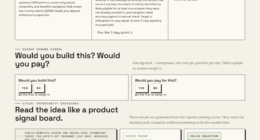
📊 Full opportunity report: Week Three — Foundation model vs Brownian motion. Kronos on five-minute BTC. on ThorstenMeyerAI.com — validation score, market gap, and execution plan.
Listen free for 30 days with Audible
Thousands of audiobooks and originals — cancel anytime.
Start your free trialAs an affiliate, we earn on qualifying purchases.
TL;DR
A recent test found that the open-source foundation model Kronos does not outperform the traditional Brownian motion baseline in predicting 5-minute BTC price movements. The results suggest current learned models may not offer a trading edge over classical assumptions.
Recent testing shows that the open-source foundation model Kronos does not outperform the traditional Brownian motion baseline in predicting 5-minute Bitcoin price movements, challenging expectations for modern AI models’ trading edge.
Researchers conducted an out-of-sample evaluation of Kronos, a 25,000-star open-source foundation model trained on global crypto exchange data, against a geometric Brownian motion baseline. Using a custom Python tool, they analyzed 497 BTC trades recorded by a paper-trading bot over a recent period. The models’ predicted probabilities of price increases were scored on accuracy and hypothetical profit. Results showed that Kronos’s predictive performance was statistically indistinguishable from Brownian motion, with both models performing slightly better than market-implied probabilities. Specifically, on the test sample, Kronos’s Brier score was 0.189, nearly identical to Brownian’s 0.188, with no significant outperformance. This indicates that, at least for 5-minute horizons, Kronos does not provide a measurable trading advantage over the classical assumption of independent, normally-distributed returns.Foundation model
vs Brownian motion.
Kronos on five-minute BTC.
all BTC · 5-min Up/Down markets
249 trades · statistically indistinguishable
signature of confident wrong predictions
the paradox · 60.7% vs 49.1% win rates
fairValuePUp(spot, openPrice, secondsLeftFrac, windowVol) formula. Matches scipy.stats.norm.cdf to three decimal places.(p_brownian, p_market, p_kronos, actual_outcome, P&L). Score on Brier + log-loss + hypothetical P&L. Sort chronologically · split into first/second half · report on both halves separately.docs/RESEARCH_PIPELINE.md. Any future candidate model gets a sibling directory in research/<model>/, reuses the same Brownian baseline, the same trade-log loader, the same OHLCV fetcher, the same metrics, the same out-of-sample split. Same gauntlet, different model, same discipline.
lower is better
lower is better
inside the noise band
docs/RESEARCH_PIPELINE.md. Publishing reproducible parameter recipes for strategies that might be marginally profitable encourages people to copy them with real money, and the prior on real-money outcomes when copying retail strategies is “they lose.” Publishing the methodology lets the next person test their own model honestly without inheriting any of mine.
By probabilistic standards · Kronos is a worse forecaster. By operational standards · Kronos is the better trader. Both interpretations are honest. Neither earns the model a place in Polybot. One of them might earn it a place, later, in TradingAgents.Thorsten Meyer AI · Week 3 · Foundation Model vs Brownian Motion
Implications for AI-Driven Crypto Trading Strategies
The findings suggest that even advanced foundation models like Kronos may not currently offer a meaningful edge in short-term crypto trading, raising questions about the practical benefits of deploying large learned models in high-frequency contexts. This challenges the assumption that modern AI can easily outperform traditional stochastic models in financial markets, emphasizing the importance of rigorous out-of-sample testing. For traders and developers, it underscores the need for cautious evaluation before integrating such models into live systems, especially given the high costs and risks involved. The result also highlights the persistent relevance of classical models like Brownian motion, which continue to serve as reliable baselines in market prediction tasks.As an affiliate, we earn on qualifying purchases.
Background on Model Testing and Market Predictions
Over the past two weeks, a researcher has been running a paper-trading bot called Polybot, which uses a geometric Brownian motion model to predict 5-minute BTC price movements. The bot’s performance was compared against actual market outcomes and a more sophisticated foundation model, Kronos, trained on extensive global exchange data. Previous attempts to find an ‘edge’ in short-term trading using various strategies have largely failed, with most models producing no consistent advantage. Kronos, developed as a research tool and not a trading system, was tested to see if it could do better than the traditional Brownian assumption. The testing methodology involved reconstructing market contexts and simulating forecasts for each trade, then evaluating the models’ predictive accuracy and hypothetical profitability.“Kronos does not outperform Brownian motion in our out-of-sample tests for 5-minute BTC predictions, indicating no current practical edge.”
— Thorsten Meyer, researcher
crypto trading prediction software
As an affiliate, we earn on qualifying purchases.
As an affiliate, we earn on qualifying purchases.
Uncertainty About Long-Term and Different Horizons
It remains unclear whether Kronos or similar models might outperform traditional baselines over longer timeframes or different market conditions. The current test focused solely on 5-minute horizons, and the model’s performance in other contexts has not yet been evaluated.
As an affiliate, we earn on qualifying purchases.
Next Steps in Model Evaluation and Market Testing
Further research will explore whether larger or differently trained models can demonstrate a measurable advantage in other trading horizons or under varying market regimes. Additionally, testing in live trading environments and across different assets may provide more insights into the practical utility of foundation models in finance.
financial modeling software for crypto
As an affiliate, we earn on qualifying purchases.
As an affiliate, we earn on qualifying purchases.
Key Questions
Does this mean foundation models are useless for crypto trading?
Not necessarily. The current results indicate that, for 5-minute BTC predictions, Kronos does not outperform classical models. Future research may find advantages in other contexts or with different models.
Could larger or more specialized models perform better?
It’s possible. The current test used a specific size of Kronos; larger or differently trained models might yield different results, but this remains to be tested.
What does this mean for traders using AI models?
It suggests caution. Even advanced AI models should be rigorously evaluated out-of-sample before deployment, as traditional models can perform just as well in certain short-term trading scenarios.
Will the results change with different market conditions?
Potentially. The current evaluation was based on recent market data; different regimes could impact model performance, but further testing is needed.
Source: ThorstenMeyerAI.com
Flea & tick season Picks
flea and tick prevention
As an affiliate, we earn on qualifying purchases.