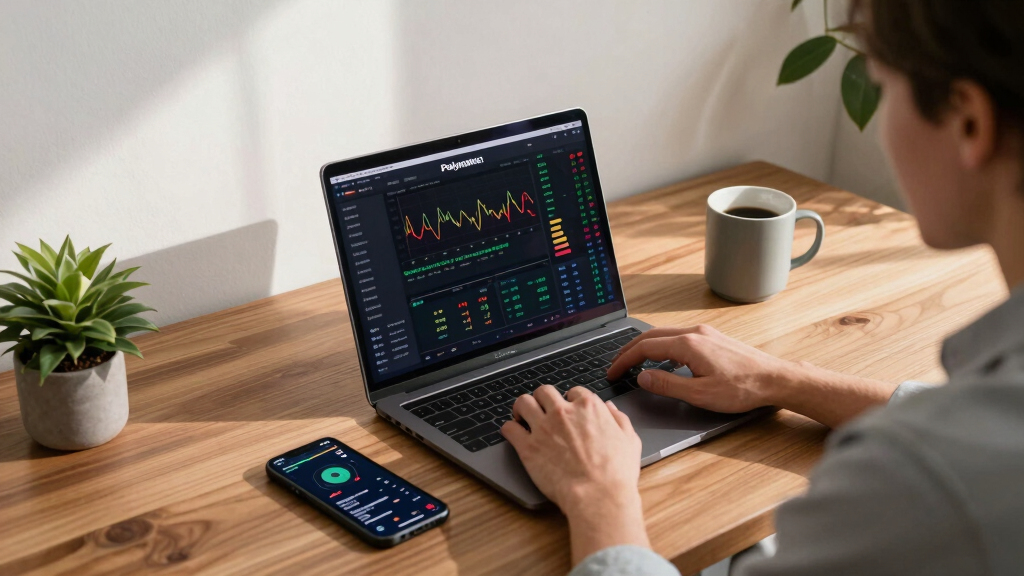

📊 Full opportunity report: Are Polymarket Trading Bots Actually Profitable? The Math Behind 2026’s Prediction-Market Arbitrage Industry on ThorstenMeyerAI.com — validation score, market gap, and execution plan.

Get hardware and tech essentials delivered free — and shop member deals
- Fast, free delivery on millions of items
- Access to Prime Big Deal Days deals on October 6–7
- Prime Video, Amazon Music and more included
TL;DR
A detailed on-chain study shows that in 2026, the majority of retail Polymarket trading bots are unprofitable. Only a small fraction of traders achieve significant gains, and most common strategies no longer work as they did in previous years.
An on-chain analysis of 95 million Polymarket transactions from April 2024 through December 2025 shows that only 0.51% of wallets achieved profits exceeding $1,000, indicating that profitable bot trading is exceedingly rare in 2026. This finding challenges widespread claims of retail traders consistently making money with prediction-market bots and underscores the importance of capital, infrastructure, and expertise for success.
The study, conducted by Thorsten Meyer, analyzed the performance of various trading strategies employed by bots on Polymarket. It found that most retail traders running off-the-shelf bots are unlikely to generate significant profits, with the median outcome being slow losses due to transaction fees, slippage, and adverse selection.
Six main strategies account for most of the small subset of profitable traders, but none resemble the simplified arbitrage methods often promoted online. Many strategies that seemed promising in 2024 have become unviable due to changing market dynamics, regulatory restrictions, and the increased sophistication of market participants.
One notable exception remains: cross-platform arbitrage between Kalshi and Polymarket, which continues to offer some edge but is difficult to execute profitably at scale. Additionally, information arbitrage using AI agents has been largely competed away, with the remaining edges being narrow and highly risky.
99.49%
lose money.
An on-chain analysis of 95 million Polymarket transactions found that 0.51% of wallets achieved profits exceeding $1,000. Not 51%. Half of one percent.
The vendor side sells the dream of “AI bots that print money” on prediction markets. The data side tells a different story. Six strategies actually work. Three look profitable but aren’t anymore. The retail edge is narrow, the legal exposure is rising, and the OpenClaw $115K-week story is real but not replicable.
Three buckets. One winner.
The on-chain analysis of 95 million transactions resolves into three populations. The mathematical baseline for any retail trader entering Polymarket.
Six categories. Different bets.
The 0.51% profitable cohort uses six identifiable strategies. Each requires a different combination of capital, infrastructure, expertise, or luck. Most retail traders cannot assemble what their chosen strategy requires.
Kalshi up. Polymarket flat.
The competitive structure has inverted from late 2024 when Polymarket held ~95% of category volume. Kalshi’s bet on CFTC regulation paid off when the agency formally classified prediction markets as derivatives in March 2026.
- Valuation$22B · Coatue raise March 2026
- Annualized volume$178B · revenue $1.5B
- Sports concentration87% of TTM volume
- FundingFiat-native · USD in/out
- State challengesNV, MA, AZ, TN, IL, CT
arbitrage
opportunity
- Valuation$15B · fundraising May 2026
- US re-entryVia QCEX (CFTC-regulated)
- Funding (intl)USDC-native on Polygon
- Active traders Apr~643K (down from 733K Mar)
- Maker feesZero · only takers pay
Five conditions. Each side.
The “polymarket trading bot profitable” search query has a specific answer. The honest one is conditional, not categorical.
- Genuine domain expertise — bot automates execution of a thesis with independent merit (NFL, Fed policy, crypto reg)
- Cross-platform arbitrage with adequate working capital ($5-50K) and tolerance for settlement delay
- Treating the bot as research — downside bounded by money you can afford to lose; learning is the value
- Built-in compliance awareness — Rule 180.1 exposure, state-by-state availability tracking
- Detailed logging from day 1 — evaluate honestly after 6 months before scaling up
- Off-the-shelf “arbitrage finder” tools — opportunity captured by sub-100ms bots before your tool finishes scan
- Following social-media bot tutorials promising $1-10K weekly profits — CFTC issued explicit fraud advisory in 2026
- Public LLMs (ChatGPT, Claude) driving trades on volatile markets without independent risk management
- Under-capitalized for chosen strategy — fees and slippage absorb most edge below $5K working capital
- Expecting “passive income” — vendor marketing pattern that does not match the empirical 0.51% baseline
The retail trader’s best-expected-value play in 2026 prediction markets is small-position domain-specialization rather than full bot automation. The capital required is lower, the edge is more durable, and the failure modes are more contained. For everyone else, the math is unforgiving.
Impact of Findings on Retail Prediction Market Trading
This analysis demonstrates that retail traders running Polymarket bots in 2026 should not expect consistent profits. Most strategies are unprofitable after accounting for costs, and only sophisticated, well-capitalized operations can hope to achieve meaningful gains. The findings highlight the increasing difficulty of arbitrage and the importance of market conditions, regulation, and infrastructure in determining success.
Moreover, the results serve as a case study for AI-agent performance in efficient, adversarial environments, offering insights into how automated trading may evolve across other markets such as sports betting, crypto derivatives, and private equity options.
As an affiliate, we earn on qualifying purchases.
Market Environment and Regulatory Changes in 2026
By April 2026, Polymarket and Kalshi have surpassed a combined $150 billion in lifetime trading volume, with Kalshi’s recent $1 billion funding round boosting its valuation to $22 billion. The regulatory landscape has shifted significantly: the CFTC’s March 2026 classification of prediction markets as derivatives and subsequent enforcement actions have tightened rules around insider trading and information arbitrage.
Polymarket resumed U.S. operations in December 2025 after acquiring a CFTC-regulated exchange, but both platforms face ongoing state-level legal challenges. The dominant trading category remains sports markets, which are more liquid and conducive to systematic trading strategies. Political and cultural markets are thinner and more sensitive to insider information, complicating bot strategies further.
These structural changes have altered the profitability landscape for prediction-market bots, making simple arbitrage and naive strategies less effective than in previous years.
“In 2026, the median outcome for retail Polymarket bots is to lose money slowly through transaction fees, slippage, and adverse selection.”
— Thorsten Meyer
As an affiliate, we earn on qualifying purchases.
Uncertainties Surrounding Future Market Dynamics
While the analysis provides a snapshot of performance through December 2025, it remains unclear how ongoing regulatory developments, technological advancements, and market evolution will impact bot profitability beyond this period. The potential for new arbitrage opportunities or regulatory restrictions to emerge is still being observed.
crypto trading bot for prediction markets
As an affiliate, we earn on qualifying purchases.
As an affiliate, we earn on qualifying purchases.
Next Steps for Traders and Market Watchers
Further research will monitor how regulatory changes, especially in insider trading enforcement, influence bot strategies. Traders should stay informed about evolving market structures and consider that current profitability models may shift with new technological or legal developments. The continued development of AI and infrastructure could also open or close opportunities in prediction markets and other adjacent sectors.
AI trading bot for prediction markets
As an affiliate, we earn on qualifying purchases.
As an affiliate, we earn on qualifying purchases.
Key Questions
Are retail traders likely to make money using Polymarket bots in 2026?
Based on recent analysis, most retail traders running off-the-shelf bots are unlikely to generate significant profits. Only a small fraction of traders employing sophisticated strategies achieve meaningful gains.
What strategies still offer some chance of profitability?
Cross-platform arbitrage between Kalshi and Polymarket remains a viable, though challenging, strategy. Narrow information arbitrage edges with AI agents are also limited but still present for well-capitalized traders.
How have recent regulations affected bot trading profitability?
The CFTC’s March 2026 classification and enforcement actions have tightened rules around insider information and arbitrage, reducing the profitability of many previously effective strategies.
Will the profitability landscape change in the near future?
It is uncertain. Ongoing regulatory, technological, and market developments could create new opportunities or further restrict existing ones. Traders should stay alert to these changes.
What does this imply for AI agents in other markets?
This analysis offers insights into how AI-driven trading performs in efficient, adversarial environments, which could inform strategies in sports betting, crypto derivatives, and private markets.
Source: ThorstenMeyerAI.com
Fall Picks
fall essentials
As an affiliate, we earn on qualifying purchases.